Nyyon · Blog
From Agencies to Systems: The New Operating Model for Marketing in the AI Era
AI is collapsing agency production costs and shifting value to systems, data, and outcomes. A sharp analysis of the new marketing operating model.
AI is not improving the agency model. It is replacing it.
The Collapse of the Labor Model
For two decades, agencies scaled by adding people. More clients meant more copywriters, designers, media buyers, and analysts. Revenue tracked headcount. Margins depended on utilization.
That equation no longer holds.
Generative AI has driven the marginal cost of marketing production toward zero. Content, ads, reports, landing pages, and even campaign structures can now be generated in minutes. What used to take days of coordinated human effort now requires a prompt and a review loop.
Buyers understand this. They see the same tools. They know the time compression. And they are no longer willing to pay for effort that no longer exists.
This is the core break: pricing anchored to labor is collapsing because labor is no longer the constraint.
From Output to Systems
The unit of value is shifting from deliverables to systems.
A traditional agency produces assets. An AI-native operator builds workflows that produce assets continuously. The difference is structural. One scales linearly. The other scales with compute, data, and design.
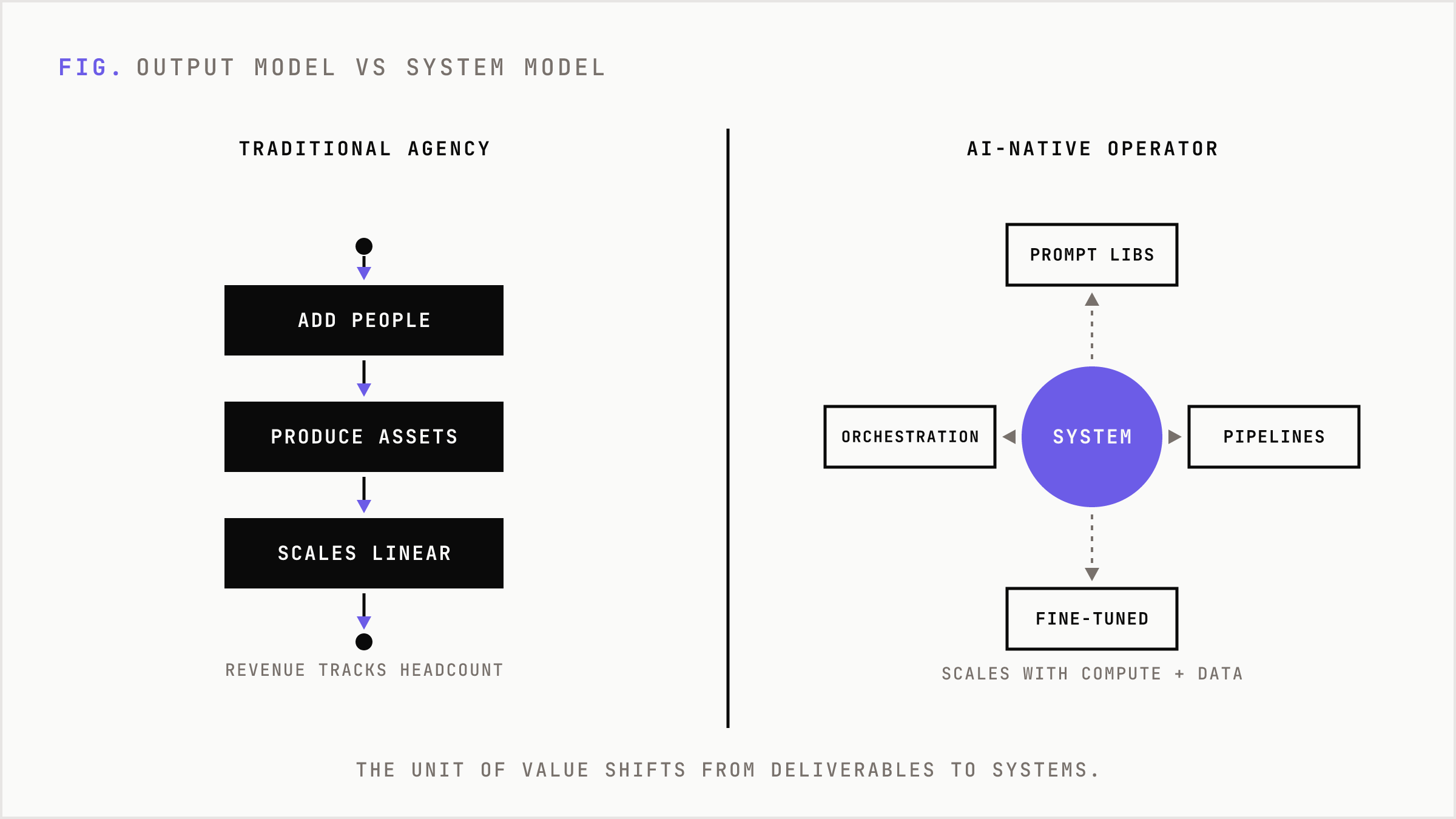
In practical terms, this means prompt libraries, automation pipelines, fine-tuned models, and orchestration layers are becoming the real product. These systems generate campaigns, test variants, optimize performance, and feed results back into the loop.
The agency is no longer a factory. It is an operating system.
Why Margins Are Both Collapsing and Expanding
There is a paradox in the market right now.
On one side, production costs are falling rapidly. On the other, pricing pressure is intensifying because clients expect those savings to be passed through.
This creates a split.
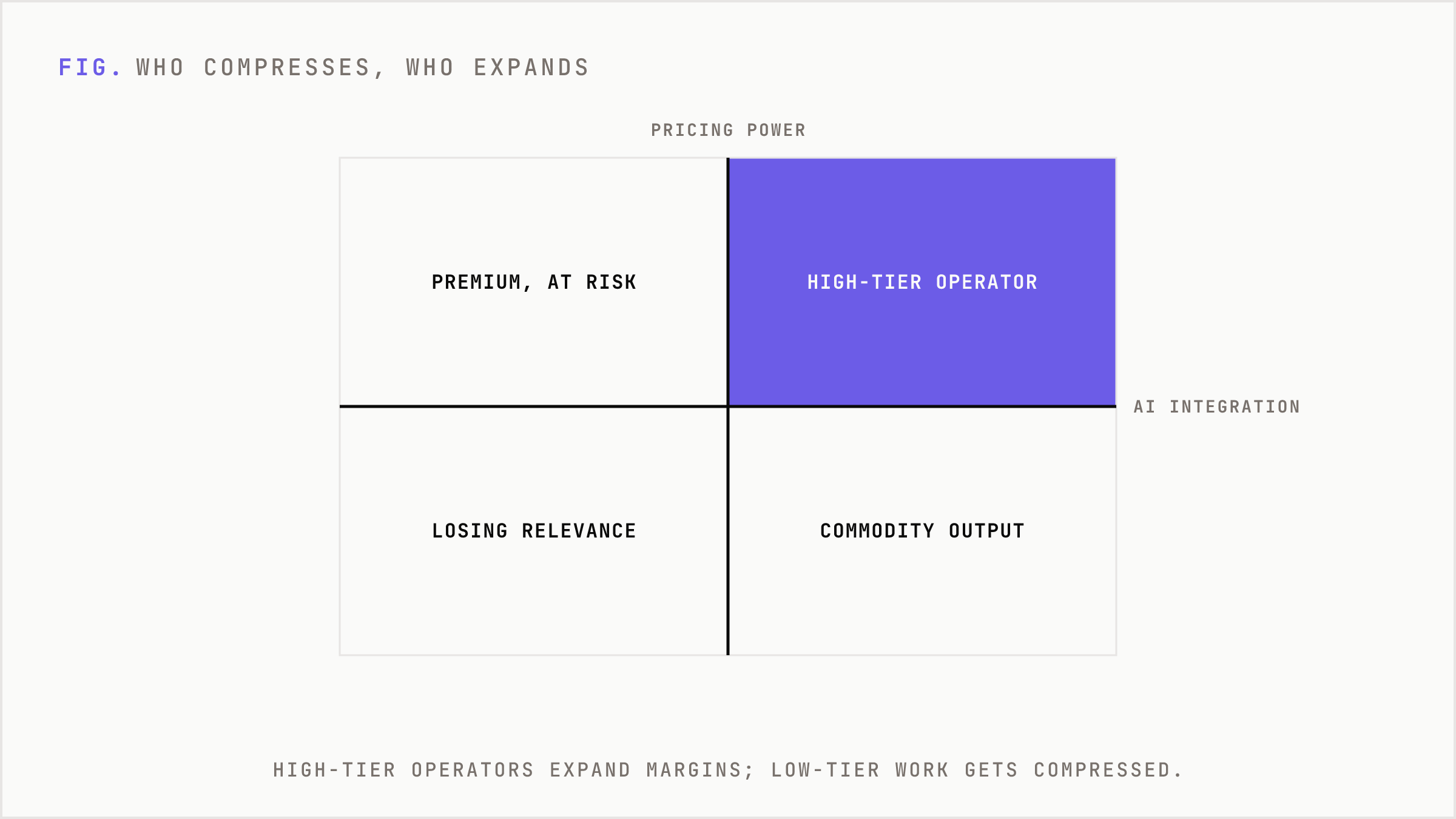
Low-tier agencies get compressed. Their work becomes indistinguishable from what clients can generate internally. They lose pricing power and eventually relevance.
High-tier operators expand margins. They use AI to increase output per employee, not to discount services. The same team can manage more campaigns, more channels, and more experiments. Revenue decouples from headcount.
The difference is not access to AI. It is how deeply it is integrated into the operating model.
The End of Bundled Services
Full-service agencies were built on bundling. Strategy, creative, media, SEO, analytics, all packaged into a single retainer.
AI breaks this apart.
Each component is now separable, automatable, and increasingly productized. A brand can use one tool for ad generation, another for SEO, and a third for analytics. Or they can build internal workflows that stitch everything together.
This leads to unbundling. Buyers no longer need a single partner for everything. They assemble capabilities.
Agencies are forced into a choice. Specialize deeply in a high value layer like strategy or distribution, or build integrated systems that recreate the bundle in a defensible way.
In-Housing Is Accelerating
AI lowers the skill threshold for execution. Tasks that required specialists now require operators.
This shifts the make versus buy decision.
When execution becomes easier, cheaper, and faster internally, brands pull work in-house. Content production, campaign setup, reporting, and even optimization loops increasingly sit inside the company.
What remains external is what cannot be easily replicated: strategic framing, system design, proprietary data, and distribution leverage.
Agencies are not disappearing. But their surface area is shrinking.
Creative Becomes a Data Problem
The economics of creative have flipped.
Historically, creative was scarce and expensive. Campaigns were built around a few high quality assets. Testing was limited.
Now, the cost of generating variations is near zero. Hundreds of ad variants, landing pages, and messages can be produced and deployed instantly.
This shifts the bottleneck.
Success is no longer about a single idea. It is about iteration velocity. The winning system is the one that can generate, test, and refine creative faster than competitors.
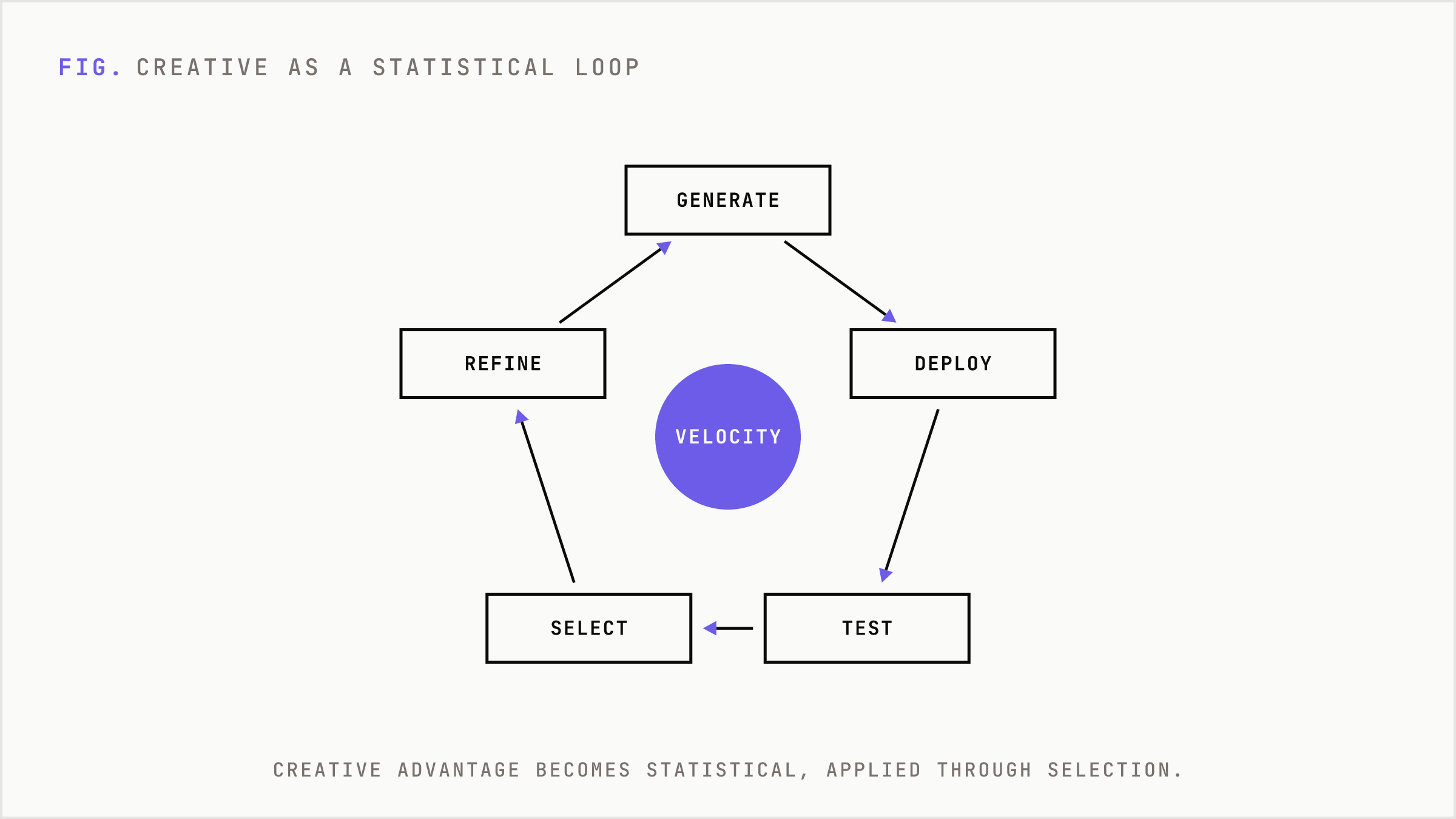
Creative advantage becomes statistical. Taste still matters, but it is applied through selection and direction, not manual production.
Speed Becomes the Primary Metric
Cycle time is collapsing across the stack.
Campaigns that once took weeks now launch in days or hours. Reporting is real-time. Optimization loops run continuously.
This changes competition.
The advantage is not just better strategy or better creative. It is faster feedback and faster iteration. The organization that learns quicker wins.
Speed is not a feature. It is the system.
Agentic Execution Rewires Workflows
Early AI adoption focused on copilots. Tools that assist humans in discrete tasks.
The next phase is agentic.
Agents handle multi-step workflows. They perform research, generate assets, set up campaigns, monitor performance, and trigger optimizations. Human involvement shifts to orchestration and quality control.
This removes coordination overhead. It also removes layers of junior roles that historically executed these tasks.
The organizational pyramid flattens. Fewer people, more systems, higher leverage.
Data and Distribution Become the Moat
When production is commoditized, differentiation moves upstream and downstream.
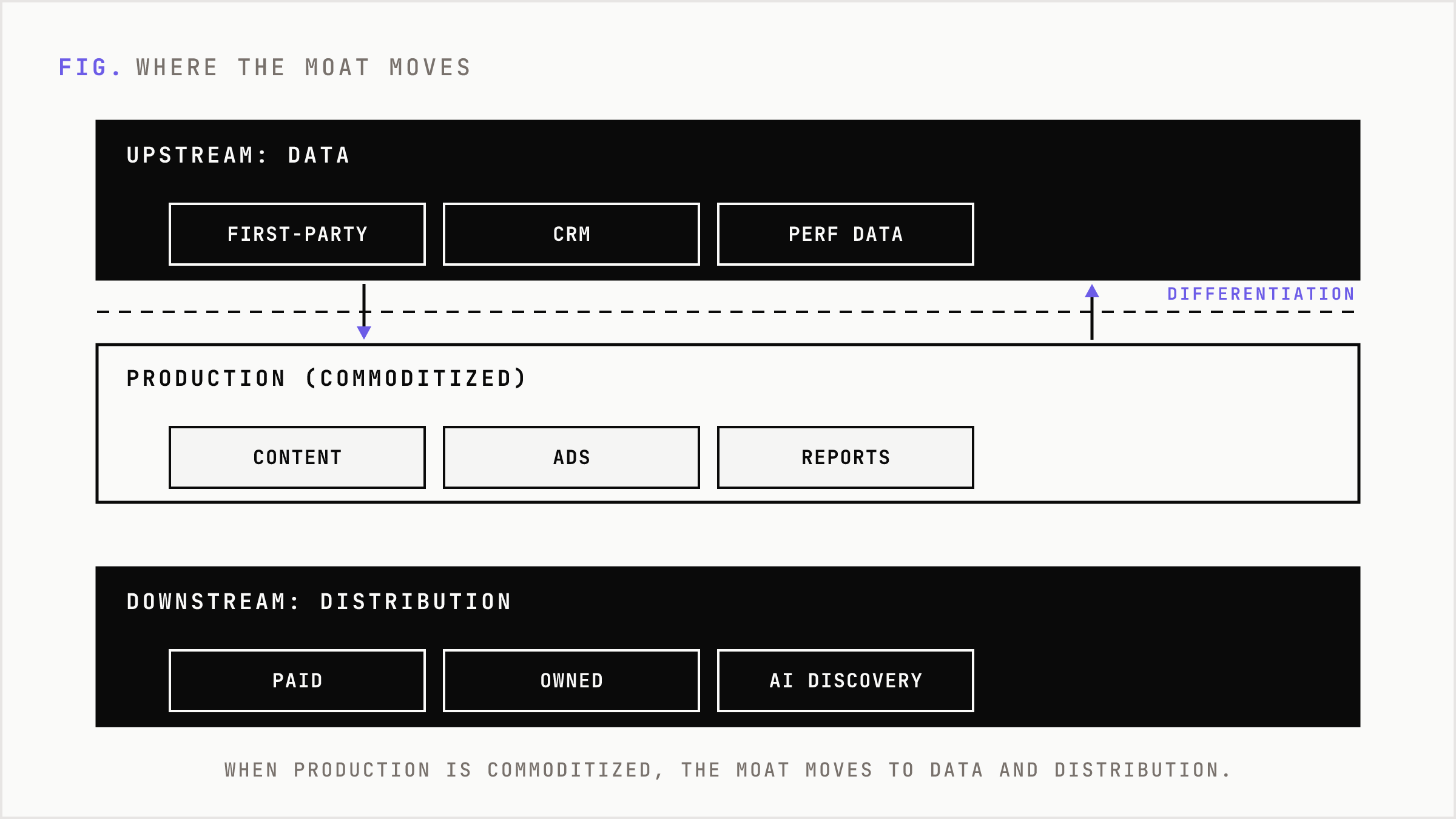
Upstream, proprietary data becomes critical. First-party data, CRM history, performance datasets. These feed the system and improve outputs over time.
Downstream, control over distribution becomes leverage. Paid channels, owned audiences, and increasingly, visibility within AI-driven discovery systems.
Generative search is already reshaping traffic flows. As users shift from traditional search to AI interfaces, the question becomes: are you present in the answer?
This creates a new discipline. Not just search optimization, but optimization for AI-generated outputs.
Pricing Has to Be Rewritten
Hourly billing does not survive in this environment.
When output can be generated in minutes, time is no longer a proxy for value. Buyers reject paying human-era rates for machine-accelerated work.
New models are emerging.
Performance-based pricing ties fees to outcomes like revenue or acquisition cost. Subscription models charge for access to systems rather than hours. Some operators license their workflows and models as products.
Each model shifts risk and alignment differently. But all share a common premise: value is defined by results, not effort.
The New Agency Archetypes
The market is reorganizing into a few distinct forms.
AI-native agencies are built from the ground up on automation. They operate with small teams and high output.
Productized agencies offer fixed scope services delivered through standardized systems. Predictable, scalable, and often lower cost.
Platform hybrids combine software and services. They build tools and layer expertise on top.
Strategic boutiques focus on high-level thinking and positioning, with minimal execution.
Each reflects a different answer to the same question: where does defensibility come from when execution is cheap?
The Boundary Is Disappearing
The most important shift is structural.
The line between agency and software is dissolving. Internal marketing teams are building their own systems. External partners are delivering infrastructure, not just services.
What used to be a vendor relationship becomes something closer to an extension of the company’s operating layer.
In some cases, the agency disappears entirely, replaced by an internal marketing OS supported by a small number of external specialists.
What This Means for Buyers
If you are allocating budget, the questions change.
You are no longer buying outputs. You are buying leverage.
How much incremental performance does this system produce? How quickly can it iterate? What proprietary advantage does it create over time?
The evaluation shifts from portfolios to infrastructure. From case studies to data loops. From team size to system capability.
The End State
Marketing is becoming a system design problem.
The winning organizations will not be those that produce the most content or run the most campaigns. They will be the ones that build the most effective machines for generating, testing, and scaling them.
This is not a marginal improvement. It is a redefinition of how marketing operates.
The agency model was built for a world where production was expensive and slow. That world is gone.
What replaces it is faster, leaner, and far more dependent on how well you design the system behind the work.
FAQ
Are traditional marketing agencies going away?
Not entirely, but their role is shrinking. Execution-heavy services are being automated or in-housed, while agencies that focus on systems, strategy, and data retain relevance.
What replaces hourly billing in AI-driven marketing?
Common alternatives include performance-based pricing, subscriptions to marketing systems, and licensing of proprietary workflows or models.
Why is AI causing agencies to lose clients?
AI reduces execution complexity, allowing brands to handle production internally. This shifts demand away from external vendors for routine work.
What skills are most valuable in the new model?
System design, data analysis, workflow automation, and strategic thinking are increasing in importance, while repetitive execution roles are declining.
What is generative engine optimization?
It is the practice of influencing how brands appear in AI-generated answers, as discovery shifts from traditional search engines to AI interfaces.