Nyyon · Blog
From Ad Generation to Growth Systems: What Actually Drives AI Marketing Performance
AI marketing tools create content at scale, but real performance comes from fast experimentation, data feedback loops, and cross-channel systems.
AI marketing performance is not driven by content generation. It is driven by how fast a system can test, learn, and adapt.
The Illusion of Progress
The current wave of AI marketing tools creates a convincing illusion. Teams can now generate hundreds of ads, landing pages, and variations in hours. Output has exploded. Performance has not.
This gap exists because most tools optimize for production, not decision making. They reduce the cost of making things, but they do not improve how choices are made about what to run, where to spend, or why something worked.
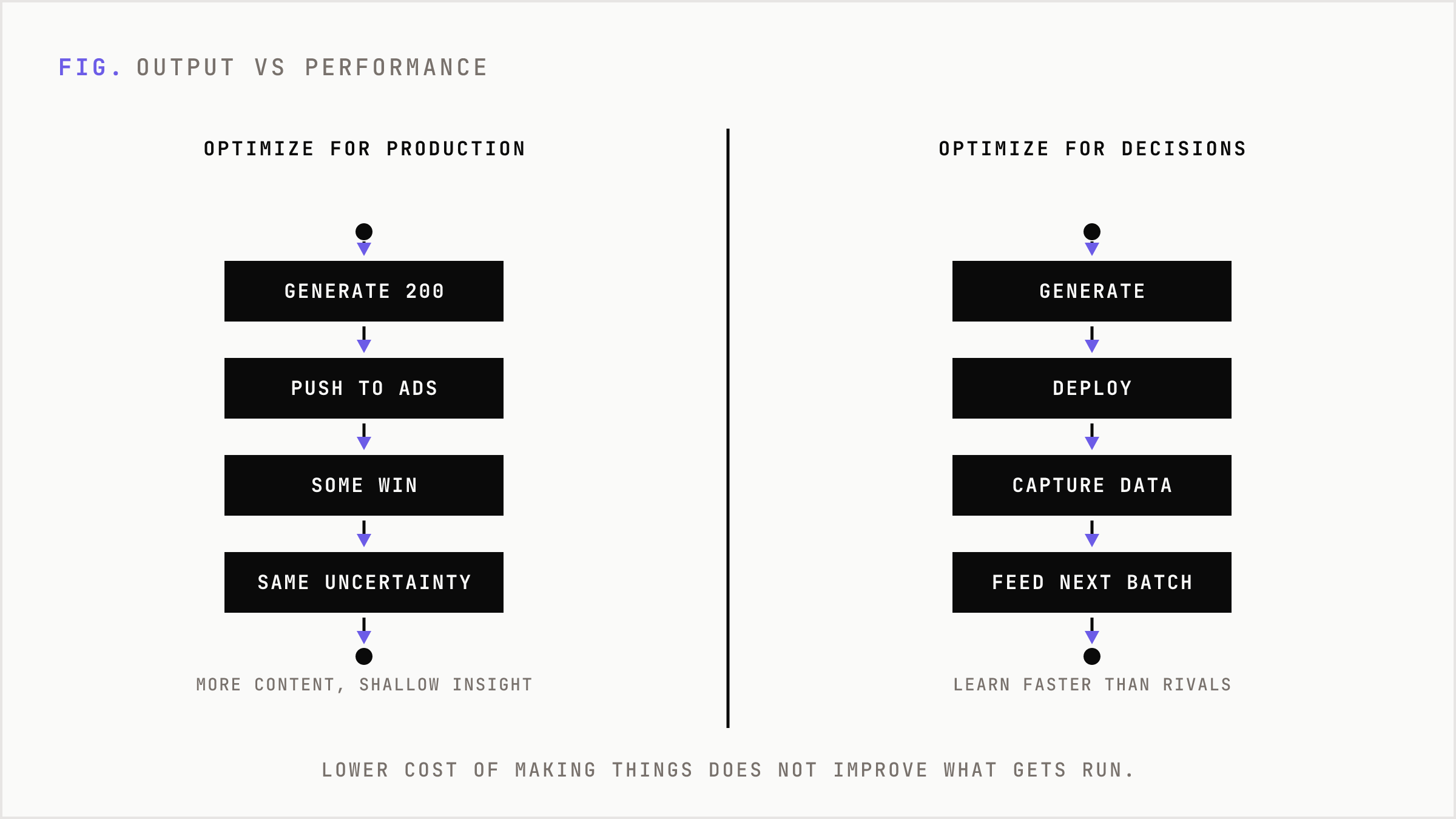
In practice, this leads to a familiar pattern. A team generates 200 ad variants using Jasper or Midjourney. They push them into Meta Advantage+ or Google Performance Max. Some ads perform. Most do not. The system reports results, but insight extraction is shallow. The next batch is created with limited learning.
More content, same uncertainty.
Where the Market Actually Is
The AI marketing stack is fragmented across four layers.
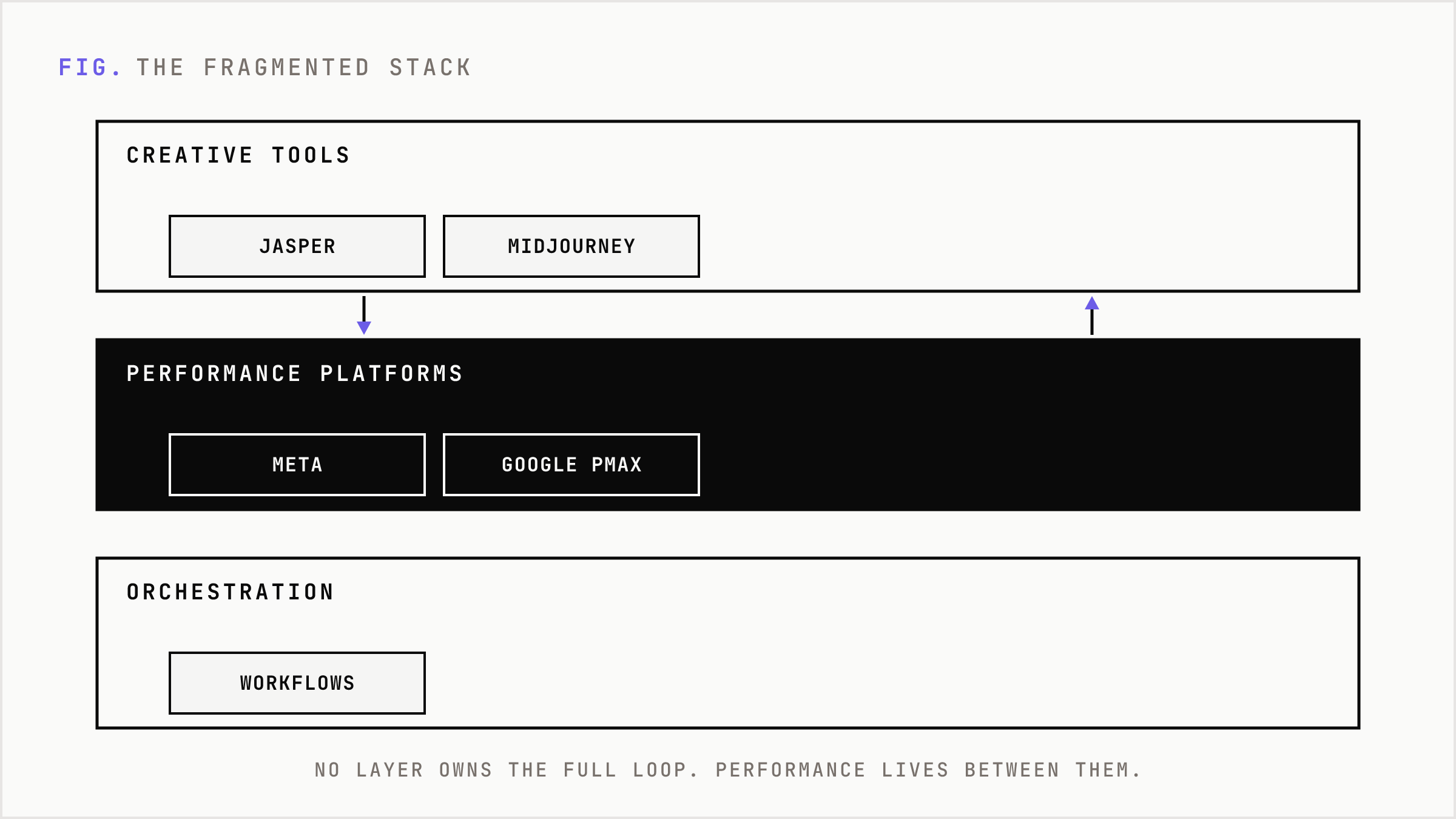
Creative tools generate assets. Performance platforms like Meta and Google automate delivery within their ecosystems. Orchestration tools attempt to connect workflows. Attribution platforms try to explain outcomes.
No layer owns the full loop.
This fragmentation matters because performance does not emerge from any single layer. It emerges from the interaction between them. Creative without distribution is inert. Distribution without feedback is blind. Data without action is unused.
Most vendors stay within their lane. As a result, the buyer assembles a stack that produces activity, not compounding results.
The Unit of Value Has Changed
Historically, marketing value was tied to outputs. Campaigns, creatives, launches. Today, the unit of value is iteration.
The teams that win are not the ones with the best single campaign. They are the ones running the most informed experiments per week.
Iteration speed directly impacts CAC. If a team can test 100 variations in the time it previously tested 10, it reaches performance thresholds faster. Budget shifts sooner toward what works. Waste is reduced earlier.
This is why generation alone is insufficient. Without a system to evaluate and iterate, additional content only increases noise.
Closed Loops Beat Open Workflows
The highest performing systems share a common structure. They are closed loops.
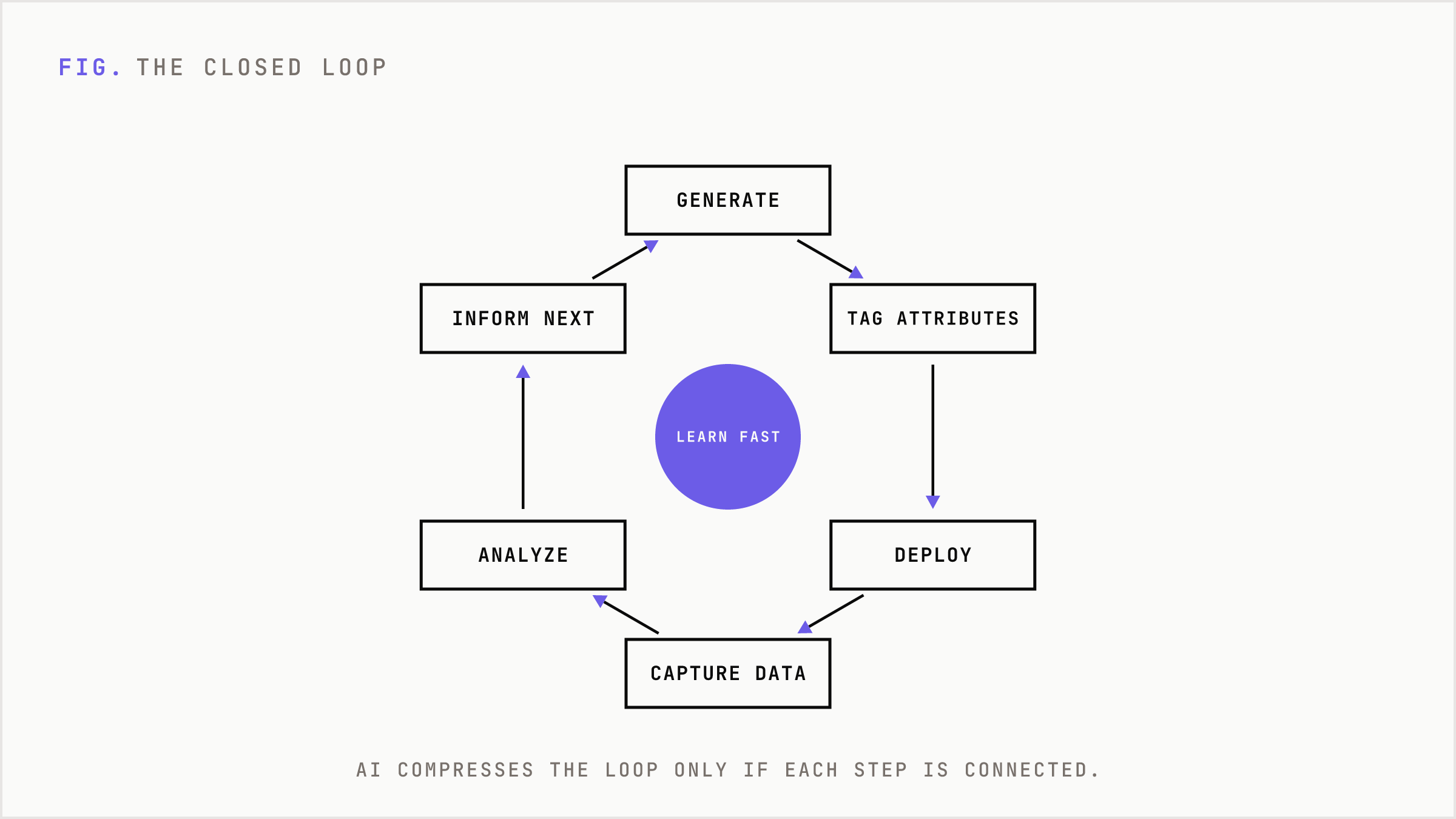
A creative is generated. It is deployed into a channel. Performance data is captured. That data feeds back into the next iteration.
This sounds obvious. It rarely exists in practice.
In many organizations, these steps are disconnected. Creative teams produce assets. Media buyers manage spend. Analysts report results days or weeks later. Feedback arrives too late and too diluted to meaningfully shape the next cycle.
AI compresses this loop. But only if the system is designed to connect each step.
For example, a high velocity system might automatically tag each creative variant with structured attributes such as hook type, visual style, audience segment, and offer framing. When performance data returns from Meta, those attributes are analyzed against conversion outcomes. The next batch of creatives is not random. It is informed by patterns.
This is where performance gains actually come from. Not from generating more ads, but from learning faster than competitors.
Channel Reality Still Wins
There is a persistent belief that a generalized AI layer can manage all marketing channels equally. This is not how the market behaves.
Each major platform has its own optimization logic, data visibility, and constraints. Meta’s Advantage+ campaigns operate differently from TikTok’s Smart Performance campaigns. Google Performance Max has its own internal allocation mechanics.
These systems are already AI driven. They are optimized for their own environments. A generic external AI cannot easily outperform them within those boundaries.
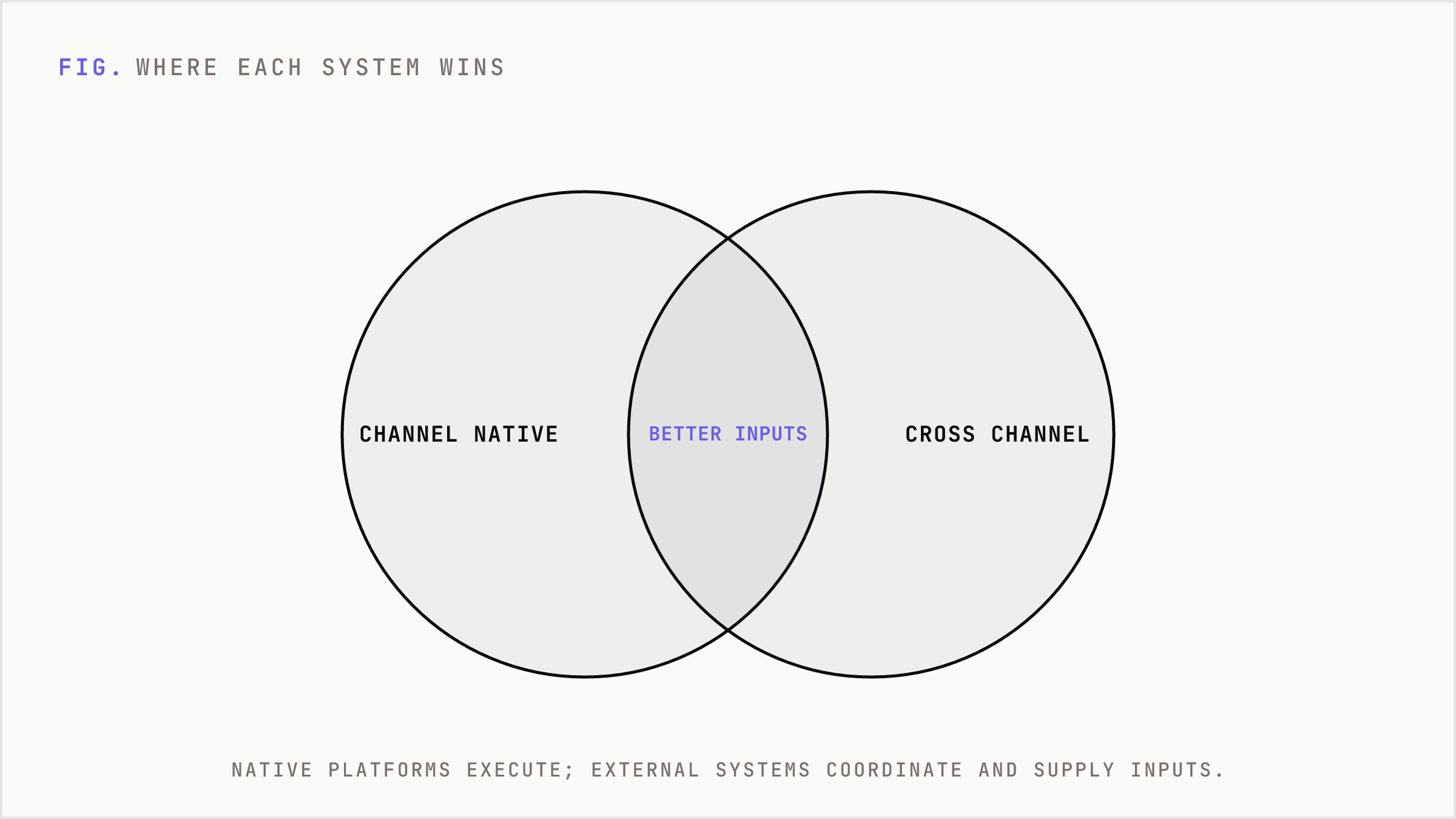
The implication is clear. The role of an external system is not to replace channel level optimization. It is to coordinate across channels and supply better inputs.
That includes creative variation, audience hypotheses, and budget direction at a higher level. Channel native systems handle execution. Cross channel systems handle strategy.
Data Is the Only Durable Advantage
Model access is not a moat. APIs are widely available. Prompt techniques are easily replicated.
What cannot be easily replicated is proprietary data tied to actual customer behavior.
Conversion events, purchase frequency, cohort retention, and product usage signals form the foundation of effective AI marketing systems. Without this data, models operate on generic assumptions. With it, they can optimize toward real outcomes.
This is why first party data pipelines are becoming core infrastructure. CRM systems, product analytics, and ad platform data need to be unified and structured in a way that AI systems can use.
Companies that invest here build compounding advantage. Each campaign improves the next. Each experiment enriches the dataset.
Why Attribution Still Breaks
One of the most persistent gaps is attribution.
Despite advances in AI, true causal attribution across channels remains unsolved at a practical level. Most systems rely on probabilistic models. They infer relationships rather than prove them.
This creates a risk. Teams may over trust AI generated insights that lack statistical rigor.
The practical response is not to wait for perfect attribution. It is to design experimentation frameworks that approximate causality.
Controlled tests, holdout groups, and structured variation still matter. AI can accelerate these processes, but it cannot replace the need for disciplined experimental design.
The Shift Inside Teams
As systems evolve, roles inside marketing teams are changing.
Creative teams are moving away from production toward direction. They define constraints, brand guidelines, and narrative boundaries that AI systems operate within.
Media buyers are becoming system operators. Instead of manually adjusting bids and budgets, they tune inputs and monitor outputs.
Generalists are replacing narrow specialists. A smaller team can oversee a larger system if the infrastructure is well designed.
This shift reduces execution cost, but it increases the importance of system design. Poorly designed systems scale inefficiency faster.
The Risk of Sameness
There is a structural downside to AI driven creative.
Models are trained on existing patterns. They tend to converge toward what has worked before. Over time, this leads to homogenization.
In performance marketing, this shows up as creative fatigue. Ads start to look and feel the same across competitors. Marginal gains decrease.
Maintaining differentiation requires intentional constraints and human input. Brand distinctiveness cannot be fully delegated to models.
The highest performing systems treat AI as a generator within boundaries, not as a source of originality.
What Buyers Actually Pay For
When companies evaluate AI marketing solutions, they are not buying content. They are buying outcomes.
Specifically, they want lower CAC, higher conversion rates, and more predictable scaling.
Tools that focus only on generation struggle to justify budget at this level. Their impact is indirect.
Systems that improve iteration speed, integrate data, and coordinate across channels tie directly to financial metrics. They sit closer to revenue.
This is why the emerging category is not AI content tools. It is AI growth systems.
The Shape of the Next 24 Months
Fully autonomous marketing systems are unlikely in the near term. The complexity of cross channel coordination, brand management, and data interpretation remains too high.
Instead, hybrid systems will dominate.
AI handles high frequency tasks. Humans set direction, constraints, and strategic priorities. The interface between the two becomes the critical layer.
At the same time, more companies will internalize these capabilities. As tooling improves, mid sized and large organizations will build their own AI marketing stacks rather than relying entirely on agencies.
This shifts competition. The advantage moves from access to tools toward quality of system design and depth of data.
From Campaigns to Systems
The core shift is conceptual.
Marketing is moving from discrete campaigns to continuous systems.
Campaigns have clear starts and ends. Systems run indefinitely. They ingest data, generate variations, test them, and adapt.
This changes how performance is measured. Success is not a single winning ad. It is the rate at which the system improves over time.
Companies that understand this build infrastructure. Those that do not will continue to produce more content without improving results.
The gap between the two is where most of the market opportunity now sits.
FAQ
Why is AI content generation not enough for marketing performance?
Content generation increases output but does not improve decision making. Performance depends on testing, feedback loops, and data driven iteration.
What is an AI growth system?
An AI growth system connects creative generation, distribution, performance tracking, and iteration into a continuous loop that improves outcomes over time.
How does iteration speed impact CAC?
Faster iteration allows teams to identify winning strategies sooner, reduce wasted spend, and allocate budget more efficiently, which lowers CAC.
Why is first party data important in AI marketing?
First party data provides real customer insights that models can use to optimize campaigns, creating a durable competitive advantage.
Will AI replace marketing teams?
No. AI will automate execution, but humans will remain responsible for strategy, system design, and brand direction.