Nyyon · Blog
The New Marketing Edge: Why Execution Systems Beat AI Hype
AI tools are commoditized. Real marketing ROI now comes from execution systems built on data, speed, and continuous experimentation loops.
AI is no longer the advantage. Execution systems are.
The Market Moved Faster Than the Narrative
Most companies are still buying “AI marketing” the way they bought martech in 2018. Tools first. Strategy second. Execution assumed.
That model is already outdated.
Language models, image generators, and synthetic video tools are now widely accessible. The cost of generating content has collapsed. The barrier to entry is gone. What used to be scarce is now abundant.
But performance did not equalize. In fact, variance widened.
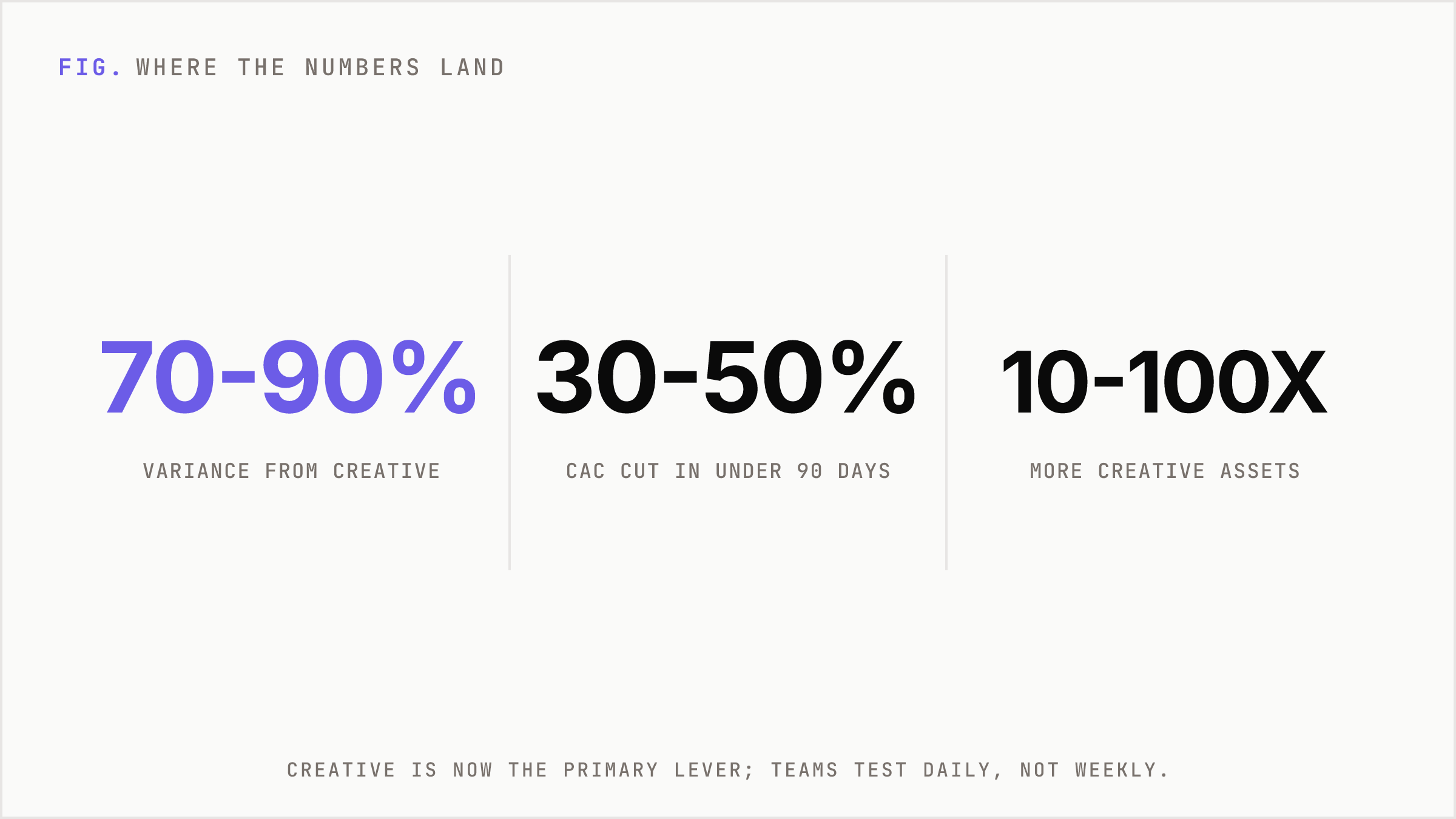
Some firms are cutting customer acquisition costs by 30 to 50 percent in under 90 days. Others see no material lift despite using the same tools.
The difference is not AI adoption. It is system design.
Three Types of AI Marketing Firms
The current landscape splits into three operating models.
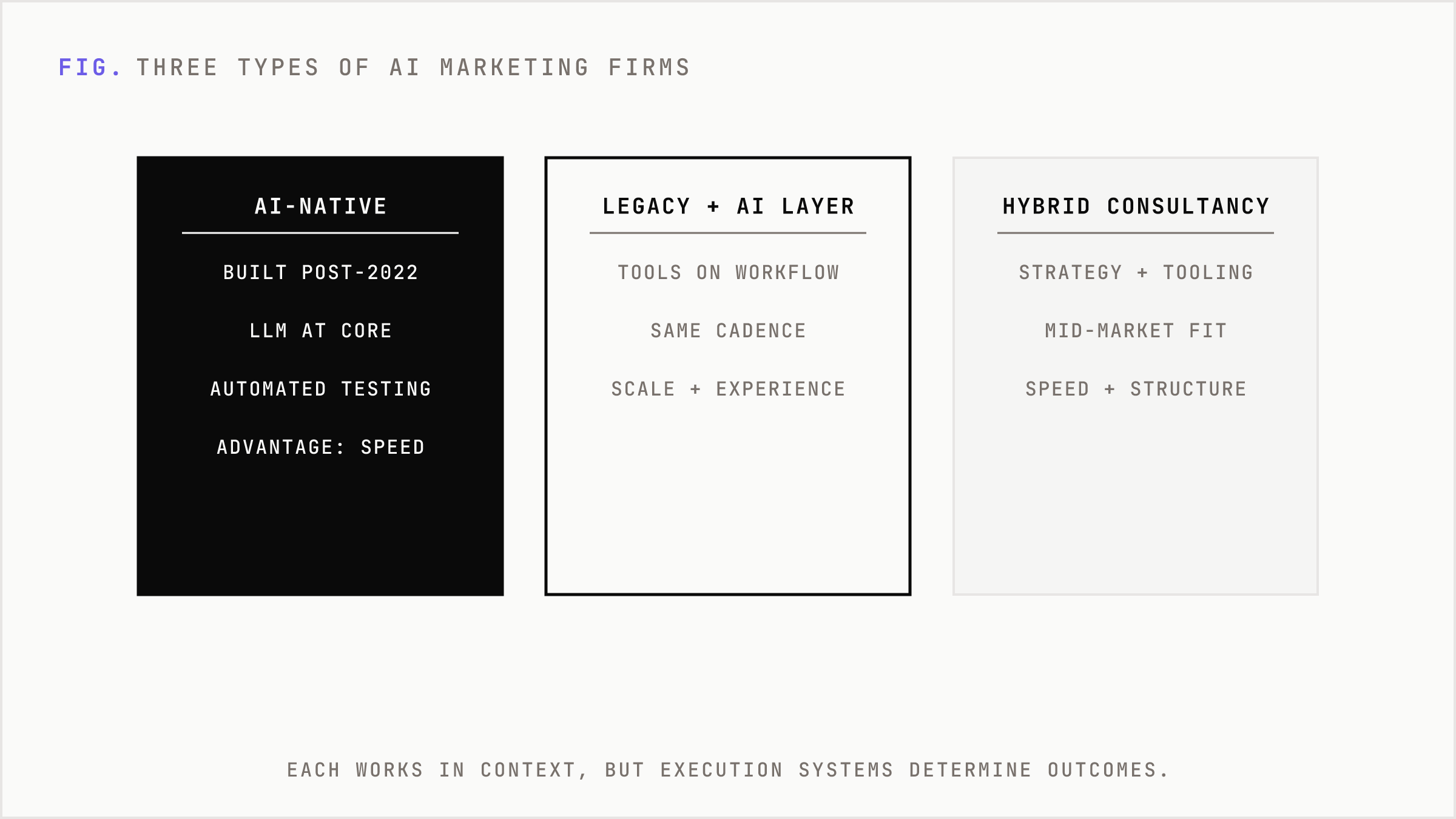
First, AI-native agencies. These were built after 2022 with LLMs at the core. They automate creative production, testing, and iteration from day one. Their advantage is speed.
Second, legacy performance agencies with AI layers. These firms add AI tools onto existing workflows. They improve efficiency but often keep the same cadence and structure. Their advantage is scale and experience.
Third, hybrid consultancies. These combine strategy, tooling, and execution. They tend to operate well in mid-market environments where both speed and structure matter.
Each model works in the right context. Early-stage companies benefit from AI-native speed. Enterprises still rely on legacy integration capabilities. But across all three, the same constraint shows up.
Execution systems determine outcomes.
Where ROI Actually Comes From
Marketing ROI is no longer driven by targeting precision or channel mix. Those have largely converged across platforms.
The drivers now are operational.
Data access sets the ceiling. Firms with deep first-party data and CRM integration can train better models, personalize more effectively, and close feedback loops faster.
Creative velocity sets the pace. High-performing teams produce 10 to 100 times more creative assets than traditional teams. They test daily, not weekly.
Media buying automation sets responsiveness. Budget reallocation happens in hours, not weeks.
Funnel ownership sets leverage. Agencies that control landing pages, CRO, and retention loops capture compounding gains. Those that only run ads operate in isolation.
These are not features. They are system properties.
Creative Is Now the Primary Lever
Across high-performing campaigns, 70 to 90 percent of performance variance comes from creative.
This is not new. What changed is the ability to act on it.
AI-native teams generate hundreds of variations across hooks, formats, and messages. They deploy quickly, kill aggressively, and scale only what works.
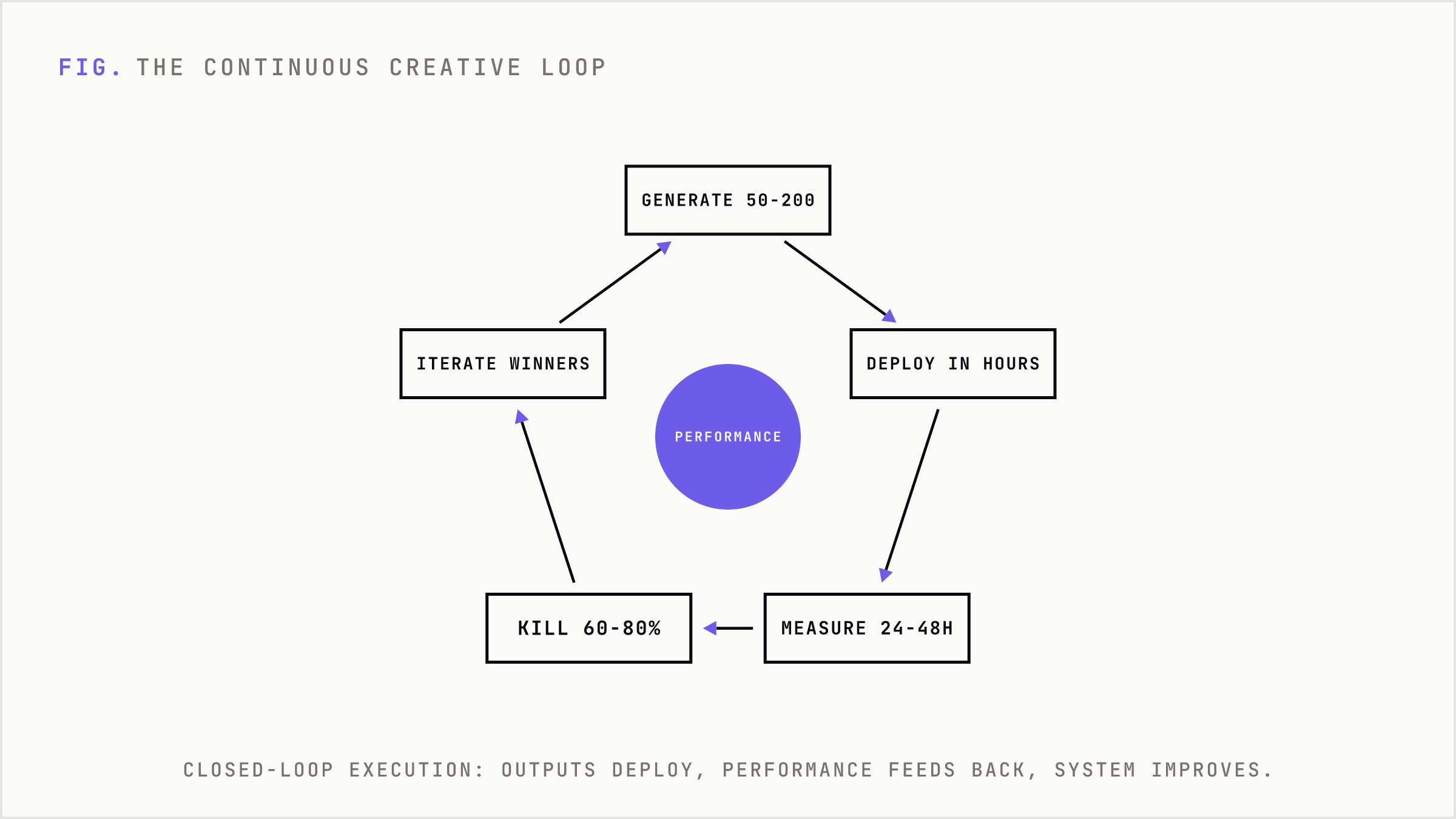
A typical loop looks like this:
- Generate 50 to 200 creative variants
- Deploy across paid social within hours
- Measure early signals within 24 to 48 hours
- Kill 60 to 80 percent immediately
- Iterate on winners and relaunch
This loop runs continuously. There are no static campaigns.
Legacy teams still operate on weekly or monthly cycles. By the time they react, the opportunity has shifted.
The Closed Loop Advantage
The highest-performing firms share a common architecture: closed-loop execution.
Data flows directly into generation systems. Outputs are deployed automatically. Performance feeds back into the model. The system improves with each cycle.
No manual interpretation layer. No delayed reporting. No static planning.
In contrast, most organizations still operate open-loop systems. Data is exported, analyzed manually, and translated into decisions days later. AI is used, but not integrated.
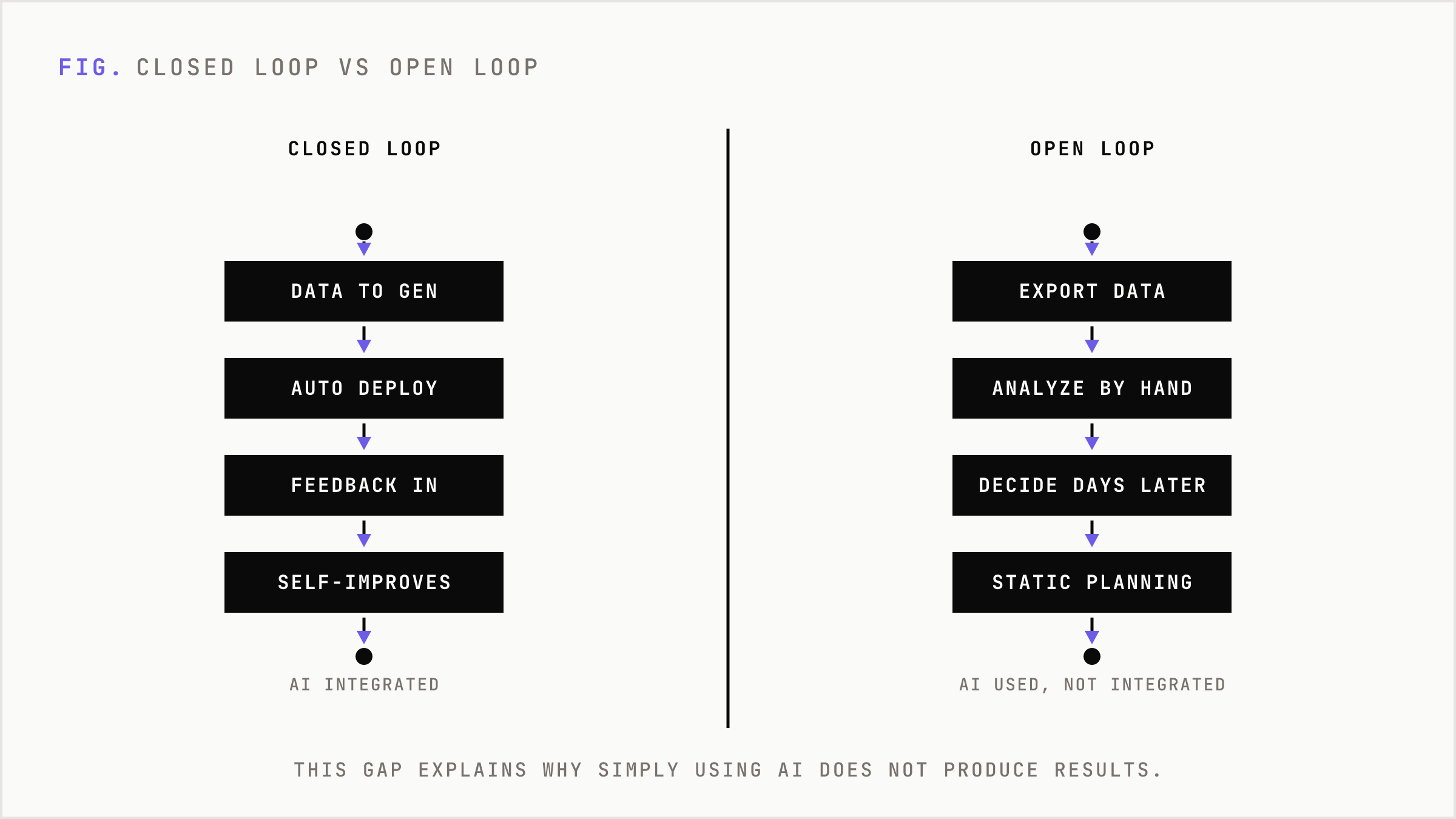
This gap explains why simply “using AI” does not produce results.
Why AI-Native Firms Are Pulling Ahead
AI-native agencies outperform in four measurable ways.
They produce more. Creative volume is an order of magnitude higher.
They move faster. Testing cycles compress from weeks to days.
They cost less. Automation reduces human labor per experiment.
They personalize better. Messaging adapts to smaller audience segments, approaching segment-of-one targeting.
This combination compounds. Faster testing produces better data. Better data improves generation. Improved generation increases performance.
The system reinforces itself.
Where Legacy Still Wins
This is not a complete replacement.
Legacy agencies still dominate in enterprise environments. Compliance, brand governance, and large-scale budget orchestration require structure that AI-native firms often lack.
Managing a 50 million dollar annual ad budget across channels requires coordination beyond creative iteration.
They also lead in attribution. Marketing mix modeling and incrementality testing remain complex and resource-intensive.
But even here, the direction is clear. Execution systems are becoming the integration layer.
Signals of Real Capability
The gap between perception and reality is wide. Many firms claim AI capability. Few demonstrate system-level advantage.
Strong operators show specific behaviors.
- They use proprietary prompt stacks or fine-tuned models
- They integrate directly with platform APIs
- They control the full funnel from ad to retention
- They run continuous experimentation without fixed campaigns
Weak operators show the opposite.
- They rely entirely on third-party tools
- They maintain static campaign structures
- Creative output is bottlenecked by manual review
- They lack direct access to raw performance data
These differences are visible within a single week of operation.
Pricing Reveals Incentives
Business models expose alignment.
Percentage of ad spend remains common. It scales revenue with budget, not performance. At higher spend levels, incentives diverge.
Flat fees with upside participation align better. The agency benefits from performance improvement, not just spend expansion.
Pure performance models are rare. They require high confidence in the funnel and tight control over execution.
The shift toward execution systems will push pricing toward outcome-based structures.
Channel-Level Reality
AI-driven advantage is not uniform across channels.
Paid social leads. Creative iteration speed directly translates into performance gains on platforms like Meta and TikTok.
Search is evolving. Programmatic SEO and synthetic content enable scale, but require careful quality control.
Email and SMS benefit from personalization. LLMs enable dynamic lifecycle messaging at scale.
Brand and PR remain resistant. Long narrative arcs and relationship-driven distribution are harder to automate.
This distribution matters when allocating budget.
From Tactics to Systems
The key shift is conceptual.
Marketing is no longer a set of campaigns. It is a continuous system.
Inputs include data, creative generation, and budget allocation. Outputs include conversions, retention, and revenue signals.
The system runs continuously, adapting in near real time.
This reframes how teams are built.
Instead of hiring for channel expertise, firms hire for system design. Instead of optimizing campaigns, they optimize loops.
What This Means for Buyers
For founders and operators, vendor selection changes.
The right questions are operational, not conceptual.
- How many creatives are tested per week?
- How quickly is budget reallocated?
- What percentage of the workflow is automated?
- Is incrementality measured or assumed?
- Who owns the data and the funnel?
These questions reveal system capability within minutes.
What Happens Next
The next phase is already forming.
Agentic campaign management will automate launch, optimization, and scaling decisions.
Synthetic audiences will allow pre-launch testing before spend is deployed.
Multimodal generation will compress production cycles for video and interactive formats.
Landing pages will personalize in real time based on user context and intent signals.
These are not incremental improvements. They extend the closed loop.
The Strategic Bottom Line
AI is now infrastructure. It is expected, not differentiating.
The competitive edge comes from how that infrastructure is wired into execution.
Firms that build fast, closed-loop systems will continue to reduce costs and increase output.
Firms that treat AI as a tool layer on top of slow processes will not.
This is not a tooling decision. It is an operating model decision.
And it is already showing up in the numbers.
FAQ
What is an execution system in AI marketing?
An execution system is a closed-loop process where data, content generation, deployment, and performance feedback are continuously integrated and automated.
Why is AI no longer a competitive advantage in marketing?
AI tools are widely available and easy to adopt. The advantage now comes from how effectively companies integrate and operationalize them.
How do AI-native agencies outperform traditional agencies?
They produce more creative assets, test faster, automate workflows, and iterate continuously, leading to better performance and lower costs.
What should companies look for in an AI marketing partner?
Focus on testing velocity, automation level, data ownership, and ability to demonstrate real incrementality rather than just reported platform metrics.
Which marketing channels benefit most from AI systems?
Paid social, search through programmatic SEO, and lifecycle channels like email and SMS see the strongest gains from AI-driven execution systems.