Nyyon · Blog
More Agents Is Not a Better System. Optimize the Org Down.
A dynamic agent org that adds an agent every time something breaks is stacking token-hungry endpoints, not building a system. Optimize the org down.
More agents is not a better system. It is a bigger bill with a maybe attached. A dynamic agent org is a methodology that lets agents build agents ad-hoc to hit a goal: you hand the system an objective, it spins up whatever agents it thinks it needs, wires them together, watches the work, and rewires itself when something new shows up. The trap is that the whole thing is designed to grow, and growth feels like progress. The better question is not how big your AI team can get. It is how small you can get away with.
The pattern that always plays out
Something is not working, so you add an agent. A planner.
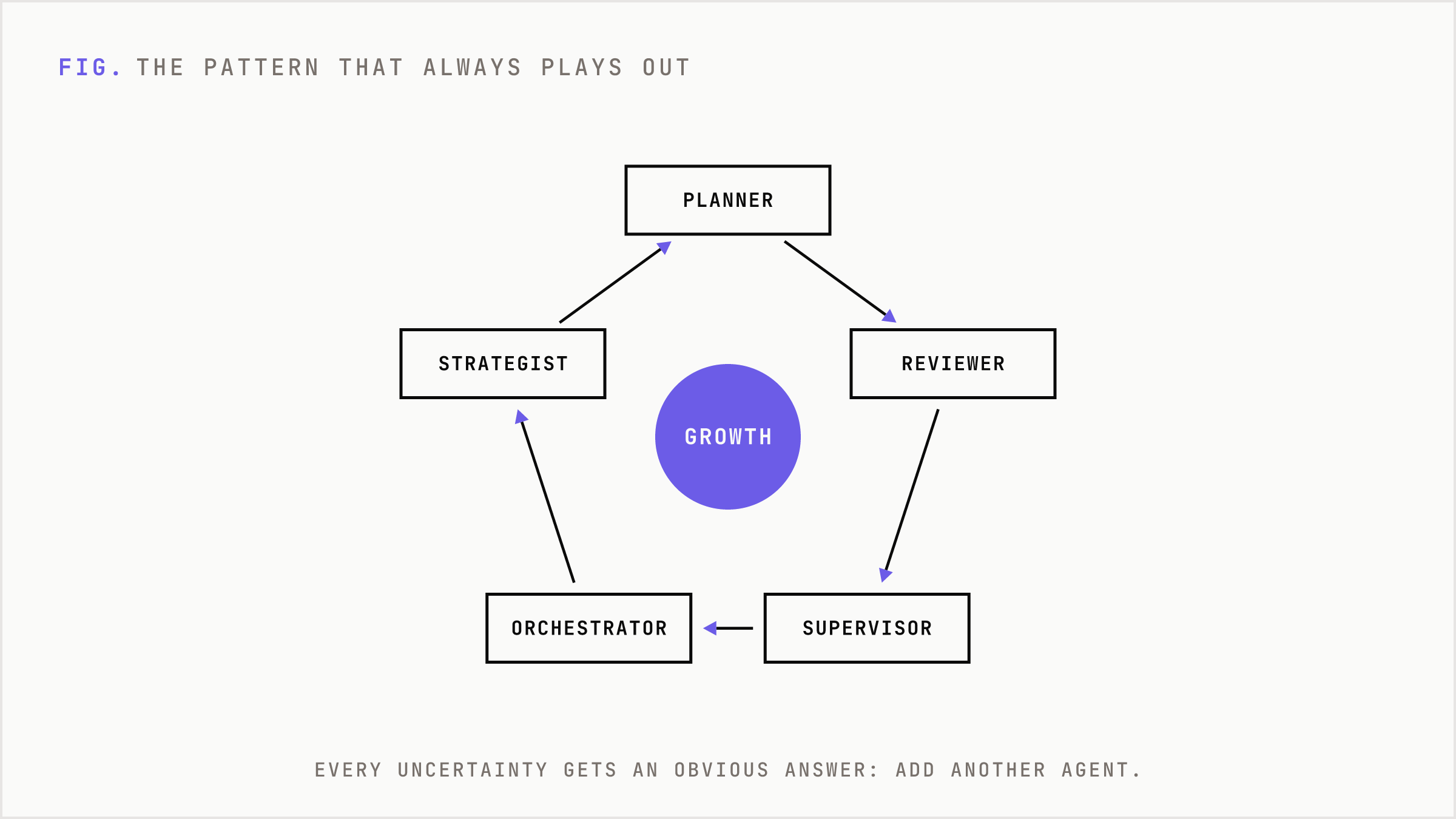
Need to review a result? Add a reviewer.
Now it is getting complex, so add a supervisor. Then an orchestrator. Then a strategist. And so on.
It feels like you are building something. You are not. You are stacking up endpoints. Hungry, token-gobbling endpoints.
Every one you bolt on is a cost you pay immediately. More prompts to pay for. More things that can break. More outputs to reconcile. More context to keep in sync so two agents do not quietly do the same job and overwrite each other. The bill lands now. The quality is a maybe.
The question is wrong
Everyone frames this as headcount: how many agents does my system need. That framing guarantees the org only grows, because every uncertainty has an obvious answer, add another agent to handle it.
Flip it. The interesting, result-oriented problem is subtraction. What is the sparsest structure that still gets the job done.
The research people are already on this. They call it dynamic workflow optimization, or dynamic agent topology. Strip the jargon and the finding is simple: more agents does not equal a better system. The setups that hold up look for the smallest structure that clears the task, and only add density when the task is genuinely hard. You optimize the org down, not up.
Optimizing the org down means treating every added agent as a cost you must justify, not a capability you get for free.
The real unit is the graph, not the agents
Here is the part that changes how you look at your own stack. The unit that matters was never the agents. It is the graph around them.
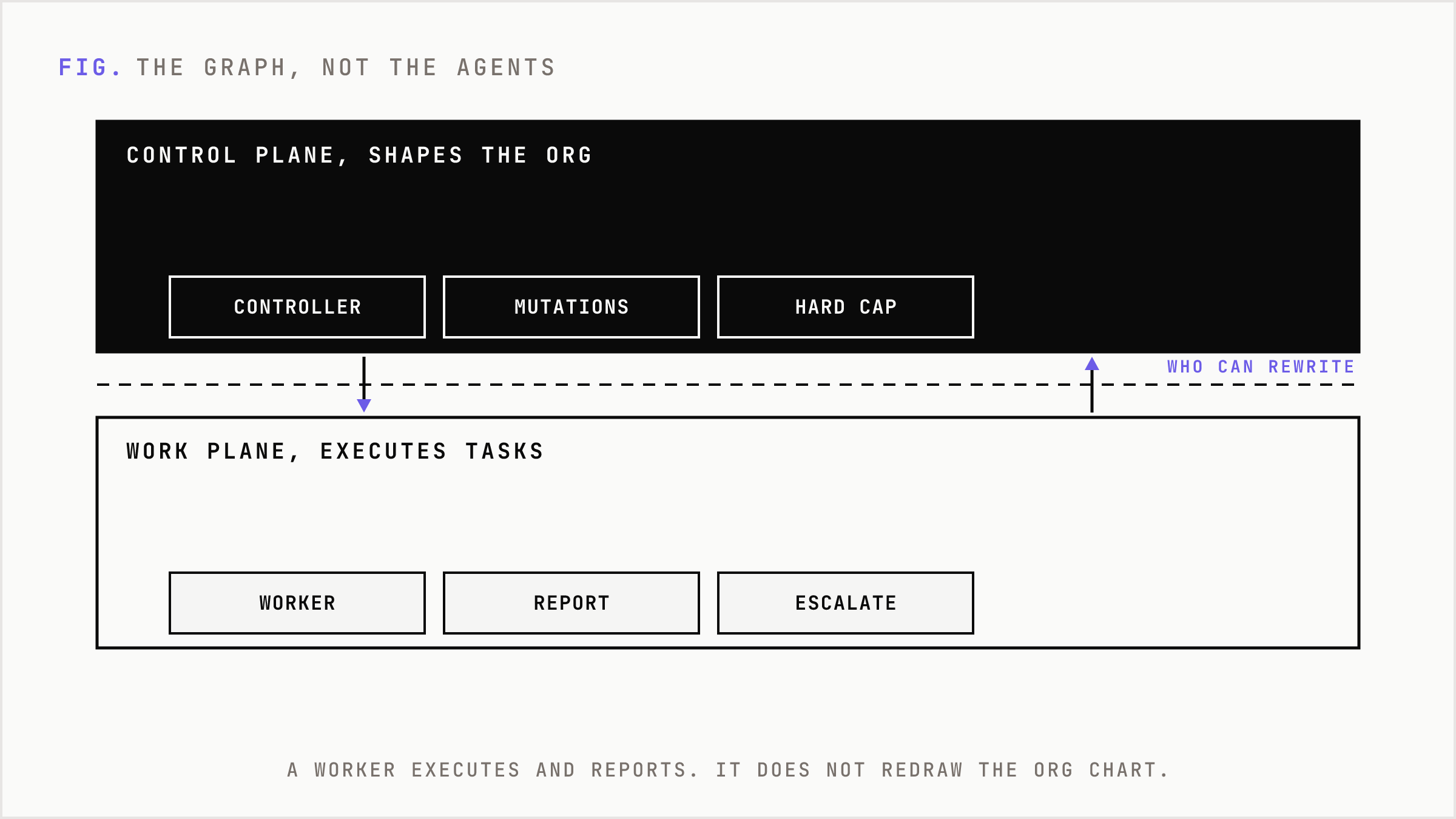
Who owns what. What runs at the same time. And, the one that matters most, who is even allowed to change the plan while it is running.
A dynamic agent org is a graph of agents plus rules about who can rewrite that graph mid-run.
That last rule is where most systems quietly rot. The worker doing a task should not also have the authority to restructure the whole organization. If it does, every uncertain agent starts spawning more agents to cover itself, and the cost grows without the progress.
So you split it into two planes. One plane decides the shape of the org. The other plane does the work. A worker executes its task and reports back. It does not get to redraw the org chart because it felt unsure.
The failure mode: organization explosion
Here is the failure in one line. Uncertainty goes in, agents come out, and none of them move the actual goal forward. That is an organization explosion.
Watch how it compounds:
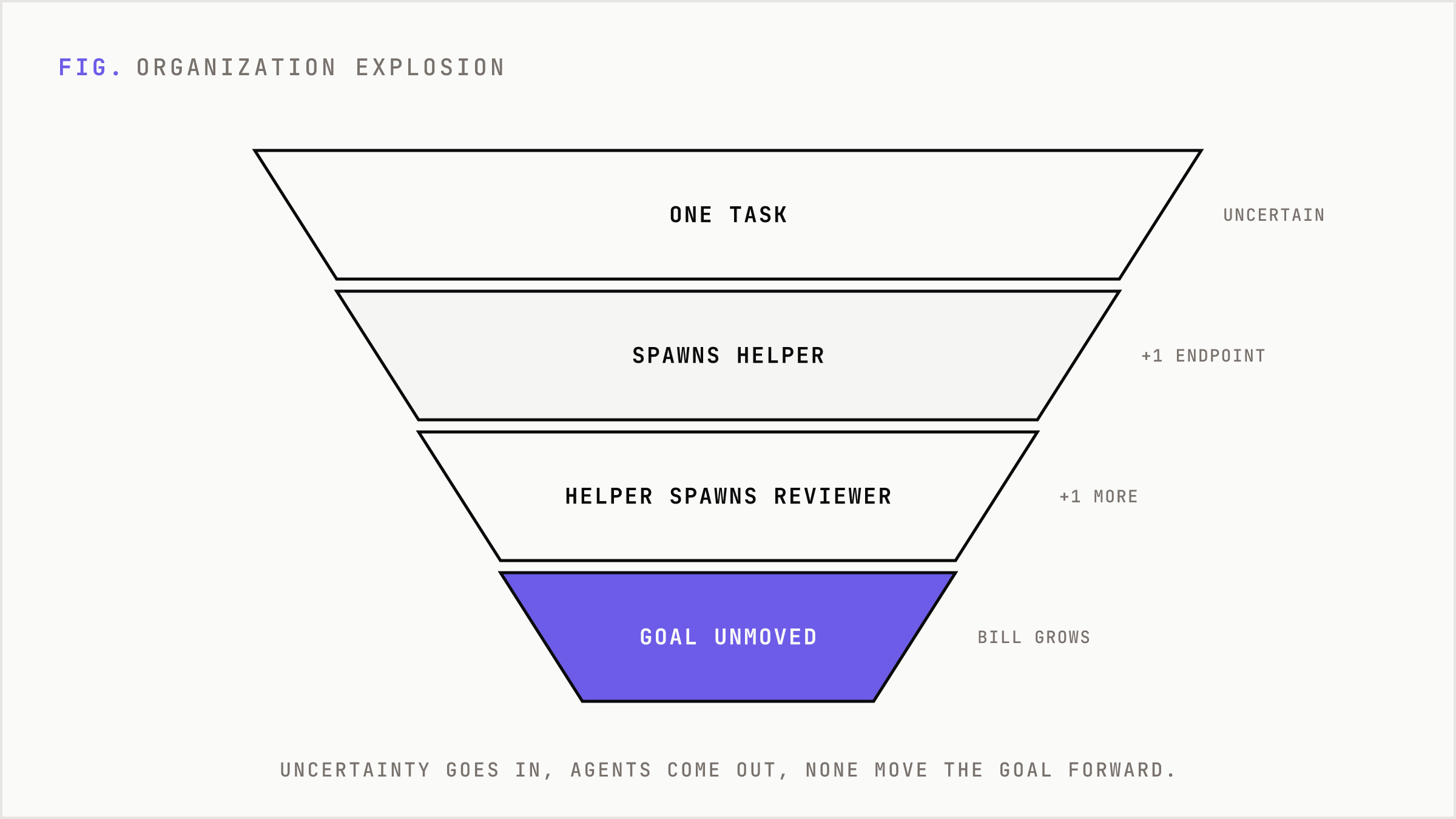
1. A worker hits a case it is not confident about.
2. Instead of resolving it or escalating cleanly, it spawns a helper agent.
3. The helper is also uncertain, so it spawns its own reviewer.
4. Three agents now exist where one task lived, and the goal has not moved an inch.
5. Every one of those agents is a live, billable endpoint burning tokens on the same unresolved question.
The instinct is to fix this with smarter agents. That is the wrong fix. Smarter agents in an uncapped graph just find more elaborate reasons to spawn. The fix is structural.
Three rules kill the explosion:
A hard cap on how many agents can exist for a given objective.
A controller that owns mutations, so only one plane is allowed to change the shape of the org.
A rule that workers cannot recursively create more workers.
None of those require a better model. They require someone to decide the org has a ceiling and enforce it.
Why this is a judgment problem, not a model problem
This is the recurring shape of stuck AI projects. The dominant pattern optimizes for the wrong thing, the org grows because growth is the path of least resistance, and the bill arrives long before the quality does. Nobody owns the decision to make the system smaller.
Deciding where the line sits is the actual work. It is not a prompt you tune. It is a tradeoff you own: which tasks are hard enough to earn extra density, and which are getting an agent bolted on because someone panicked. A model cannot make that call for you, because the model is the thing incentivized to spawn.
We have been poking at how our own stack is wired through this lens, and honestly it has made us want to delete half of it. That is probably the right instinct. Where exactly the line sits is still an open question, and any operator who tells you they have the universal number is guessing. But the direction is not in doubt: optimize the org down instead of up.
What changes, what stays
If you adopt this, what changes is the default answer to failure. Today the default is add an agent. The new default is: does this task actually need more structure, or does the existing structure need to be cleaner. Most of the time it is the second.
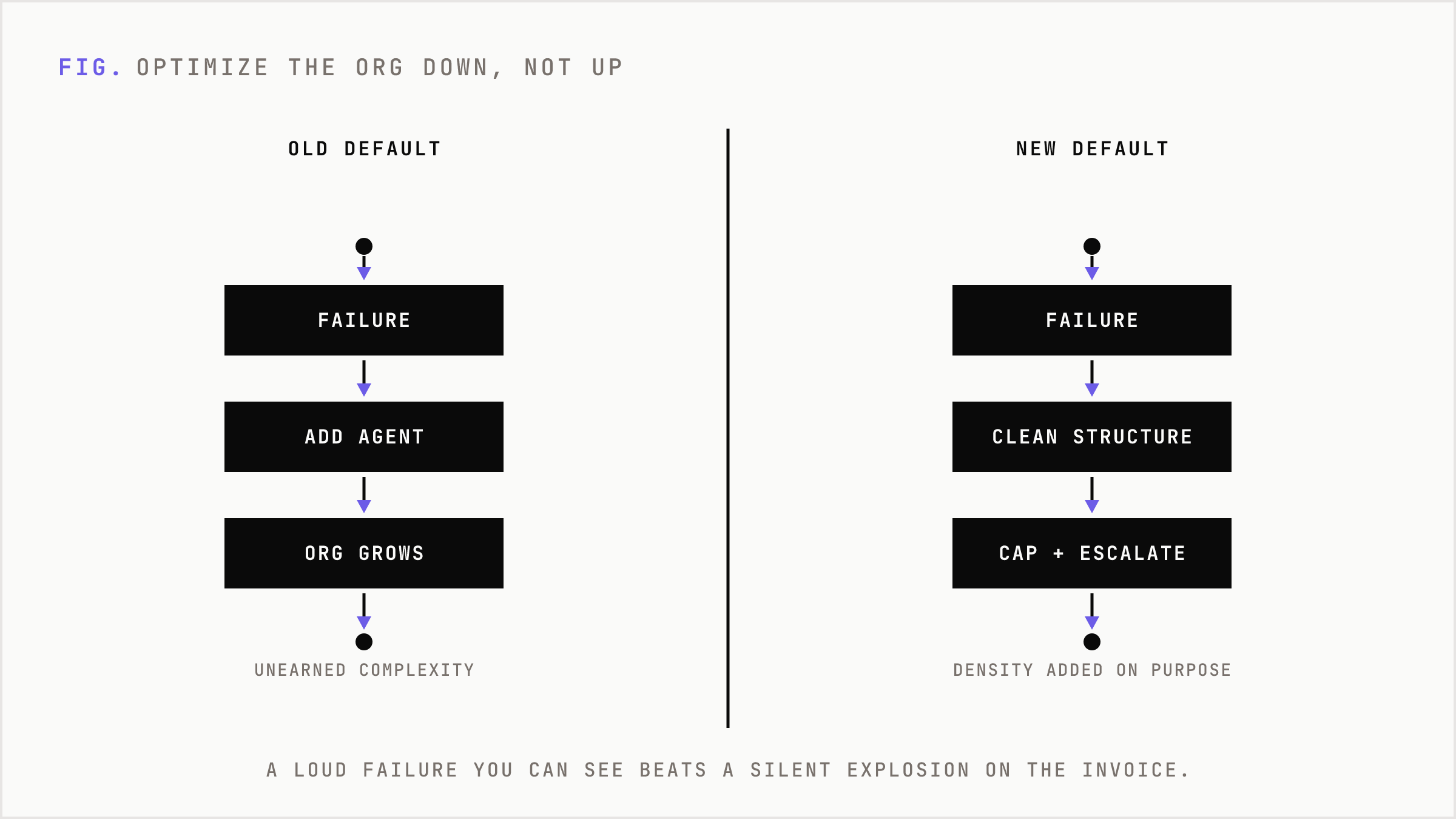
What stays the same is that hard tasks still get density. This is not a rule against complexity. It is a rule against unearned complexity. When a task is genuinely hard, you add agents on purpose, with a controller deciding it, not with a nervous worker spawning cover for itself.
The honest tradeoff: a capped, sparse org will occasionally hit a task it cannot handle and have to escalate to a human or fail loudly. That is a feature. A loud failure you can see beats a silent organization explosion you find on the invoice. You are trading a small amount of autonomous reach for a system whose cost you can actually predict.
The agents were never the hard part. The graph is. Who owns what, what runs together, and who is allowed to change the plan while the work is live. Get that right and you can run a smaller org that does more. Get it wrong and you will pay for a large one that does the same thing twice.
If you have a problem, if no one else can help, and if you can find them, maybe you can hire Nyyon.