Nyyon · Blog
Decision Velocity: The New Growth Advantage for AI-Native Marketing Teams
Decision velocity is the new marketing edge: clear owners, sharper evidence, better AI use, faster tests, and decision logs that compound learning.
The next marketing advantage is not more data, more content, or more AI. It is a faster system for making good decisions and learning from them.
Most marketing teams do not have a creativity problem. They have a decision architecture problem.
The symptoms are familiar. Budget meetings become attribution trials. Campaign reviews turn into taste debates. A landing page test runs too long because nobody defined the kill criteria. A channel keeps getting funded because it has a clean dashboard, not because it creates profitable customers. AI tools multiply the number of assets, messages, segments, and reports, but the team still cannot answer the basic operating question: what should we do next, and who owns it?
This is where the market is moving. The scarce resource is no longer access to tools. It is not even access to data. It is the ability to convert signal into action before competitors do, without turning the company into a casino.
Call it decision velocity.
Speed Is Not the Opposite of Quality
Executives often treat speed and rigor as a tradeoff. Move fast and you get sloppy. Slow down and you get smart.
That is usually false. Slow decisions are often not rigorous. They are often unowned. They stall because the decider is unclear, the criteria were never stated, the evidence is messy, the politics are hidden, or the downside has not been priced.
McKinsey has found that faster decisions tend to be higher quality, not lower quality. That should not be surprising. The same operating practices produce both: clear decision rights, explicit criteria, relevant data, real alternatives, and commitment to execution. Speed is the output of a clean system.
Marketing exposes this faster than most functions because the feedback loops are short and the budget lines are visible. A SaaS company deciding whether to shift spend from paid search into partner content is not making one abstract marketing choice. It is reallocating capital across time horizons, buyer intent levels, margin profiles, and learning rates. If that decision takes six weeks, the cost is not just delay. The cost is six weeks of missing market information.
The Dashboard Is Not the Decision
The last decade trained teams to become data-driven. That was useful, but incomplete. Data-driven often means collect everything, build dashboards, and wait for insight to appear.
Better teams work the other way around. They are decision-driven. They start with the decision, define what evidence would change the decision, then gather or generate that evidence.
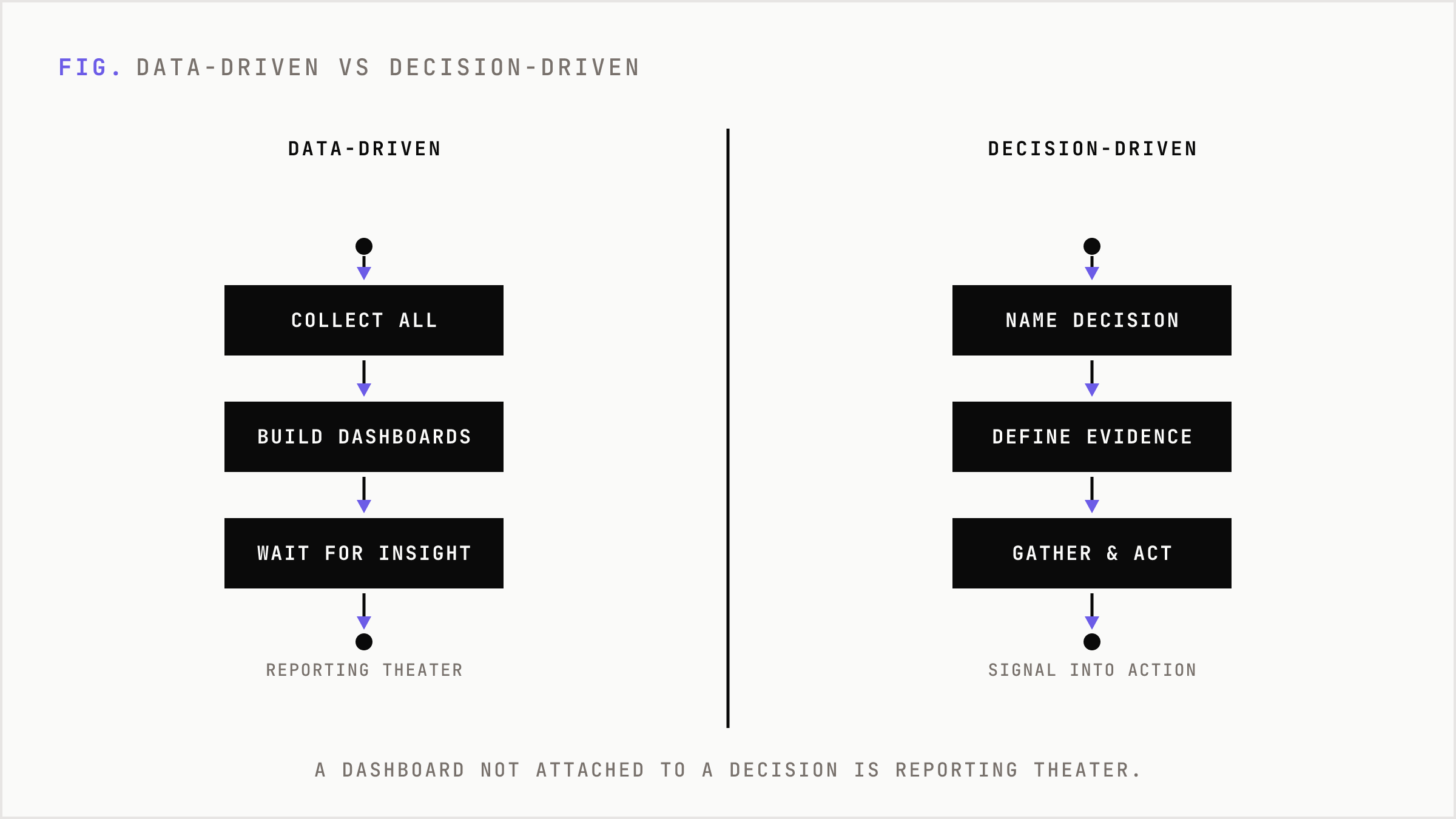
A dashboard that is not attached to a decision is reporting theater. It may be accurate and still useless.
Consider a growth team reviewing paid social. The dashboard shows CPM, CTR, CAC, ROAS, frequency, creative fatigue, and audience overlap. Fine. But the decision is not to admire the dashboard. The decision might be: do we increase budget by 30 percent next week, hold spend, change offer, refresh creative, move spend to retargeting, or stop the campaign?
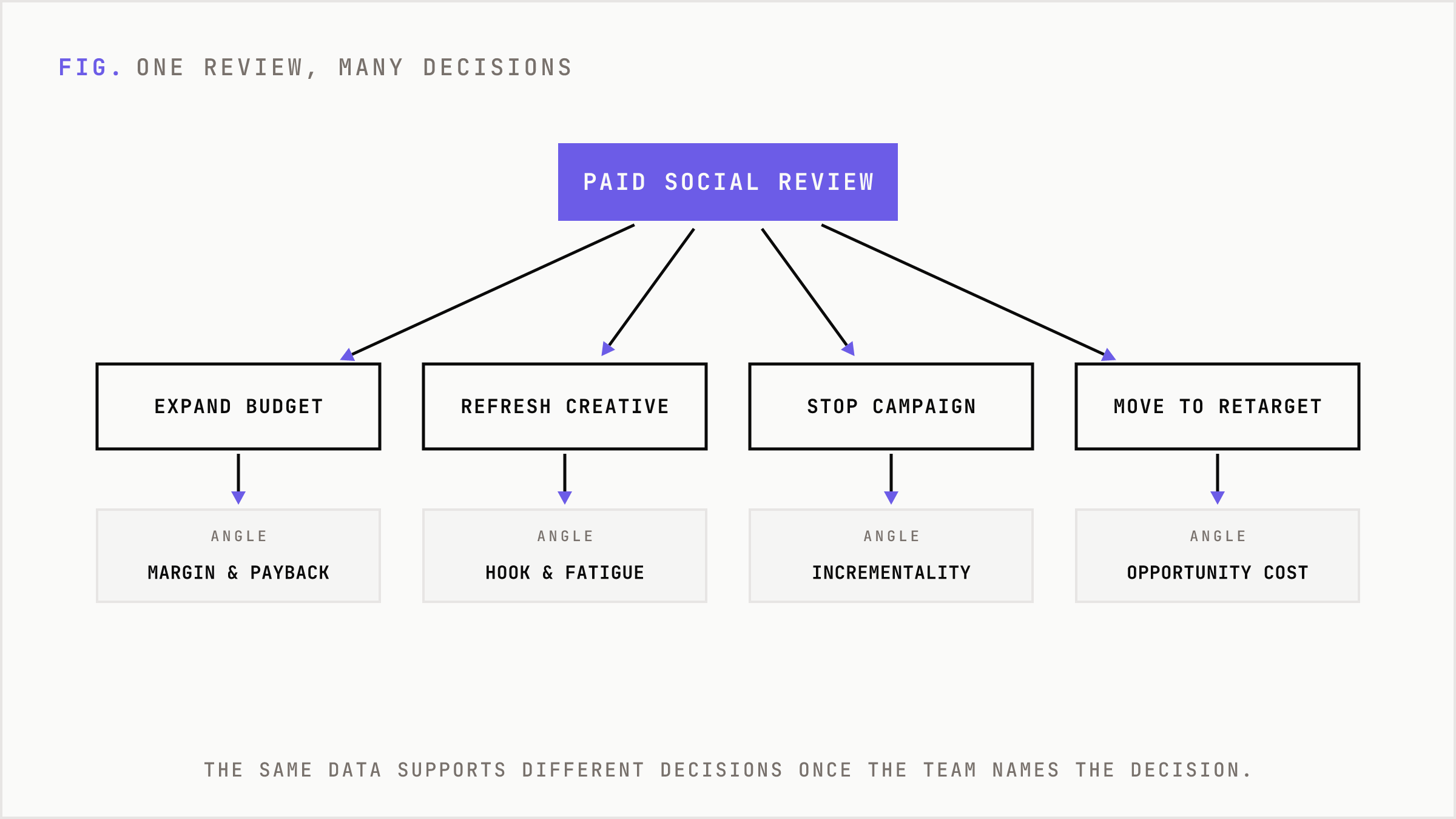
Each option needs different evidence. If the decision is budget expansion, margin quality and payback matter more than CTR. If the decision is creative refresh, hook-level performance and fatigue curves matter. If the decision is channel shutdown, incrementality and opportunity cost matter. The same data can support different decisions, but only after the team names the decision.
This is why poor data quality is not a technical nuisance. Gartner has estimated that poor data quality costs organizations millions per year on average, while many organizations still do not measure it. The fix is not to clean all data equally. The fix is to scope data quality by business use case, value, and risk. Marketing does not need perfect data everywhere. It needs trusted data where decisions depend on it.
The Unit of Work Is Changing
Old marketing work was organized around outputs: campaign, asset, channel, report.
AI-native marketing work is organized around decisions: which buyer to prioritize, which claim to test, which offer to package, which channel to fund, which campaign to kill, which learning to feed into the next cycle.
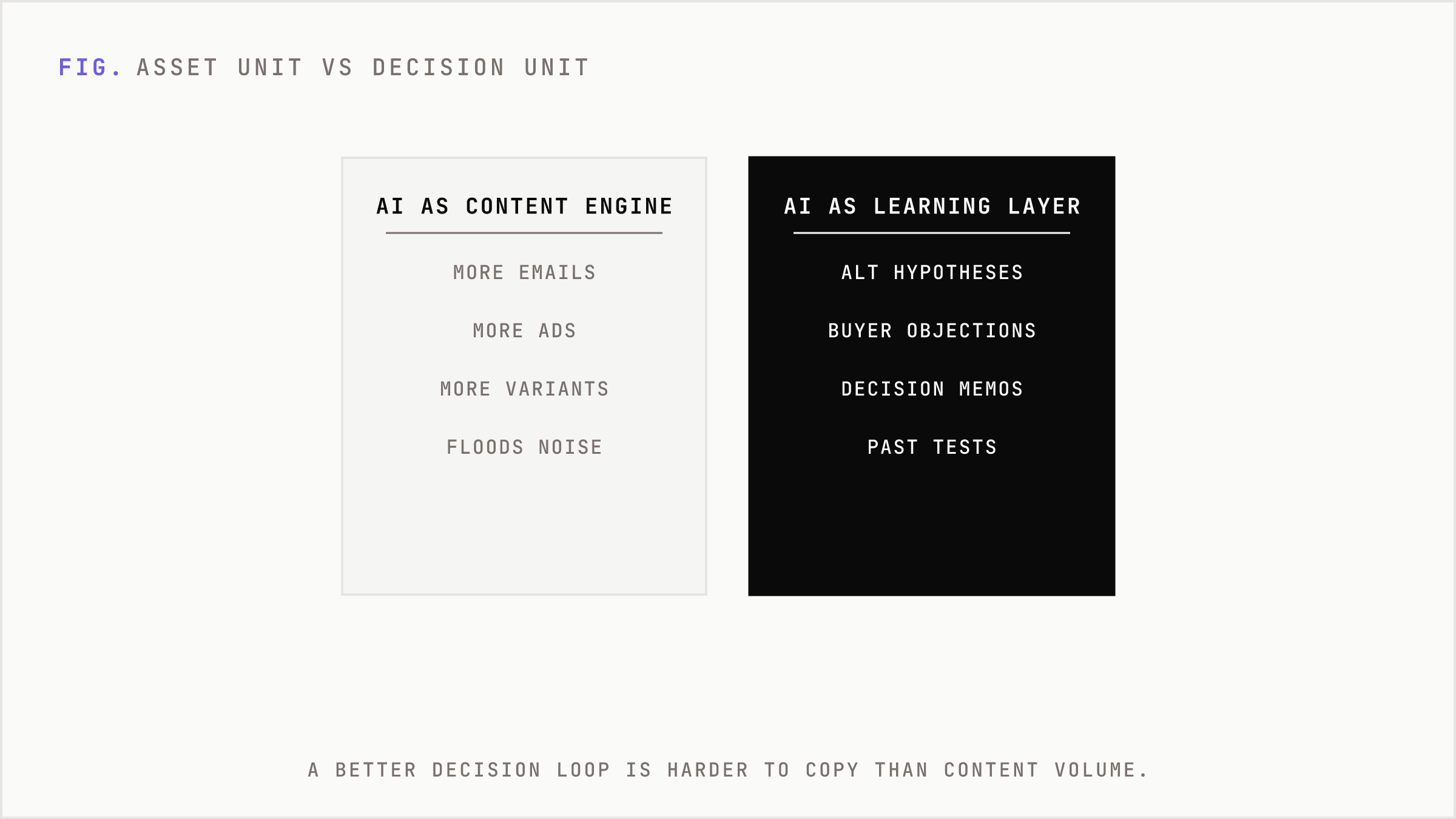
This shift matters for workflow design. If the unit of work is an asset, AI becomes a content engine. It produces more emails, more ads, more landing pages, more variants. That can lower production cost, but it can also flood the system with noise.
If the unit of work is a decision, AI becomes an analysis and learning layer. It can generate alternative campaign hypotheses. It can summarize call transcripts into buyer objections. It can find contradictions between sales feedback and ad messaging. It can draft a decision memo. It can retrieve similar past tests. It can produce counterarguments before the team commits budget.
The commercial difference is large. Content volume is easy to copy. A better decision loop is harder to copy because it depends on proprietary context, clean operating rhythms, institutional memory, and management discipline.
Every Important Marketing Decision Needs an Owner
The fastest way to improve decision velocity is to stop letting meetings make decisions.
For every high-value marketing decision, name one decider. Not a committee. Not a vague leadership group. One person accountable for the call.
Then name the recommender, the input sources, the performers, the deadline, the criteria, and the escalation path. Veto roles should be rare and tied to hard constraints like legal, security, compliance, finance, or brand safety.
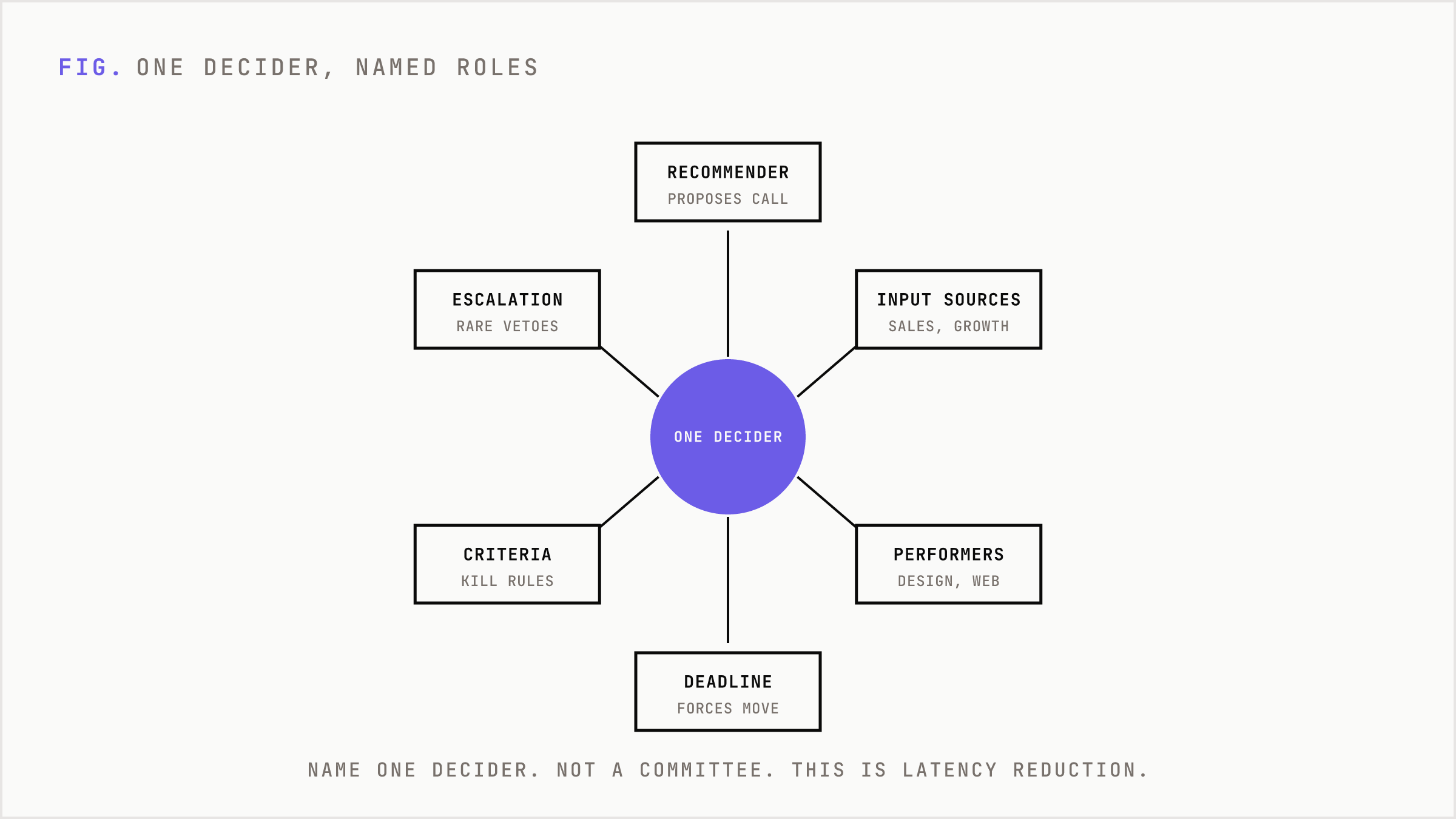
This is not bureaucracy. It is latency reduction.
Take a pricing page overhaul. Product marketing may recommend. Growth may provide conversion data. Sales may provide objections. Finance may set margin constraints. Legal may review claims. Design and web teams may perform. But one person must decide. If nobody owns the decision, the org defaults to consensus. Consensus feels safe because everyone is implicated. It is often expensive because nobody is accountable.
Decision rights also protect delegation. If senior leaders keep reopening delegated calls, the team learns to wait. If every landing page test needs executive taste approval, the company has not built a growth engine. It has built a bottleneck with branding guidelines.
Force Alternatives Before You Fall in Love
Most bad strategic decisions arrive disguised as recommendations with one option.
One option is not a decision. It is a sales pitch.
At minimum, a real marketing decision should compare the status quo, the recommended path, a contrarian path, and a lower-risk test path. That structure alone changes the conversation. It makes opportunity cost visible. It separates preference from judgment. It exposes whether the team is solving the right problem.
McKinsey has reported that adding just one alternative makes very good strategic decision-making far more likely. The mechanism is simple. Alternatives force comparison. Comparison forces criteria. Criteria force tradeoffs into the open.
Example: a B2B company wants pipeline growth. The default plan is to increase paid search. The recommended plan is a founder-led webinar series. The contrarian plan is to narrow ICP and cut broad campaigns. The lower-risk test path is a two-week outbound and retargeting sprint around one painful use case.
Now the team is not debating whether webinars are good. It is comparing learning speed, buyer quality, cost, sales capacity, payback, and strategic fit. That is a better meeting.
Use Experiments Where the Market Can Answer
Marketing teams overanalyze questions the market could answer in days, then underanalyze decisions that can damage trust for years.
Match the method to the uncertainty.
If the decision is high frequency and low risk, delegate it or automate it. If the decision is uncertain but reversible, test it. If the decision is uncertain and hard to reverse, use scenarios, premortems, expert review, and senior decision rights.
A subject line test does not need a steering committee. A brand repositioning does not need a vibes-based sprint. A pricing change may need experiments, customer research, margin modeling, and a rollback plan.
The best online experimentation cultures use clear evaluation metrics, fast release cycles, automated ramp-up and shutdown, and a bias toward testing. Most ideas fail. That is not a problem if the cost of finding out is low and the learning compounds.
For marketing, the key is to test decisions, not trivia. Button color tests are rarely a strategy. Offer tests, audience tests, proof-point tests, pricing tests, onboarding tests, and channel allocation tests can change the business.
AI Should Widen Judgment, Not Replace It
AI is useful inside the decision system. It is dangerous as a substitute for the decision system.
A 2024 meta-analysis of more than 100 experimental studies found that human and AI combinations do not automatically outperform the better of human-alone or AI-alone. In decision tasks, the combination can perform worse. That is a warning against lazy augmentation. Adding AI to a flawed workflow can make the workflow faster at being wrong.
The strongest use cases are component tasks. AI can generate options the team missed. It can surface disconfirming evidence. It can summarize customer interviews. It can identify missing data. It can simulate objections from finance, sales, legal, and customers. It can monitor leading indicators after a launch. It can draft a premortem.
But AI output is not evidence by default. It is a hypothesis, a synthesis, or a prompt for human review. The company still needs a named owner, source traceability, override logging, model monitoring, escalation thresholds, and incident handling. NIST's AI Risk Management Framework points in this direction: governance, oversight, inventories, monitoring, diverse review, and clear accountability.
The mature posture is not AI makes the call. The mature posture is AI improves the inputs, the options, the critique, the documentation, and the feedback loop. Humans own the tradeoffs.
Decision Logs Are the Missing Dataset
Most companies lose the reason behind their decisions. Six months later, the outcome is visible but the context is gone. The team remembers the headline, not the assumptions. New employees inherit conclusions without the logic that produced them.
This is an avoidable loss.
A decision log should capture the decision, owner, date, context, options considered, evidence used, evidence missing, assumptions, expected outcome, confidence level, risks, kill criteria, revisit date, result, and lessons.
This separates decision quality from outcome quality. A good decision can produce a bad outcome because the market moved or the model was incomplete. A bad decision can produce a good outcome through luck. If the company only rewards outcomes, it reinforces noise. If it reviews process, calibration improves.
Decision logs also become a strategic asset in AI-native companies. They give future copilots something better than generic best practices. They provide proprietary examples of how the company thinks, what it tried, where it was wrong, and what evidence actually mattered.
This is decision memory. It compounds.
The Metrics That Matter
Decision velocity is not the same as moving quickly. It needs measurement or it becomes another slogan.
Track quality: percentage of decisions with clear criteria, real alternatives, evidence scores, premortems for high-risk calls, forecast accuracy, and assumption validity.
Track speed: time from issue raised to decision, time from decision to execution, number of meetings, approval layers, reopened decisions, and bottleneck owners.
Track yield: percentage executed as intended, expected impact versus actual impact, experiment win rate, learning generated, and downstream business outcome.
Track effort: hours spent, stakeholder count, cost of analysis, cost of delay, and mismatch between decision value and process complexity.
Bain has framed decision effectiveness around quality, speed, yield, and effort. That is useful because it forces the full economic view. A decision that is correct but too slow can still destroy value. A decision that is fast but never executed is theater. A decision that consumes 40 executive hours to resolve a low-risk issue is mispriced.
The Budget Logic Is Brutal
Marketing budgets are being re-underwritten. CFOs are less patient with attribution stories. Founders are less tolerant of activity metrics. Investors want efficient growth, not motion.
AI raises the bar because it lowers the cost of production. When everyone can generate more campaigns, assets, landing pages, and reports, the market stops rewarding output volume. It rewards allocation quality.
That changes buyer behavior inside the company. The marketing leader who can say we shipped 200 assets sounds busy. The marketing leader who can say we cut decision cycle time by 40 percent, killed low-quality spend faster, improved forecast calibration, and moved budget toward experiments with higher expected value sounds like an operator.
That is the difference between a cost center defending activity and a growth system allocating capital.
The Operating Cadence
A practical system is not complicated.
Weekly: review the decision backlog, escalate blocked decisions, delegate high-frequency calls, review active tests, and flag stale assumptions.
Monthly: review decision quality, inspect the top decisions by value and risk, tie data-quality issues to real decisions, audit AI-assisted decisions, and identify speed bottlenecks.
Quarterly: run decision retrospectives, recalibrate forecasts, clean up decision rights, review kill and scale choices, refresh strategic assumptions, and review AI governance.
The cadence matters because decision velocity is a habit, not a workshop. It lives in the calendar, the memo, the experiment, the dashboard, and the postmortem.
The Strategic Implication
The best marketing teams will not be the teams with the most tools. They will be the teams with the best loops.
They will decide what matters, define evidence before analysis, force alternatives, use AI to widen the option set, test where the market can answer, log what they learn, and reallocate capital faster than competitors.
This does not guarantee perfect decisions. That is the wrong target. The target is a system that makes good decisions more often, bad decisions less expensive, and learning reusable.
In a slower market, that was operational hygiene. In an AI-native market, it is a growth advantage.
FAQ
What is decision velocity in marketing?
Decision velocity is the speed and quality with which a marketing team turns signal into action. It depends on clear ownership, explicit criteria, useful evidence, real alternatives, fast execution, and post-decision learning.
How is decision velocity different from moving fast?
Moving fast can mean shipping activity without judgment. Decision velocity means reducing delay while improving decision quality. It measures speed, yield, effort, and learning, not just output volume.
Where should AI fit into marketing decisions?
AI should improve components of the decision process: option generation, evidence summaries, counterarguments, assumption mapping, experiment design, monitoring, and decision logs. It should not replace accountable human judgment for important tradeoffs.
What is the easiest first step?
Start with the top ten recurring marketing decisions by budget or risk. For each one, name a decider, define criteria, require at least two real alternatives, set kill criteria, and log the outcome.