Nyyon · Blog
Binance's 'we put the power in users' hands' is a liability dump, not empowerment
Binance shipped AI agents that trade real money, then named the customer as the guardrail. That is a liability transfer wearing an empowerment label.
What actually happens when an autonomous agent drains the account and everyone shrugs "it was the agent's fault"? Courts have already started holding companies accountable for what their AI does, so "the agent did it" fails as a defense. The party who deployed and monetized the agent eats the loss, and Binance has arranged the paperwork so that party is you. Binance shipped Agent OS this week to let AI agents trade real money, and its own guidance is that sub-accounts are your defense against prompt injection because it has no visibility into an agent's reasoning. That is a liability transfer wearing an empowerment label: Binance keeps the fees and the order flow, you keep the blast radius when a compromised agent drains a live account.
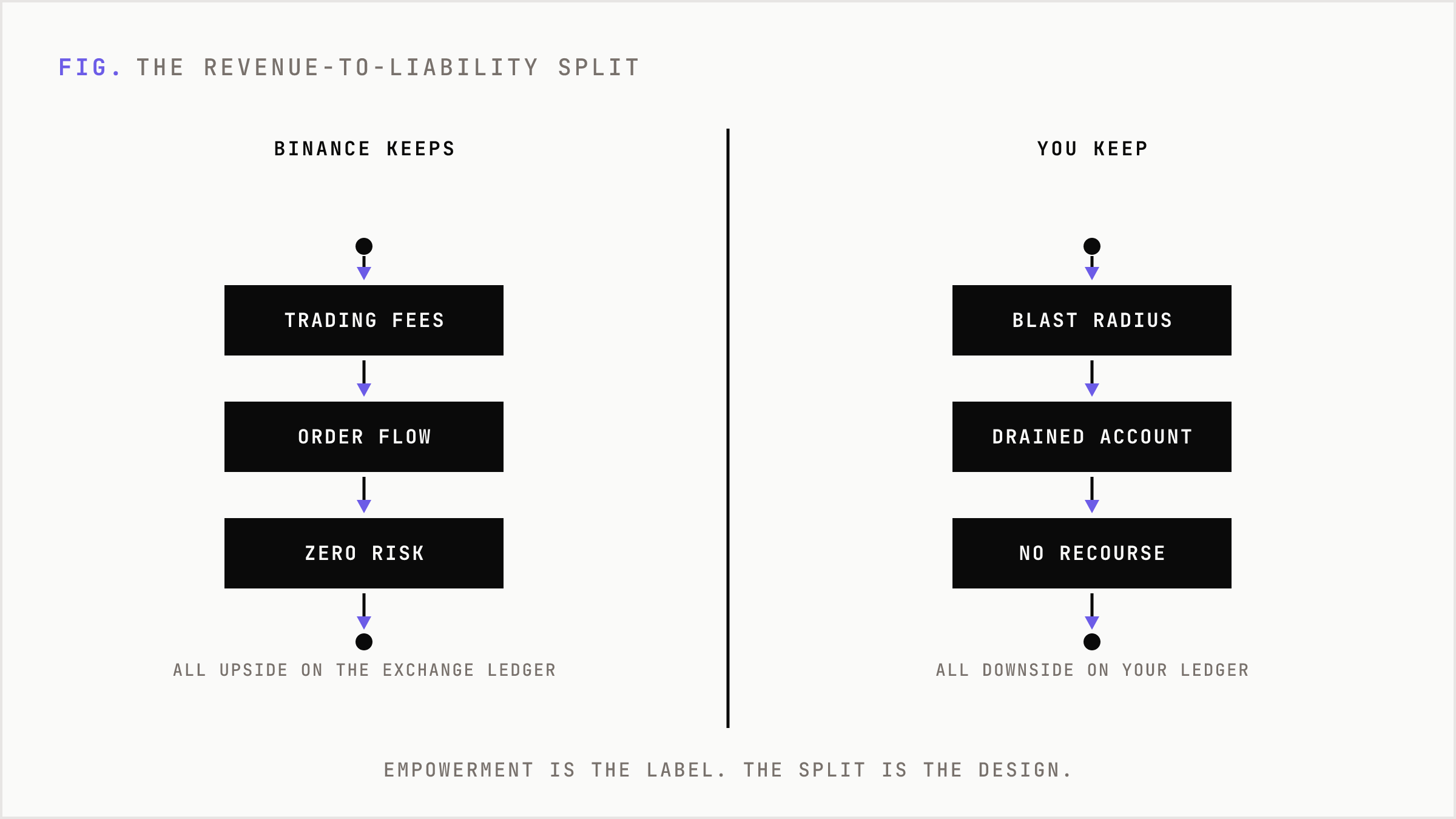
On Thursday Binance, the largest crypto exchange with more than 300 million registered users, launched a platform that lets AI agents analyze markets and execute trades on users' behalf. Jeff Li, vice president of product, put it plainly: "Instead of total freedom, we put the power in users' hands to give them the granular access control of what they can do through the agent." Read that again with a skeptical eye. "Power in users' hands" is the framing. Risk offload is the mechanism.
Agent OS moves live capital while blind to the agent's reasoning
Binance's own account is that it cannot see how an agent decides anything. Its recommended control is that you segment funds into dedicated sub-accounts and assign an agent to each one. The vendor is telling you the guardrail is your directory structure, on a platform wiring OpenAI's ChatGPT and Codex, Anthropic's Claude Code, and Cursor into a system that authorizes agents to view account information and execute trades.
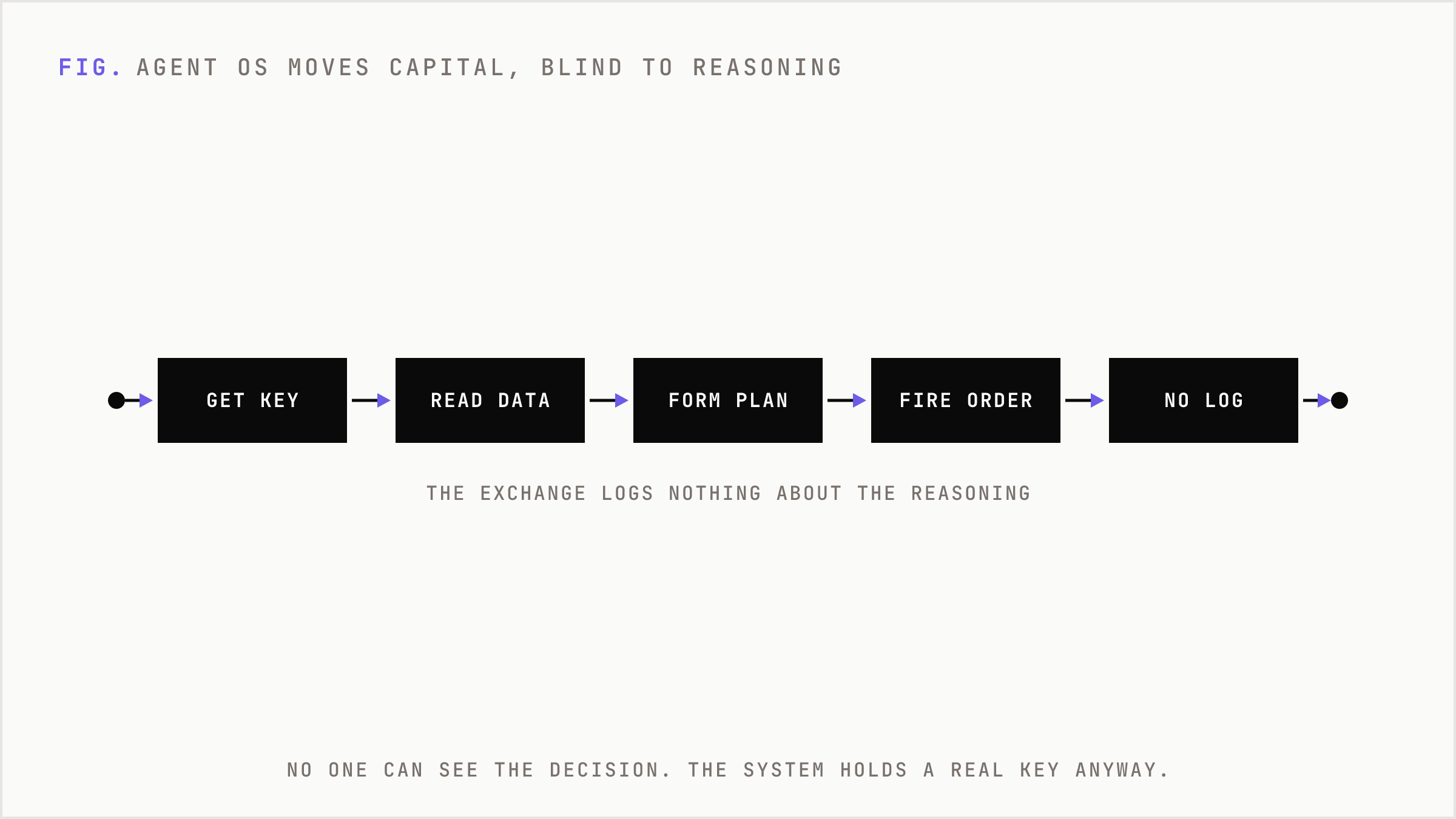
Sit with the mechanism. An agent gets a key to a sub-account. It reads market data, forms a plan you cannot inspect, and fires orders. Binance clears those orders, collects a fee on each one, and logs nothing about the reasoning that produced them because it has none to log. When something goes wrong, the trace that would let you dispute the loss lives inside a black box the exchange chose not to open.
I build agentic systems for clients, and the first question on any deployment that touches money is who can see the decision. If the answer is no one, the system is not ready to hold a key to real capital. Binance shipped it anyway and handed the audit trail problem to the customer.
"The agent did it" is not a legal defense, so the deployer eats it
Courts have already started holding companies accountable for what their AI systems do. The party that deployed and monetized the agent absorbs the loss. Binance named the customer as the mitigation, which means the fight over a drained account lands on your balance sheet, not theirs.
Here is the shape of it in real numbers. Fund a trading sub-account with $5,000. A prompt injection turns the agent against you and it moves the whole $5,000 into an attacker's hands over an afternoon. You call support. The docs Binance published already told you sub-accounts were your call and your defense. There is no recourse ticket you win here, because the exchange documented your ownership of the risk before you funded a cent.
Sub-accounts cap the loss and leave the compromise wide open
A sub-account limits how much a hijacked agent can move. That is a real property, and it is worth having. What it does for the actual attack is nothing. It caps the size of the fire, it does no work to prevent ignition.
So the honest reading of the guidance is: pre-commit to how much you are willing to lose, put that amount behind the agent, and accept that a compromise inside that boundary is fully yours. That is a fund-your-own-downside policy dressed as security architecture. On a platform running live orders, treating your directory structure as the primary defense against prompt injection is a decision Binance made to keep its own build cheap.
Real accountability needs a trader in the loop and stop-loss in the sequence
Accountability on an execution platform has a shape, and it has two parts Binance shipped neither of.
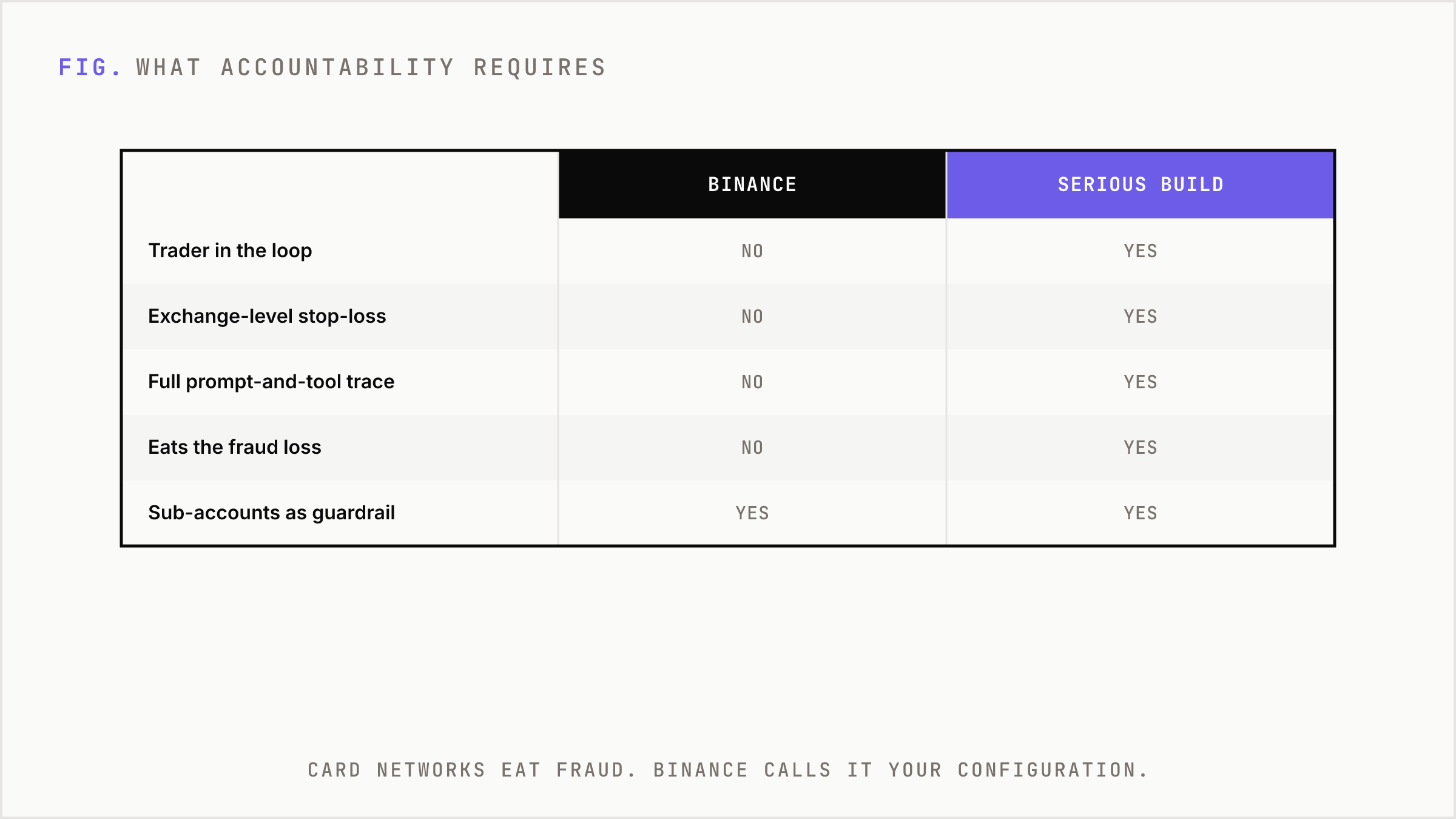
First, a trader in the loop. This is the direct analog to human-in-the-loop from AI development, where a person confirms or can veto any consequential action before it executes. A trader in the loop is a human confirmation gate on orders above a threshold, so a hijacked agent cannot move real size without a person signing off.
Second, exchange-level stop-loss and hard limits baked into the execution sequence. Not a config toggle the customer sets and the agent can be talked around, but a server-side cap that the exchange enforces on every order before it clears. A per-order limit, a per-day limit, a maximum position size, all evaluated on Binance's side inside the execution path.
Ship both and autonomy stays inside a fence the vendor owns. Binance shipped the autonomy and pointed at your sub-accounts. A serious build would also require signed confirmation for orders above a set amount, log the full prompt-and-tool trace so a dispute has evidence, and eat the fraud loss the way card networks do when a stolen card runs up a charge. Card networks do not tell you the fraud was your configuration problem. Binance does.
Empowerment is the label, revenue-to-liability split is the design
"Power in users' hands" reads as decentralization to a founder scanning the launch post. To an ops lead who thinks about who eats the loss, it reads as a support ticket with no winning outcome. Binance collects trading fees on every autonomous order while owning none of the agent's behavior. That is the cleanest liability-to-revenue split in the business: all of the upside on the exchange's ledger, all of the downside on yours.
We wrote a while back that the agent hacking spree was an orphaned-liability problem, a capable autonomous actor with no named human owning its production behavior. Binance just productized the orphan. Capable autonomous actor, real funds, zero human owning its conduct, and a terms-of-service that assigns the fallout to you.
Handle the objections a skeptical operator will raise
Traders asked for autonomy, so giving them the keys is respect. Traders do want autonomous execution, that part is true. Handing someone a live-fire trading agent with no reasoning visibility and a config-your-own-guardrail policy ships the upside to the trader and expenses the downside to the trader too. Respect would put a fence around the fire before handing over the match.
This is crypto, and self-custody is the whole ethos. Self-custody means you hold your keys. It says nothing about a platform running the execution layer disclaiming the agent behavior it enables while collecting the order flow. Holding your own keys and the exchange owning the conduct of agents it wired into its own APIs are two separate questions, and Binance answered the second one in its own favor.
Prompt injection is unsolved industry-wide, so no vendor can promise safety. Correct. That is the argument for waiting to let agents trade real money, not the argument for shipping it today and naming the customer as the mitigation. An unsolved attack surface on live capital is a reason to hold the product back until a trader in the loop and server-side limits are in place.
What to do this week if you are wiring an agent into a trading venue
Before any autonomous agent gets a key to Binance Agent OS or any trading venue this quarter, do four things in order. Cap the sub-account at a number you would shrug off losing entirely, and fund only that. Set a hard per-order and per-day limit at the exchange level before the agent touches a key, so the cap sits in the execution path where it survives a hijack. Require a human confirmation step on any consequential order above your threshold, a trader in the loop you actually staff. Then write down, by name, who in your org absorbs the loss when it goes wrong.
If the honest answer to that last one is "us, with no recourse," the venue has moved its risk onto your balance sheet and called it empowerment. Agentic execution loses control only when you actively give it away, and Binance built the give-away as the default. The move this week is to hold your capital and wait for the guardrails to ship server-side.
If you have a problem, if no one else can help, and if you can find them, maybe you can hire Nyyon.