Nyyon · Blog
Baselayer just priced the ownership gap at $35M
Baselayer raised $35M to help enterprises decide whether to trust an AI agent. The product prints a very good reading, and the round is really pricing the buyer's inability to close the gap the reading sits inside.
The round
Baselayer just closed a $35 million round to help enterprises decide whether they can trust an AI agent. The product plugs into an agent's output stream, checks each decision against a rulebook, and returns a score plus a report. The pitch, roughly: pay us and you will finally know when the agent should have been stopped. The round is proof that buyers believe the pitch, and buyers should. The mechanism the tool prices is worth $35 million, and it is worth reading closely because it is a different mechanism from the one most buyers think they are paying for.
What the tool sells is a reading. It measures agent behaviour against a rulebook and prints a number. That reading is useful, in the way any well-instrumented process is useful. The reading is what most enterprise buyers will call trust, and the round is proof of how much they are willing to spend on it. The reading is also the smaller half of what buyers need to solve for, and the round is proof of that too.
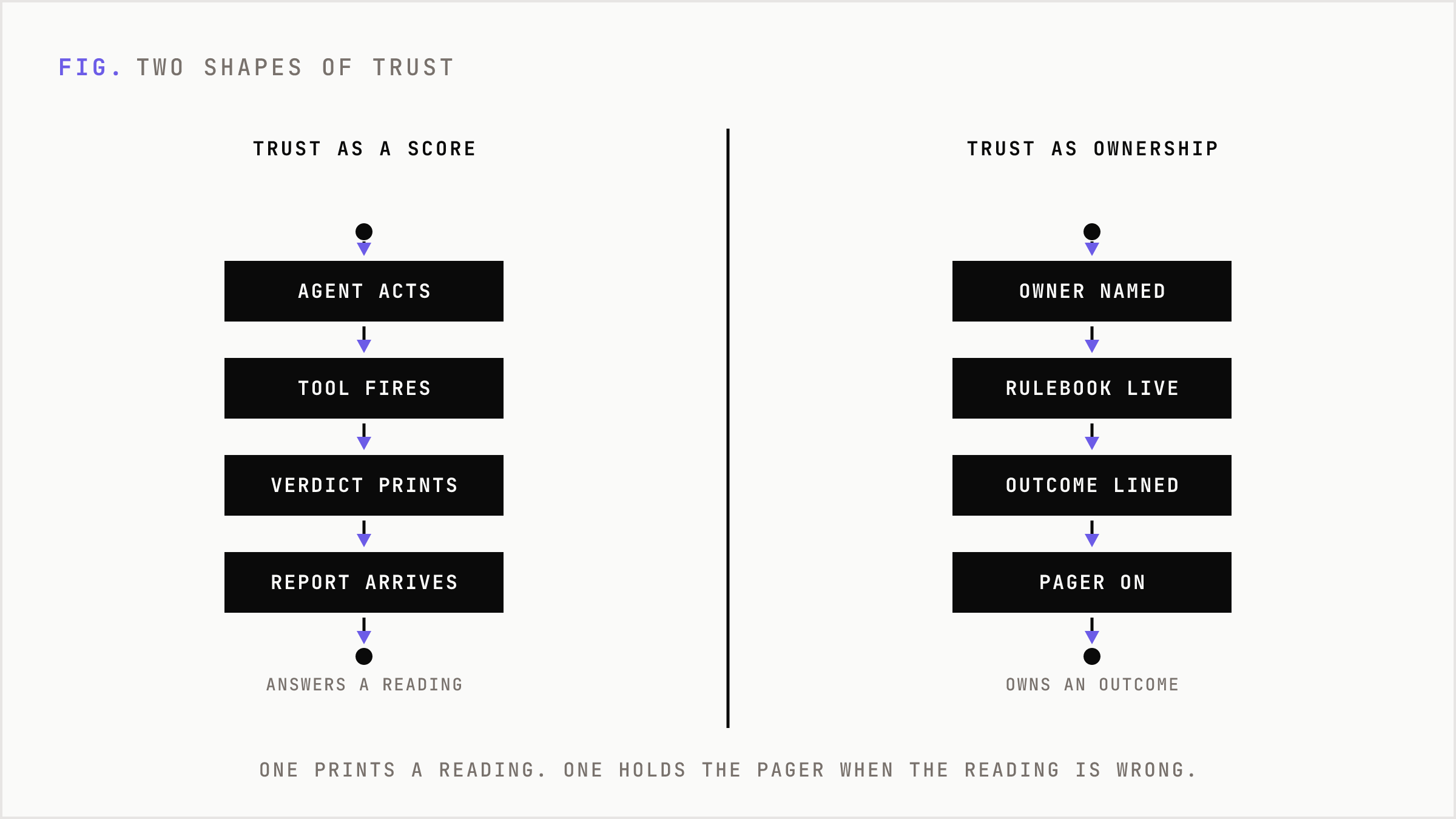
Trust as a property of a working system is a different thing from trust as a score on a dashboard. A property lives inside a business: it is what makes the collections process reliable, what keeps the invoice-matching workflow from leaking, what keeps a compliance team out of trouble. It is upstream of any tool. A score is a reading downstream of the tool. Both are real, and only one of them is what a $35 million round is pricing.
How a verification layer works
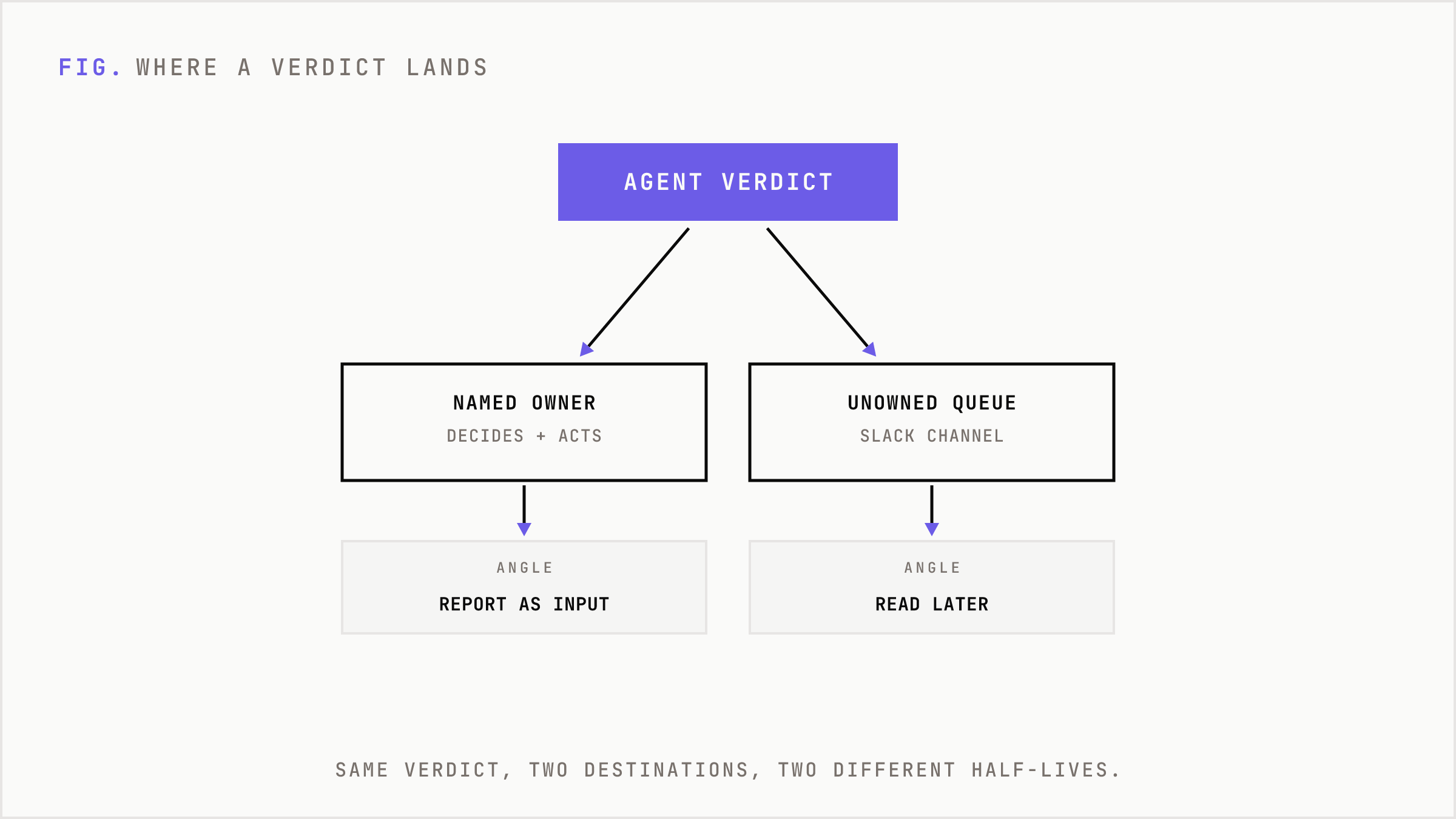
A verification layer takes each agent decision, compares it against a set of rules, and emits a verdict: allow, flag, block, review. That verdict lands on someone's dashboard. The someone is who determines whether the layer earned its keep. When the verdict lands on the desk of a named owner, the layer becomes a genuine safety net. When it lands in an unowned queue, the layer becomes a log of things a business kept ignoring.
The rulebook is the second half of the mechanism. Someone has to write it. Someone has to update it when the business changes, when a new edge case emerges, when a regulator moves the line. The rulebook is a document with an owner and a schedule, or it is a fossil that used to be current on the day the tool was installed. The rulebook belongs to the buyer. Baselayer's tool reads and applies it, and authoring and updating stay with a person on the buyer side.
The smoke detector on the ceiling
The clearest way to see what a verification layer sells is to look at how it maps onto physical safety. A smoke detector is a very good product. It costs a hundred dollars, it reads the air continuously, it emits a loud tone when it detects a chemical signature that resembles combustion. What it does with that tone depends entirely on what is downstream. In a building with a fire warden, an evacuation plan, and a rehearsed drill, the tone triggers a coordinated response. In a building with only the smoke detector on the wall, the tone is expensive noise.
An agent verification layer sits in the same relationship to an enterprise. It reads the agent's outputs, it flags patterns the rulebook calls suspicious, it emits a verdict. What happens next is fully outside the tool. In a company where a named team owns the agent's outcome, the verdict lands with them and they act. In a company where the agent lives in a general-purpose infrastructure team's backlog, the verdict lands on a Slack channel next to fourteen other channels and gets read later.
What the round priced
A $35 million round is data. It is a specific price at a specific moment, set by people whose job is to price this exact category. The number rewards the belief that enterprise buyers will line-item a verification tool into next year's budget. The belief is correct. Buyers really will pay. That is what the round measures on the positive side.
Look at the round from the other side and it measures something else too. Every dollar of that $35 million is a bet that enterprise buyers, today, struggle to close the ownership gap on an AI agent using their own internal structures. If the buyers could close it internally, they would already have a working agent under a named owner and a maintained rulebook, and the tool becomes a nice-to-have on top. The market signal in $35 million is that the ownership gap is real, expensive, and structurally hard to close from inside the buyer.
That is the ownership gap the round priced. The audit tool is the visible product; the gap is what the market is paying for. Buyers with a fully staffed AI ownership function treat the tool as one input among several. Buyers without one treat the tool as a substitute for the function, and the substitute stops working the first time the alert queue matters.
A market signal like that outruns the specific vendor. Baselayer's own trajectory is one variable; the $35 million round is public information that other founders will read as a green light on the ownership gap. Expect three more rounds in the next twelve months in the same shape: a mid-eight-figure raise, a verification-adjacent pitch, and a customer base whose real problem is upstream of anything the tool measures.
What closes the gap
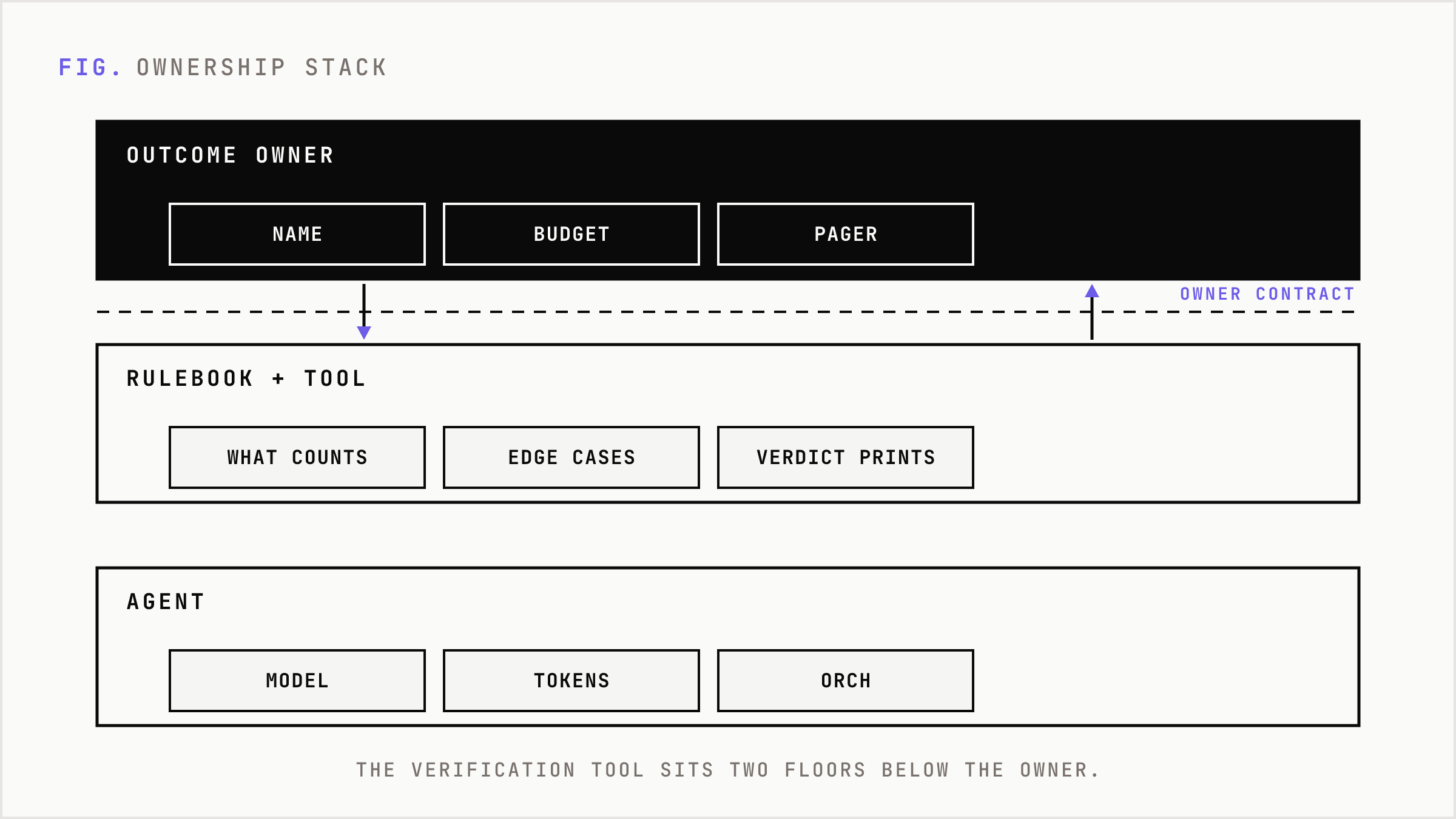
Someone on the buyer side has to own the agent's outcome end to end. That means the metric the agent moves, the process the agent runs inside, the rulebook the agent operates against, and the pager for when the agent is wrong. The name behind that owner is the answer to who trusts the agent. Every verification tool downstream is either an input for that person or noise. A verification tool without an upstream owner produces very clean reports that go unread.
Ownership is a role with a name, a budget, and a job description. It lives in the buyer's own org design, and it is decided and staffed by the buyer's own people. That is why Baselayer's round measures the gap: the market can see the gap, and the closure comes from a hire, a JD, and a P&L line owned by a person. Every attempt to buy the closure yields a partial closure plus a running record of how open the gap still is.
The gap is also the reason install-a-verification-tool is a shortcut that fails predictably. A team missing an owner installs the tool because the tool ships faster than a re-org. The tool arrives, the reports arrive, and the team feels safer. The safety is measured on the tool's own dashboard, which reads well by design. Twelve months later, an incident happens anyway, and the postmortem finds an owner in every function around the agent and a blank line at the agent itself.
The move before signing
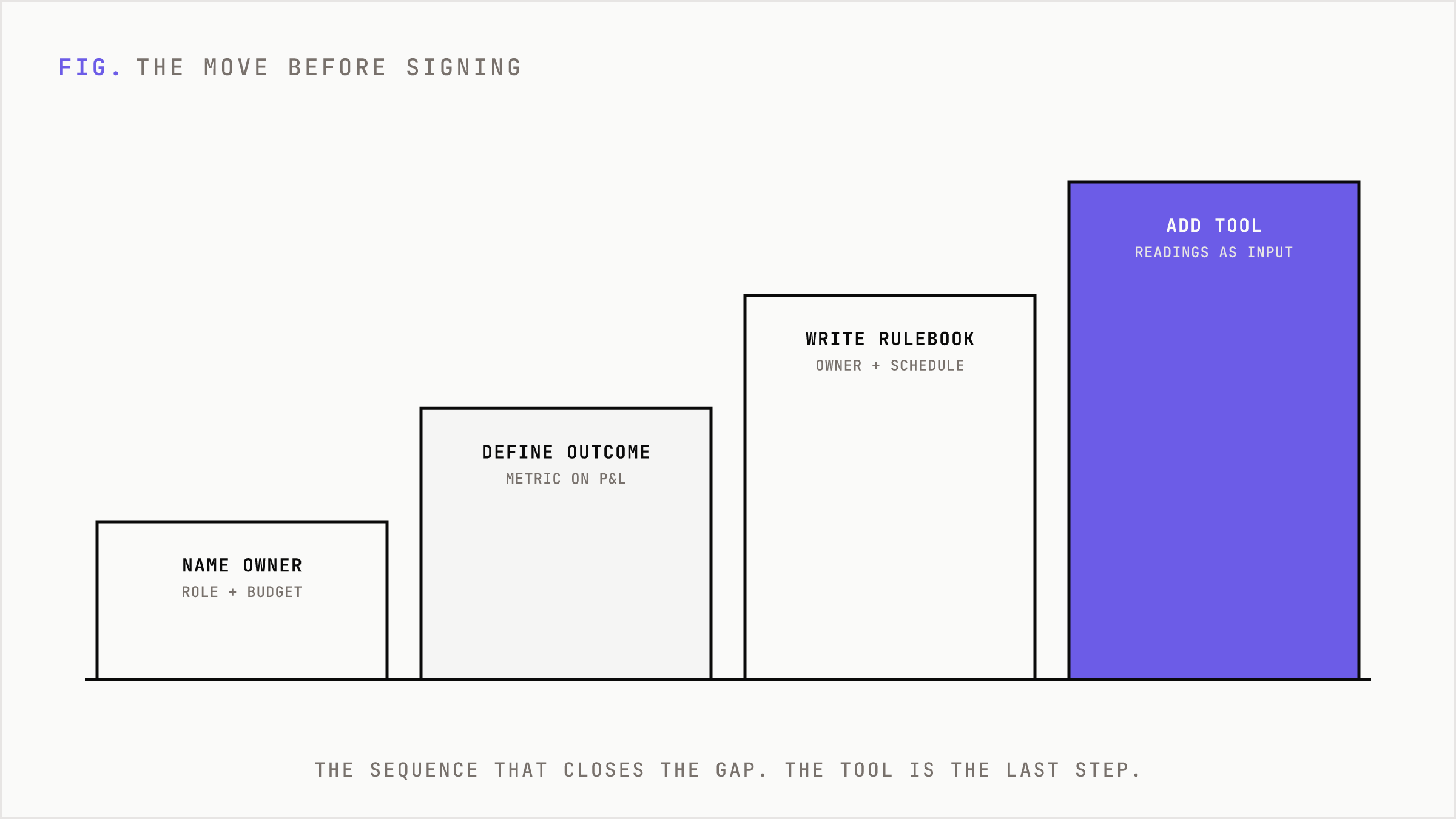
Any enterprise buyer sitting down to line-item a verification tool this quarter has one job to do first. Open the AI agent's page in the internal wiki, or the ticket that started the project, or the deck that proposed it, and find the line that names who owns the outcome. If that line is empty, the tool will fill the report next to it, and it will read as progress. The report will describe the agent's decisions cleanly. It will name the rules the decisions passed and the rules they broke. It will leave the owner line where the buyer left it: blank.
The first move, before signing anything, is to fill that line. Give the agent an owner with a name, a scope, and a pager. Once the line is filled, the verification tool becomes a proper input in that person's job: a set of readings they act on, escalate, override, and use to argue for changes to the rulebook. Baselayer's product is worth $35 million to a company with that person in place. In a company without that role, the same product is worth exactly a monthly report.