Nyyon · Blog
One engineer's judgment is the moat in Asana's Codex miracle
OpenAI's Asana case study describes a $6M-to-$12K collapse driven by Codex, and the operating model buried in the case study runs on one engineer at the review desk approving every change twice a day for two weeks.
The story everyone quoted
OpenAI's Asana case study lands like a headline: five years of engineering work cleared in two weeks, cost line collapsing from six million dollars to twelve thousand. Every engineering leader forwarding the link this month is reading it as permission to greenlight the migration they have been holding back, and to thin out review while they are at it. The numbers are real. The reading of the numbers is the interesting part, and most of the reading is wrong in the same direction.
The case study describes a specific operating model, and the model is the story once anyone reads past the top-line figures. Four Codex agents ran in parallel on the codebase. The prompt they ran on was five sentences long. One engineer sat at the review desk and approved every change twice a day for two weeks. Twelve thousand dollars is what those two weeks cost in models. The two weeks themselves ran on one engineer's judgment.
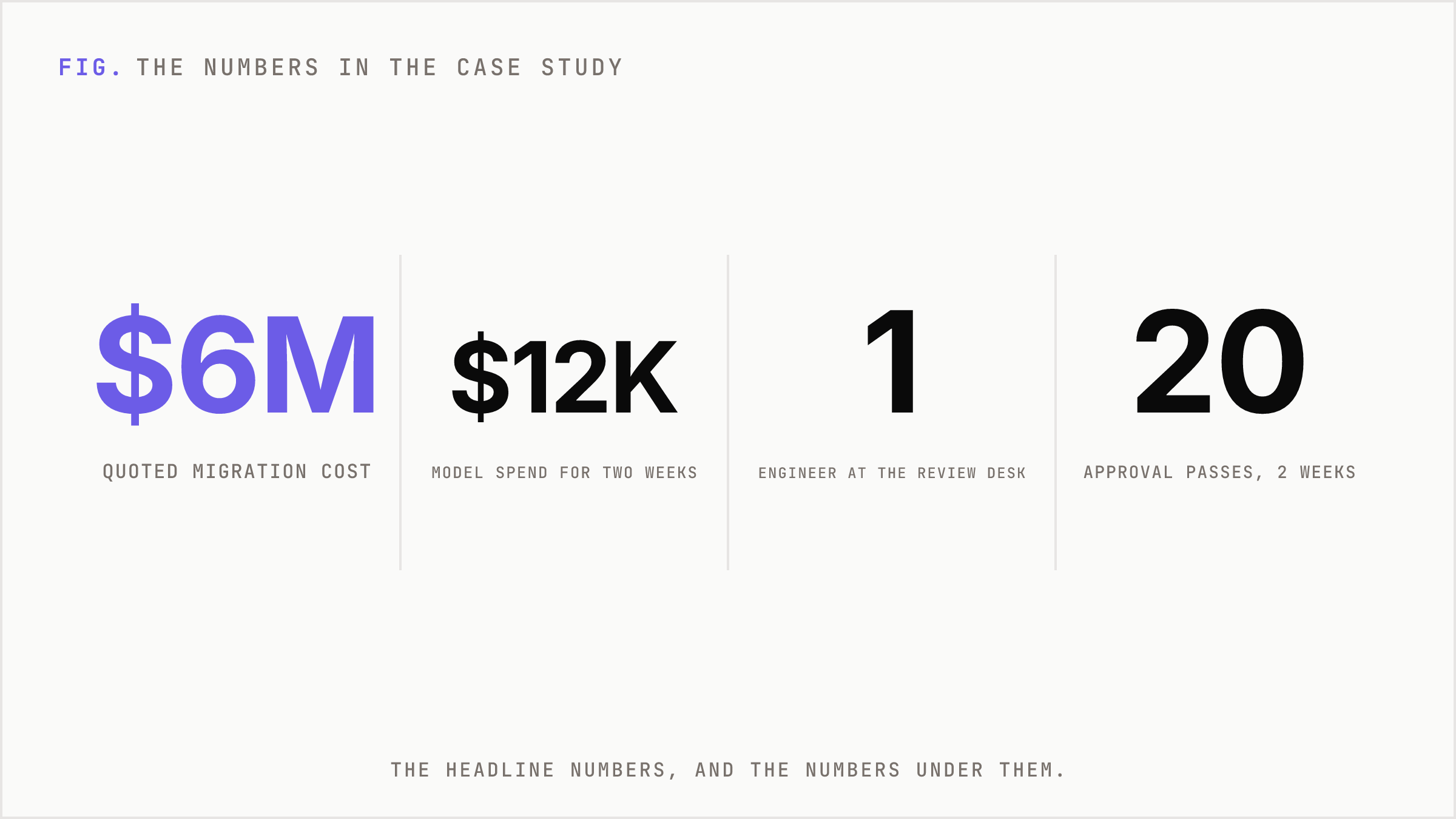
The reviewer is the line item the case study describes and the industry then quietly deletes. Every version of we-can-now-do-this-without-engineers that follows in the next quarter's board decks strips out the piece the case study depends on. Read the case study once and it looks like a Codex miracle. Read it twice and it looks like a specific engineer at a specific keyboard, making a specific set of correctness calls that live outside any model on the market.
The operating model buried in the case study
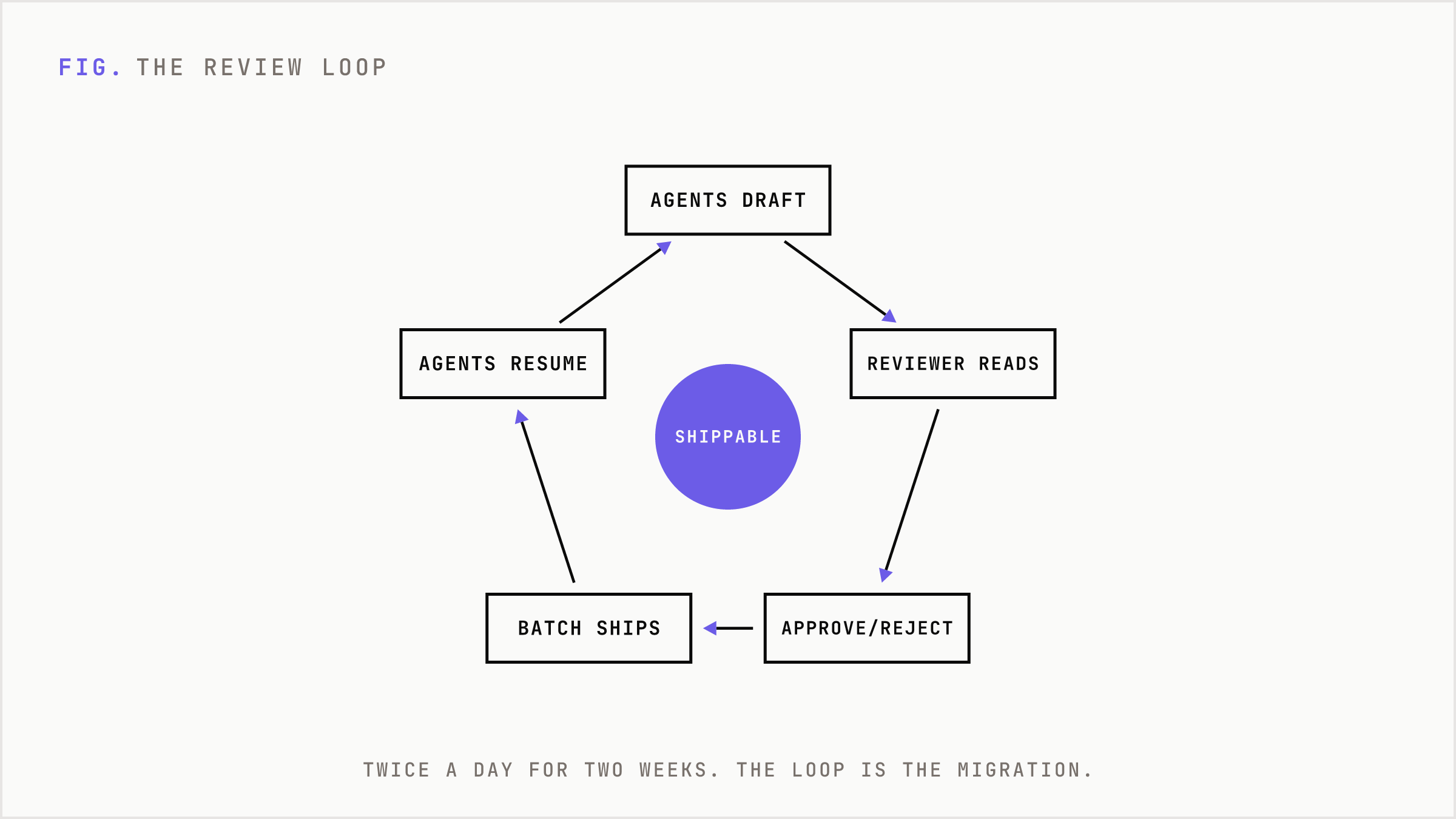
Zoom in on the two weeks. Twice a day, morning and afternoon, the engineer opens the batch of changes the four agents produced overnight and through the day. He reads them. He accepts the ones that read correctly for this codebase, this migration, this business. He rewrites the ones that read plausibly and diverge on some specific edge. He rejects the ones that would introduce a defect the tests would silently pass. The pass through the batch is the mechanism. The prompt is short precisely because the batch is where the work happens.
The five-sentence prompt is a bounded instruction. The models read it, produce plausible code, and stay inside the sandbox. Every change that reached Asana's main branch went through a human hand first. Every change that reached the deployed system went through the same hand, twice a day, ten working days, two weeks. The system's throughput was set by that hand's read speed and judgment, and Codex kept that hand fed with parallel drafts to review.
The reviewer's job at the desk
The batches Codex produced were fluent. They compiled. They matched the surface style of the surrounding code. Every batch also contained a subset of changes whose plausibility was carrying a defect: a subtle type mismatch that the test suite would silently pass, an implicit invariant broken by a rename that looked cosmetic, a migration step written against a schema the codebase had already outgrown. The engineer's job was to read for those defects and stop them at the review desk. Twice a day for two weeks, that read is the migration.
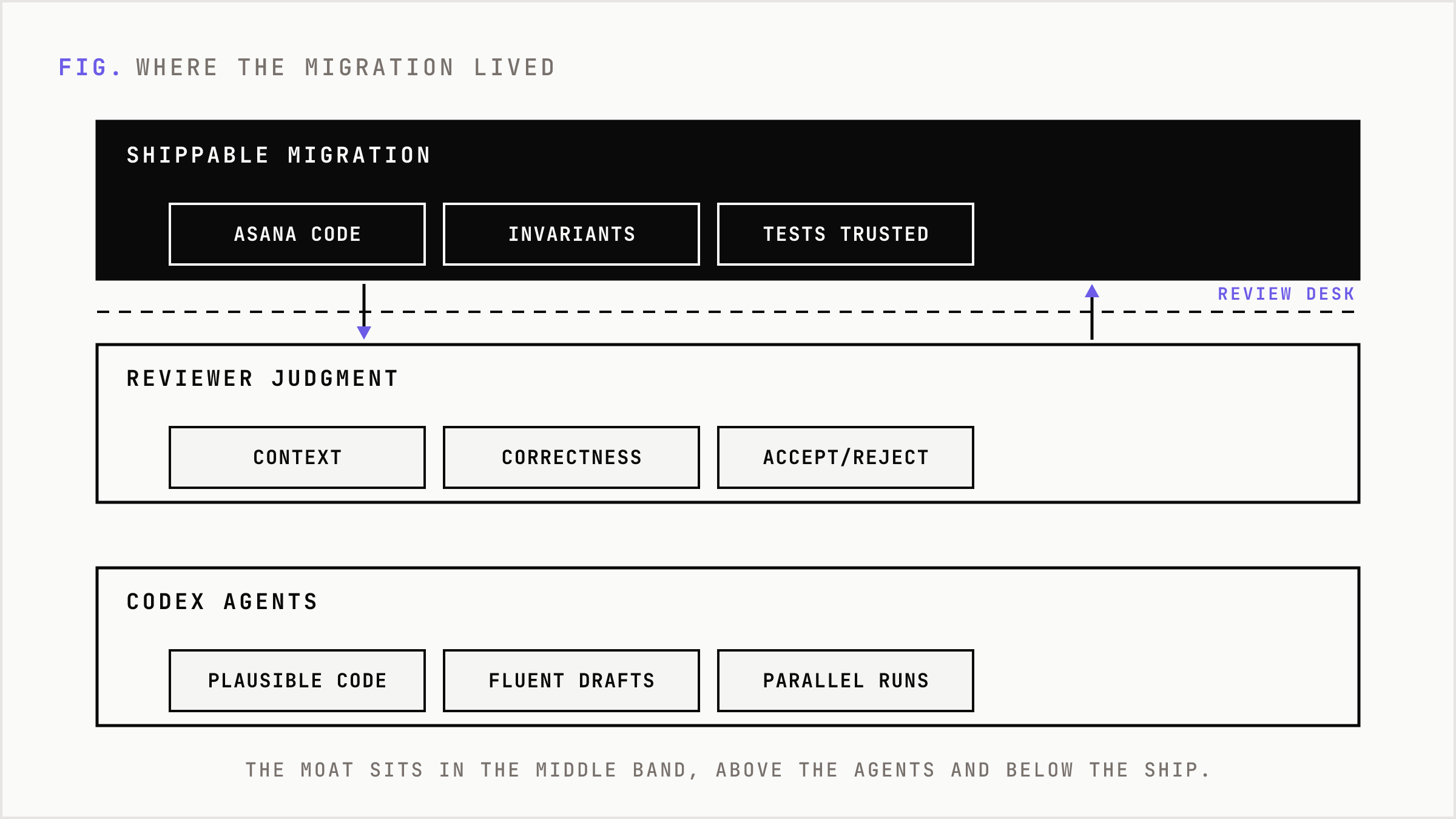
What allowed the read to work was context that lived in one person's head. What correct meant in Asana's codebase, at that moment, for that particular migration, is a specific set of facts: which service owns which invariant, which test suite is decorative and which is load-bearing, which pattern the team standardized on three quarters ago and which one is legacy that shipped in a hurry. The models on the market read the code the way a fluent reader reads any text, and the context the reviewer supplied every time comes from a different source: the codebase's history, the team's operating memory, the migration's specific end-state.
Why the model gets less credit than it looks
The model layer commoditizes on a public curve. Every enterprise customer of every frontier lab is riding the same rising capability at the same time, more or less, and the price of plausible code drops another notch each quarter. A capability that every engineering team on earth can rent by the API call is priced by the market at exactly what it takes to serve one API call, and every team that competes on that layer converges to that price. Whatever moat sat there yesterday erodes on a schedule the whole industry publishes together.
The reviewer's judgment sits above that curve. It lives in a specific business's context, and that context refuses to commoditize because every business's context is a different object. Asana's reviewer knew Asana's codebase. He knew which of the four agents to trust on which class of change. He knew the migration's end-state well enough to see a plausible-looking change that walked in the wrong direction. Trying to hire the same engineer for Datadog's migration would leave you with the same person, a completely fresh context, and a different two weeks.
That is the layer OpenAI's twelve-thousand-dollar number quietly leaves out. The models generated the drafts, and the drafts were shippable because a human read them and made calls that require a specific business's context to reproduce reliably. Credit for the collapse belongs to that judgment layer first, and to the model layer as a fast, cheap, willing draft generator second.
What happens when the reviewer is cut
Read the case study and the seductive move is to run the same setup with two agents supervising each other. Cheaper. Faster. The desk stays empty. The trouble is that agent-supervising-agent supervision inherits its correctness definition from the same public model curve every other team is riding. The model can catch mistakes it recognizes because it has seen them a thousand times in training. It struggles to catch mistakes that live inside a specific business's context.
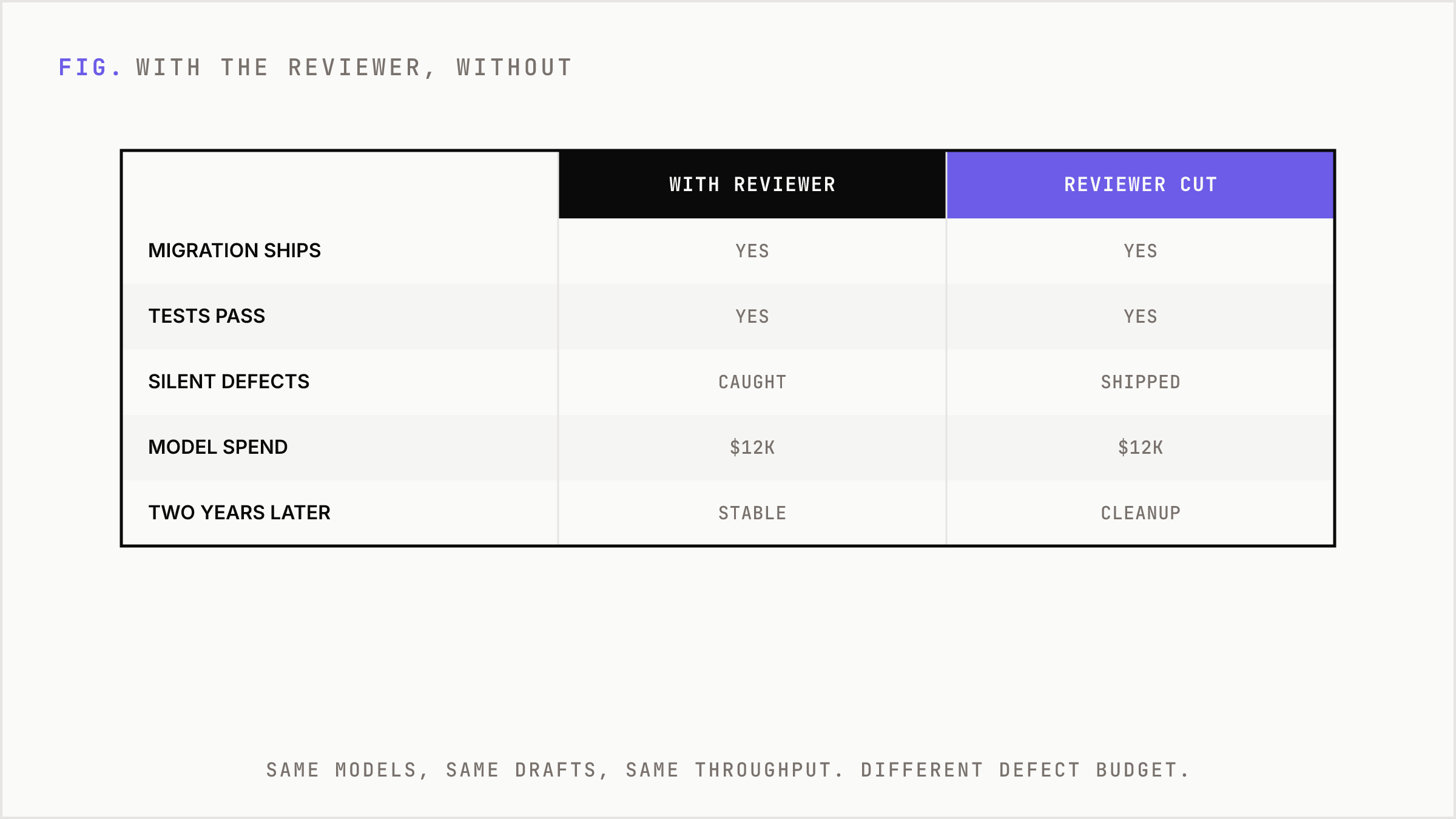
Run the same two-week migration and leave the review desk empty, and the throughput number stays impressive. The migration ships. The tests pass. The staging environment looks green. Six months later, the invariants that got broken start surfacing as customer bugs, and the team spends three quarters cleaning up defects the review desk would have caught in an afternoon. The savings against the reviewer's salary become a rounding error against the incident response cost.
The failure mode is a common one in AI adoption right now. Teams read a case study, subtract the human it depends on, and greenlight the migration on a projected cost that ignores the layer the original team was leaning on. The projected cost lands. The rented capability does the work it always did. The judgment layer is the seat that stayed empty, and the defects it would have caught keep shipping through.
What to budget instead
Any engineering leader running the same play this quarter has one line to fill first. Name the single person whose judgment defines correct in this codebase, right now, for the migration in front of them. The role belongs to a single engineer with enough context to make each call, and the seniority to reject changes the pipeline wants to push through.
Budget the reviewer's time as the largest line item on the migration. The Codex spend is the rounding error. Two weeks of one senior engineer's judgment, at whatever fully loaded rate a specific business runs, is the real cost of the twelve-thousand-dollar number, and the migration succeeds because that cost was paid. The teams pricing the model spend at the center of their business case and the reviewer at the periphery have the inputs to their model transposed.
Read the case study one more time with the reviewer named on every page. The story shifts. Twelve thousand dollars is still real, and it is also rented from a single engineer whose two weeks are worth several multiples of that. The teams that will replicate Asana's result this quarter are the ones that write the reviewer's name onto the budget line before they choose the model, and the ones that will spend the next three quarters cleaning up defects are the ones that read the case study as permission to remove that name.