Nyyon · Blog
AI Without the Slop: A CMO’s Guide to White Glove Marketing Systems
A practical CMO guide to white glove AI marketing systems, covering brand memory, workflow design, governance, GEO visibility, and measurable growth.
AI marketing is not a tool category. It is a managed operating model for producing market learning faster without damaging trust.
That distinction matters because most companies are buying the wrong thing.
They buy a writing tool and expect a content engine. They buy a chatbot and expect personalization. They buy a prompt library and expect strategy. Then the output gets louder, cheaper, and worse. The brand starts sounding like everyone else. Legal gets nervous. Sales ignores the assets. The CMO is left with more files, more approvals, and no clearer path to revenue.
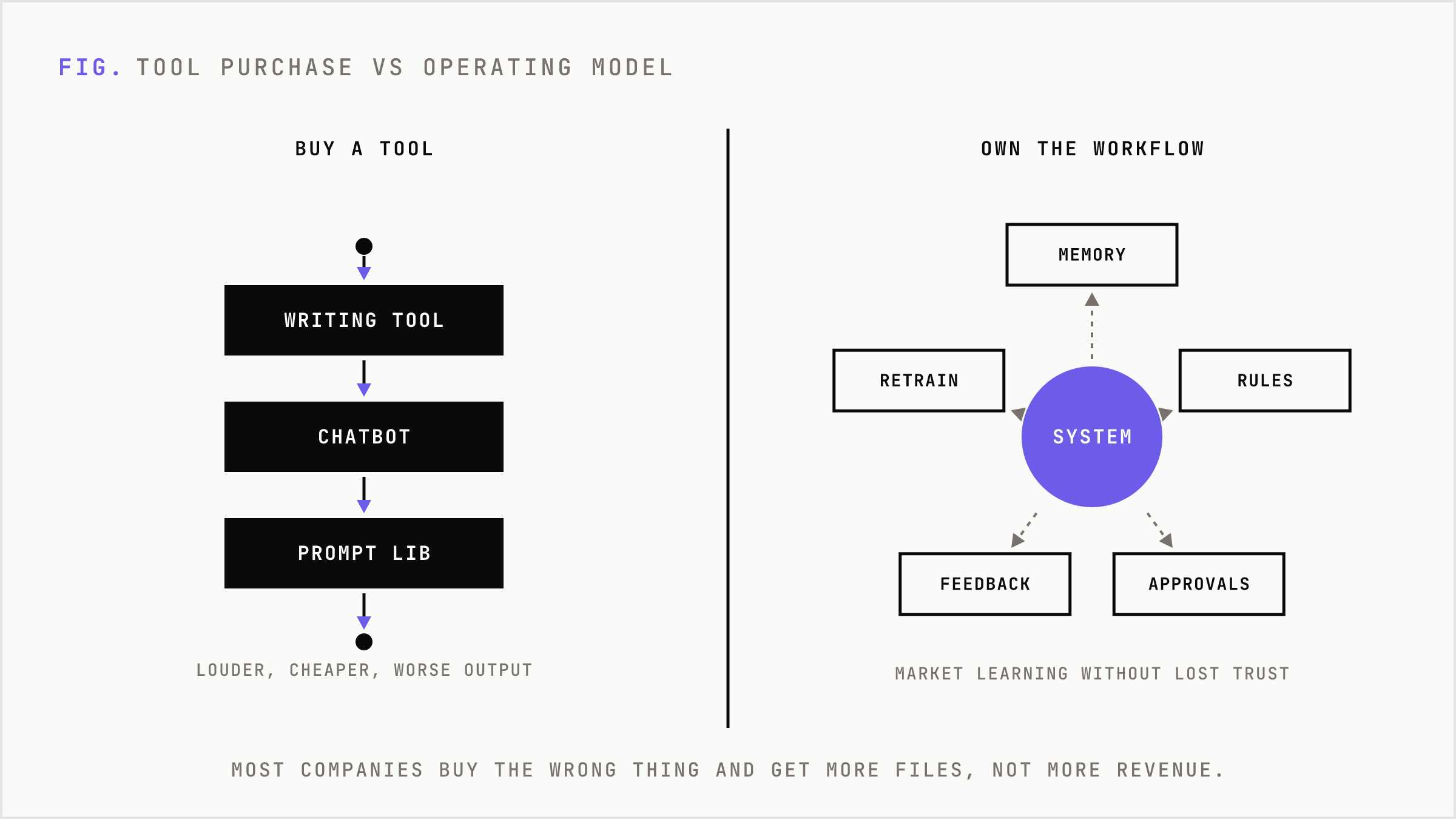
This is the gap white glove AI marketing is moving into.
Not because executives want more agency mystique. They do not. They want lower cost, faster cycles, better conversion, more tests, cleaner attribution, and less dependency on headcount. But they also know the fastest way to destroy a premium brand is to automate judgment before defining taste.
The market has adopted AI. It has not operationalized it.
The surface data looks aggressive. McKinsey has reported that a large majority of surveyed organizations regularly use generative AI in at least one business function, with marketing and sales among the common use cases. The CMO Survey showed generative AI use in marketing activity rising sharply from 2024 to 2025. Gartner has reported that many CMOs are already seeing ROI from AI through time efficiency, cost efficiency, and expanded content capacity.
That is adoption. It is not maturity.
The same market is full of evidence that AI remains shallow inside real workflows. Gartner has found that more than a quarter of CMOs reported limited or no GenAI adoption in marketing campaigns. IAB research has shown that most agencies, brands, and publishers are not fully integrating AI across planning, activation, and analysis.
The problem is not access. Everyone has access.
The problem is operating depth.
Marketing teams can generate headlines, product blurbs, email drafts, and ad variants. That is easy. What they struggle to build is the system around the generation: inputs, decision rules, memory, approvals, data permissions, claims control, experiment design, publishing flows, performance feedback, and retraining.
AI is cheap at the task level. It is expensive at the workflow level if nobody owns the workflow.
The budget line is changing
CMOs are under pressure. Gartner’s 2025 CMO Spend Survey put average marketing budgets at 7.7 percent of company revenue, effectively flat, while a majority of CMOs said they lacked enough budget to execute their strategy.
That creates a clear substitution dynamic.
AI does not simply replace copywriters, designers, analysts, or media planners. It attacks the unit economics of repeatable production. Translation, resizing, first drafts, research summaries, localization, versioning, campaign briefs, audience variants, sales enablement, reporting narratives. These are not trivial jobs, but they are full of structured repetition.
Klarna made the substitution visible. The company reported cutting sales and marketing spend by 11 percent in Q1 2024 while increasing campaign activity and refreshing collateral more often. It also reported a 25 percent reduction in external marketing supplier spend across areas like translation, production, CRM, and social agencies.
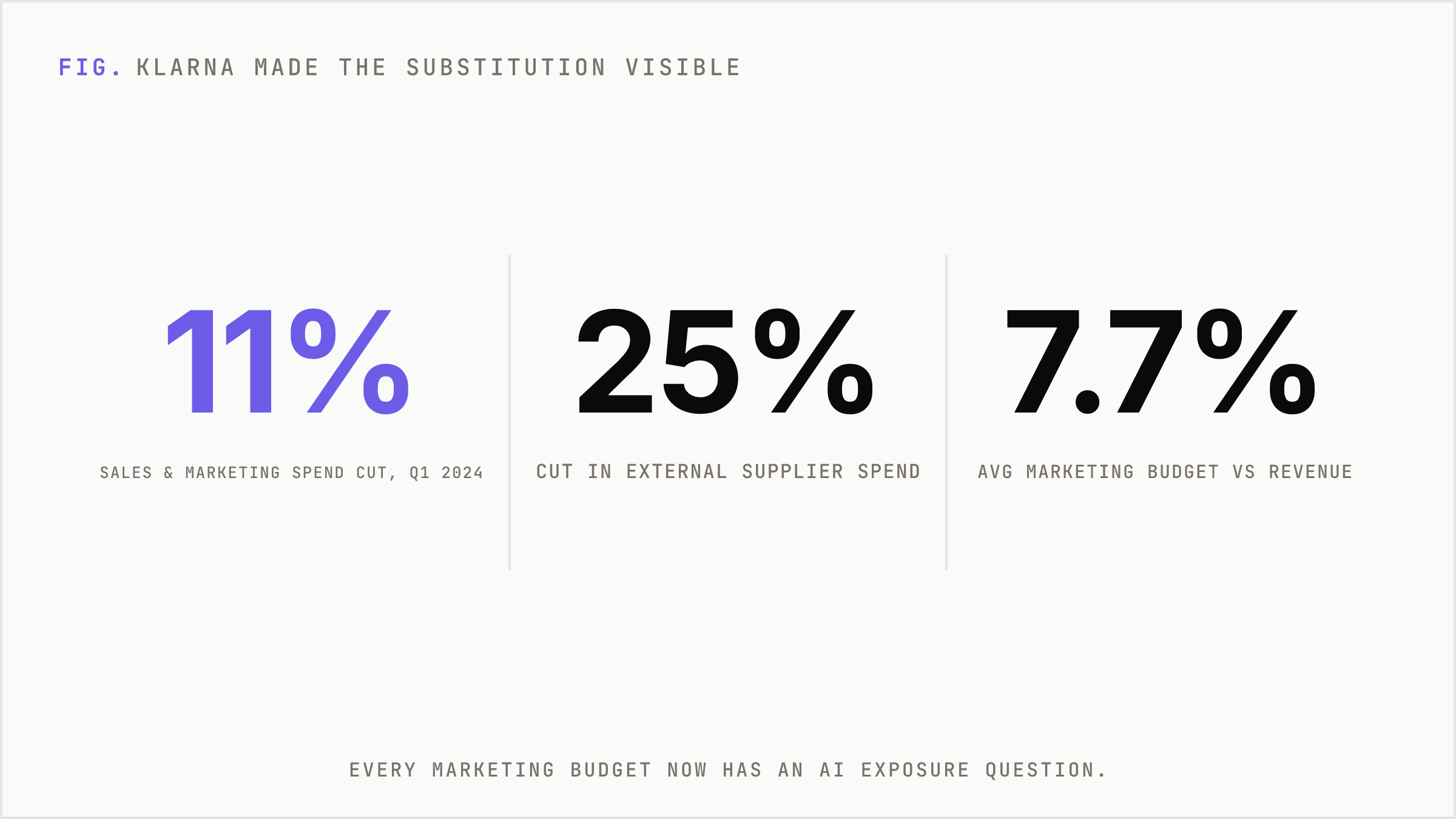
That does not mean every company should fire its vendors. It means every marketing budget now has an AI exposure question.
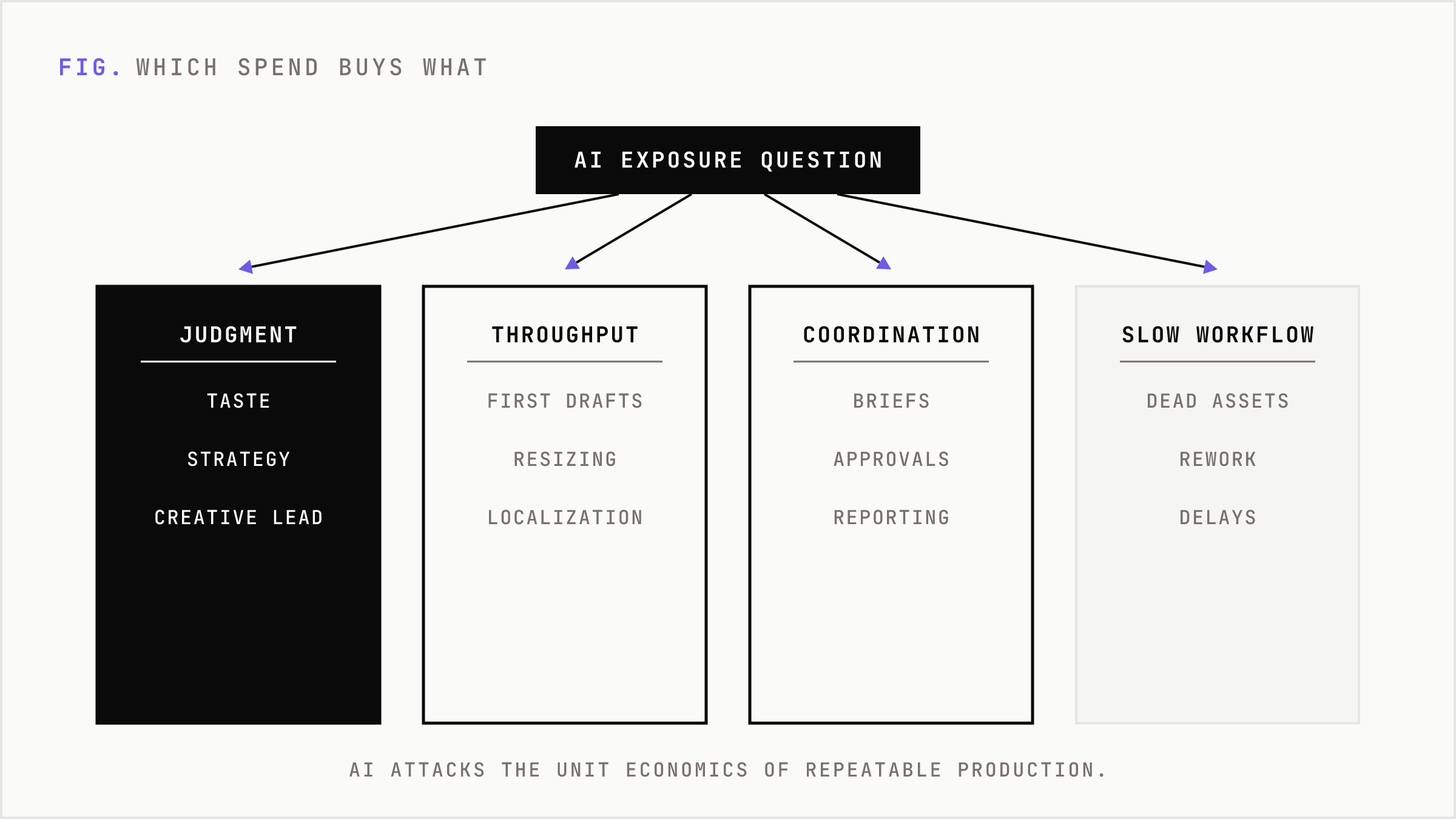
Which spend buys judgment?
Which spend buys throughput?
Which spend buys coordination?
Which spend exists only because the current workflow is slow?
The strongest AI-native providers will not sell labor replacement as the core promise. They will sell marketing cycle compression. Less time from insight to test. Less cost from idea to asset. More feedback per dollar. Fewer dead assets created without a market signal.
The agency model is being rebuilt from the inside
The holding companies see the shift.
WPP Open is not positioned as a clever prompt wrapper. It is an agentic marketing platform for planning, media, production, commerce, and operations. WPP has cited pilots where teams saved hours each week and campaign development cycles compressed dramatically. WPP Open Pro extends that logic downmarket, giving smaller businesses access to AI-powered planning, content creation, and media execution.
Omnicom’s Omni frames the advantage differently: identity, media buying power, creative intelligence, commerce signals, and agentic orchestration. Publicis has integrated Adobe Firefly into CoreAI, with emphasis on commercially safe generation and personalized content at scale. Dentsu is adding AI agents across planning, content, chat, customer data structuring, and marketing hub workflows.
The pattern is obvious.
Big agencies are turning service IP into operating systems.
Consultancies are doing the same from the transformation side. Accenture Song has worked on generative AI powered creative and content studios, including programs using Adobe Firefly. Mondelez reportedly built a generative AI marketing tool with Publicis and Accenture, with an expected production cost reduction of 30 to 50 percent and a reported investment above $40 million.
This is not a software story alone. It is a workflow ownership story.
The buyer is not asking, “Which model writes better copy?”
The buyer is asking, “Who can redesign how our marketing organization produces, approves, tests, learns, and scales?”
AI slop is a workflow failure
Bad AI marketing usually gets blamed on the model. That is too convenient.
Most AI slop comes from missing infrastructure.
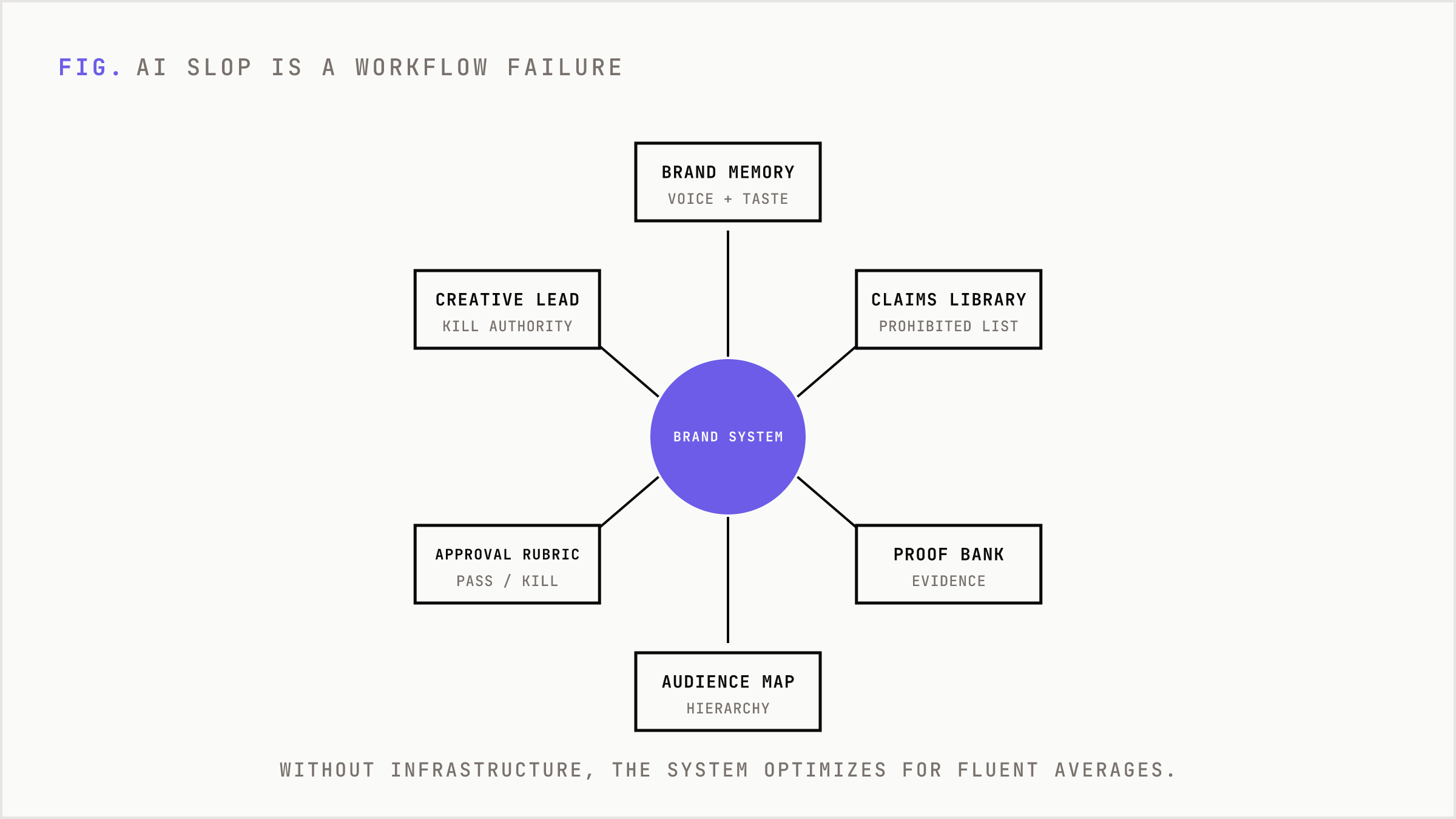
No brand memory. No claims library. No prohibited claims. No audience hierarchy. No proof bank. No competitive contrast map. No approval rubric. No clear distinction between internal ideation and production-ready output. No human creative lead with authority to kill weak work.
The result is predictable. The system optimizes for fluent averages. It generates content that sounds plausible, safe, and dead. It fills space. It does not create preference.
Coca-Cola’s AI-generated holiday ads drew backlash because audiences perceived them as cheap, uncanny, and emotionally thin. McDonald’s Netherlands halted an AI-generated holiday campaign after criticism around blandness, poor editing, and the replacement of human actors. These are not arguments against AI. They are arguments against using AI where craft, memory, and emotional context have not been codified.
The lesson is simple: speed without taste creates brand debt.
White glove AI marketing exists because companies want leverage without that debt.
What white glove actually means
White glove does not mean expensive meetings and polished decks.
It means someone owns the messy middle between a model and a business outcome.
At minimum, that includes workflow mapping, data readiness, brand system design, prompt and system design, content operations, tool integration, human review, governance, measurement, and iteration. The provider is not just making assets. It is building the operating memory layer that generic tools lack.
A serious AI marketing system has several layers.
First, the brand brain. This is the structured memory of the business: voice, positioning, offers, proof, objections, customer segments, visual rules, legal constraints, approved claims, banned claims, competitor comparisons, and examples of good and bad work.
Second, the content supply chain. This maps the flow from research to brief, concept, asset production, localization, QA, approval, publishing, measurement, and refresh. Adobe GenStudio’s work with Lumen is a useful example of the category. Lumen reported reducing B2B campaign launch time from 25 days to 9 days using Adobe’s generative AI content capabilities.
Third, the experimentation engine. AI can generate 50 to 200 angles quickly. Humans should filter them down to the 10 or 20 worth testing. Then the team tests across paid social, search, email, landing pages, or outbound. The winning signal gets polished, reshot, expanded, or localized. The loser is discarded cheaply.
Fourth, the governance layer. This is where many AI programs fail. Marketing claims need substantiation. Testimonials and endorsements need controls. Synthetic people and synthetic reviews create risk. Regulated or adjacent categories need human thresholds. The FTC has already made clear that deceptive AI claims are an enforcement issue.
Fifth, the measurement loop. AI should be judged by cycle time, asset cost, approval cycles, error rate, conversion rate, CAC, pipeline influence, qualified meetings, and learning velocity. Not by word count.
GEO is the new visibility layer
Search is changing from a list of links to an answer layer.
Gartner predicted that traditional search engine volume would drop by 25 percent by 2026 because of AI chatbots and virtual agents. Adobe Analytics reported major growth in U.S. retail traffic from generative AI sources in 2025. SparkToro and Datos have shown how much Google activity already ends without a click to the open web.
This changes the marketing job.
SEO was about ranking pages. GEO, or generative engine optimization, is about making the brand retrievable, citeable, comparable, and recommendable inside answer engines like ChatGPT, Gemini, Perplexity, Claude, and Google AI Overviews.
The mechanics are not mystical. They are operational.
Run AI answer audits. Ask category questions across models. Track whether the brand appears. Track which competitors appear. Identify citation gaps. Build structured authority content. Create comparison pages, FAQs, use case pages, schema, expert sources, and third-party references. Monitor Reddit, forums, review sites, analyst pages, and industry lists. Measure share of AI answer, citation frequency, sentiment, AI referral traffic, branded search lift, and demo requests from AI-referred users.
For many B2B and high-consideration buyers, this will become a core channel. Not because AI chat will replace every search. Because it will influence the shortlist before the buyer ever reaches your site.
The buyer criteria are getting sharper
A serious buyer should not ask, “Do you use AI?”
That question is obsolete.
Ask how the provider maps workflows before automating them. Ask what data they need. Ask how brand memory is built and maintained. Ask where humans review output. Ask which tools and models are used. Ask how data is protected. Ask how claims are approved. Ask how performance signals feed back into the system. Ask what business KPIs the provider is accountable to.
Red flags are easy to spot.
- They talk about AI but cannot show a workflow map.
- They sell content volume as the main outcome.
- They use generic prompts instead of structured brand systems.
- They have no QA process.
- They have no claims policy.
- They cannot explain the difference between draft assets and production assets.
- They measure success only in impressions, clicks, or posts shipped.
- They claim human review is unnecessary.
The right provider sounds less like a prompt seller and more like an operating partner.
The strategic implication
AI expands the marketing market by lowering the cost of trying ideas. That sounds simple. It is not.
When testing gets cheaper, strategy changes. Teams can explore more segments, more messages, more offers, more creative angles, more landing page structures, and more account-specific plays. The bottleneck moves from production to prioritization. From writing to judgment. From asset creation to learning design.
That is why the future is not “fully automated marketing.” That phrase should make buyers nervous.
The future is managed AI infrastructure plus senior human judgment.
Premium brands, B2B companies, professional services firms, healthcare-adjacent businesses, finance-adjacent businesses, and high-ticket service providers do not need more content. They need more credible market learning per unit of spend. They need AI systems that can move fast without making the brand look careless.
The winners will build memory before output. Governance before scale. Measurement before volume. Human taste before automation.
That is white glove AI marketing.
Not AI decoration on an agency retainer.
Not a prompt shop.
Not a dashboard nobody uses.
A marketing operating system that makes the business faster, sharper, and more measurable without making it generic.
AI will keep getting cheaper. Attention will not. Trust will not. Taste will not. The companies that understand that will use AI as leverage. The companies that do not will use it as a content machine and call the damage innovation.
FAQ
What is white glove AI marketing?
White glove AI marketing is a managed operating model that combines AI tools with strategy, workflow design, brand governance, human creative direction, measurement, and ongoing optimization.
How is it different from using AI content tools?
AI content tools generate outputs. White glove AI marketing builds the system around those outputs: brand memory, approvals, data inputs, testing processes, compliance controls, and performance feedback loops.
What should CMOs look for in an AI marketing provider?
Look for workflow mapping, custom brand systems, human review, data security, claims governance, measurable KPIs, integration with your existing stack, and a clear process for turning performance data into better future work.
What is GEO in marketing?
GEO, or generative engine optimization, is the practice of improving whether AI systems like ChatGPT, Gemini, Perplexity, Claude, and Google AI Overviews mention, cite, compare, or recommend your brand.
What are the biggest risks of AI marketing?
The main risks are brand dilution, inaccurate claims, weak creative quality, data misuse, legal exposure, overproduction, and measurement theater. Most of these come from poor workflow design, not from AI itself.