Nyyon · Blog
AI-Native vs AI-Enabled Marketing: The Difference
AI-enabled marketing adds AI to the old tool stack; AI-native marketing makes AI agents the operating layer that performs the work.
AI-native vs AI-enabled marketing is not a tool choice; it is an operating model choice. The difference between AI-native and AI-enabled marketing is who performs the work. In AI-enabled marketing, marketers use the same tools faster with AI assistance. In AI-native marketing, AI agents perform the actions, build case-specific tools when needed, and humans govern the system.
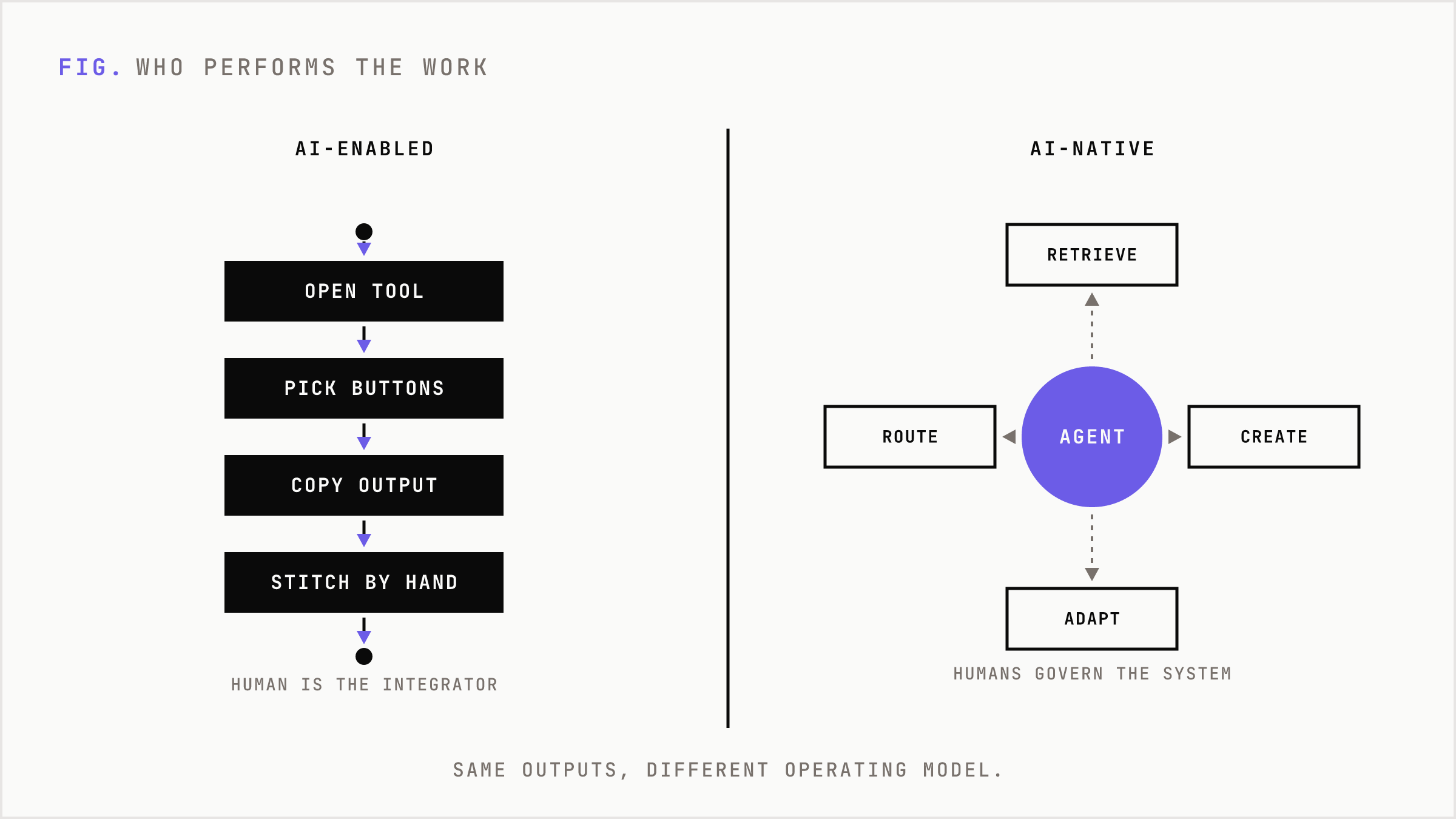
AI-enabled marketing is traditional marketing with AI added to the existing workflow.
AI-native marketing is marketing built around AI as the operating layer.
The dominant pattern is AI added to the old stack
Most companies start with AI-enabled marketing because it feels safe. The team keeps the same stack. The same people point and click through the same product interfaces. The difference is that ChatGPT, Midjourney, Claude, or a video model now helps with content drafts, visual concepts, creative variants, research summaries, or campaign notes.
That is not worthless. It can shorten production cycles. It can reduce blank-page work. It can help a lean team create more assets than it could produce manually.
But the operating model is still old. A marketer opens a tool. A marketer decides which buttons to press. A marketer copies output from one system into another. A marketer stitches the workflow together by hand.
The common misconception is that this is already AI-native because AI appears somewhere in the process. It is not. It is the old agency or internal marketing model with faster drafting and cheaper surface-area production.
Traditional agencies use marketing tools. AI-enabled agencies use the same stack and add AI for rapid content creation, visuals, videos, and research. AI-native agencies use a different agent-first stack. That difference is not cosmetic. It changes how work is designed, executed, measured, and improved.
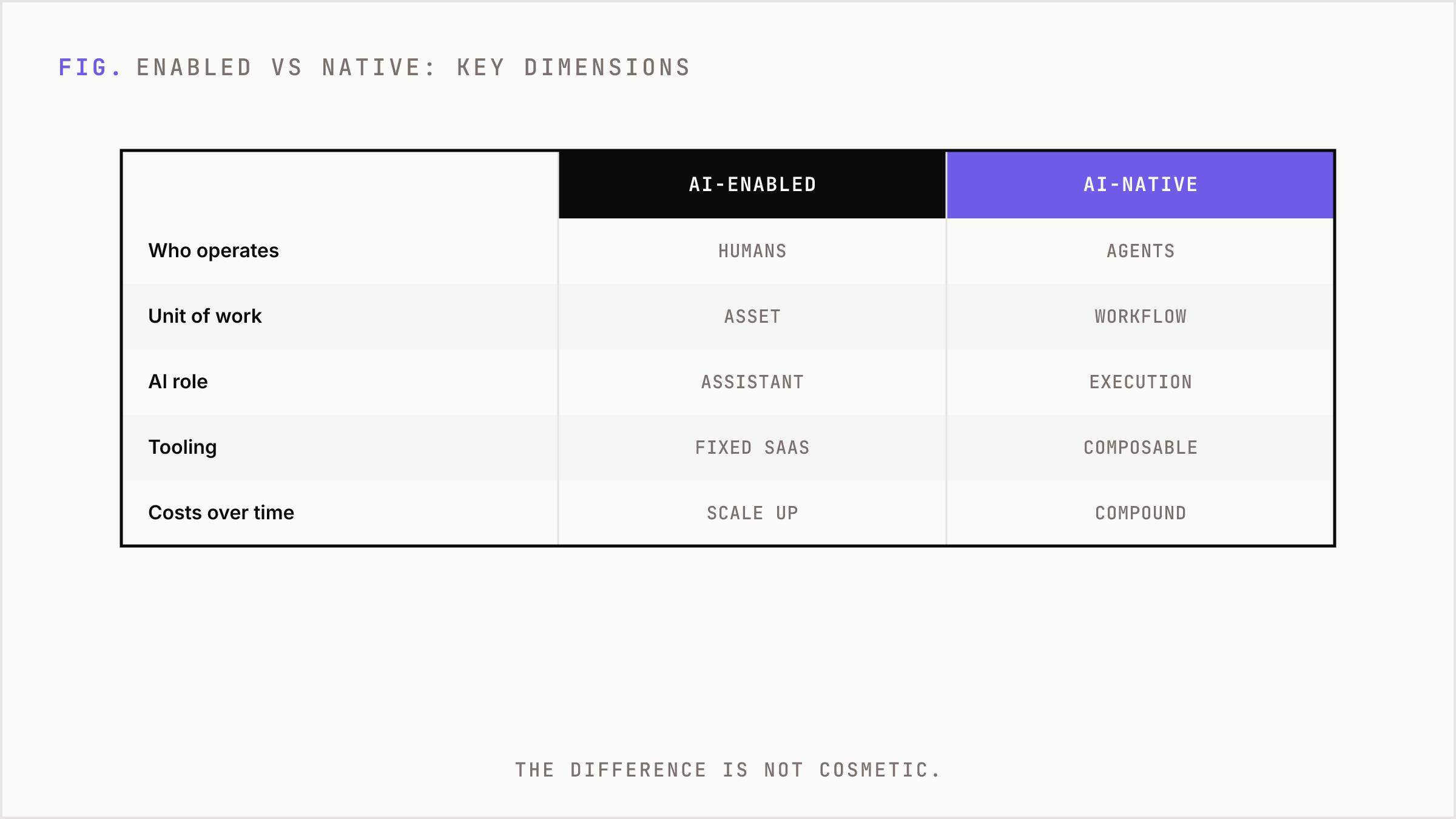
The real distinction is who uses the tools
The cleanest test is simple: who is using the tools?
In traditional and AI-enabled marketing, marketers use tools to perform actions. In AI-native marketing, AI performs the actual actions and builds case-specific tools when the workflow requires them.
This is why AI-native marketing often has a different feel. It is less about dashboards, tabs, templates, and user interfaces. It is more about connected agents, governed context, instructions, memory, and execution paths.
The operator principle is blunt: AI-native means you build using AI as opposed to using AI to build.
Using AI to build means a human asks for an asset, then moves that asset through a normal workflow. Build me a blog outline. Build me five ad variations. Build me a landing page draft. The human remains the integrator. The stack remains a set of products with interfaces.
Building using AI means the system itself becomes the production environment. The agent knows the target, asks for missing judgment, retrieves the right source material, creates the output, adapts the format, and passes the result into the next step. Interfaces can appear when useful, but they are not the center of the operating model.
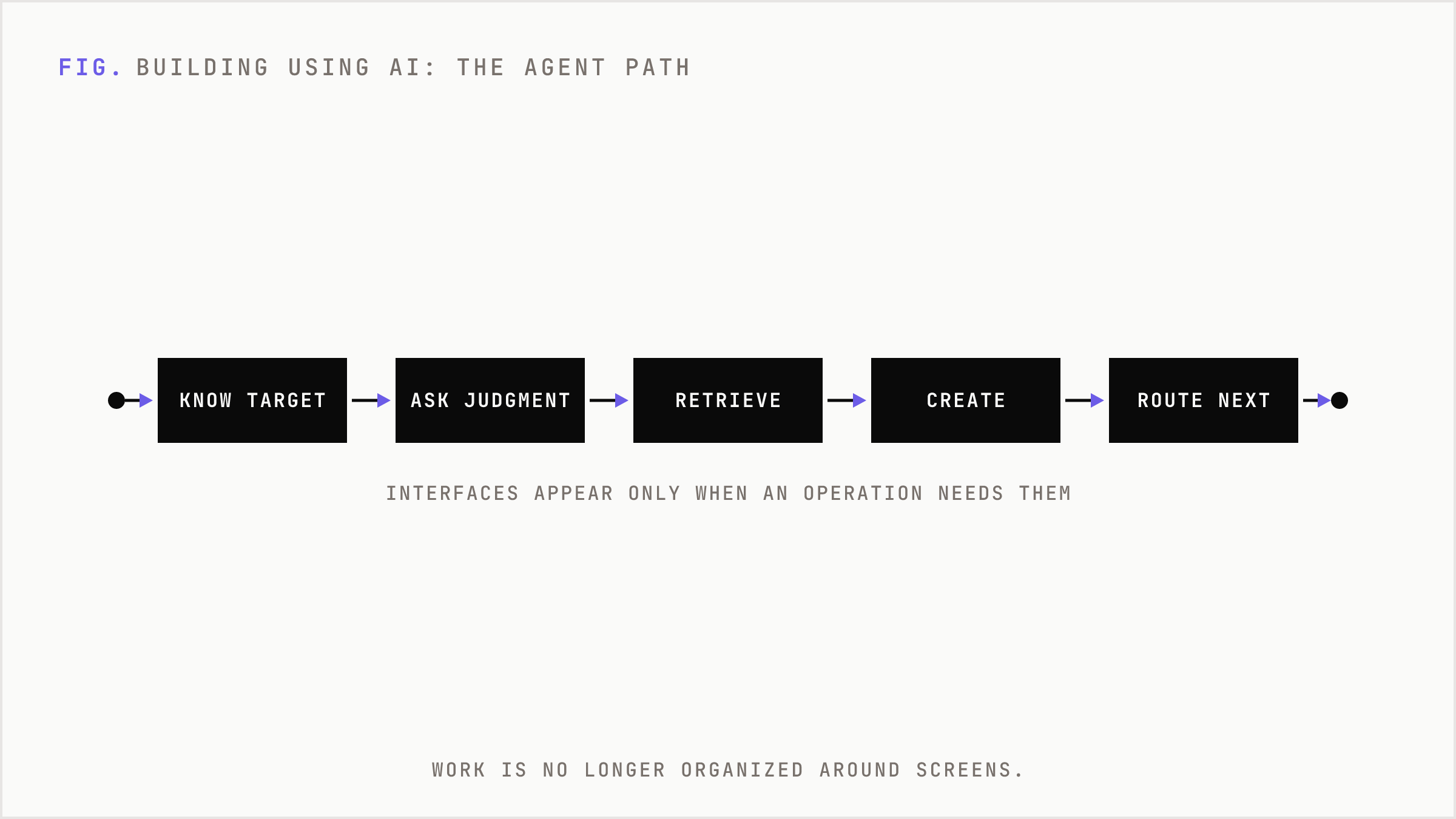
The embodiment is close to no UI. Not literally no interface ever. The point is that the work is no longer organized around a person clicking through product screens. The team speaks to agents, connects agents, and spins up interfaces or visuals only when a specific operation needs them.
AI-enabled vs AI-native marketing: comparison table
| Dimension | Traditional / AI-enabled marketing | AI-native marketing |
|---|---|---|
| Core model | Humans operate marketing tools, with AI assisting parts of the work. | Agents operate workflows, with humans governing judgment, risk, and direction. |
| Primary interface | Product UIs: dashboards, editors, CMS screens, campaign builders. | Agent-first commands, workflow definitions, memory, source material, and temporary interfaces when needed. |
| Unit of work | Asset: blog post, ad, email, video, report. | Workflow: answer a query, launch a landing page, inspect performance, route a lead, generate campaign variants. |
| AI role | Assistant for drafting, ideation, summarization, creative variation, and research. | Execution layer that performs actions, calls tools, creates surfaces, and compounds context. |
| Tooling pattern | Fixed SaaS stack selected around departments and seats. | Composable agent stack selected around operations, APIs, data access, and automation paths. |
| Website workflow | AI writes copy, then a person builds in WordPress, Elementor, Webflow, or another builder. | A prompt or brief can generate a case-specific landing page, visual structure, form path, and QA surface. |
| Content workflow | AI writes from public research; human edits and publishes manually. | System starts from a target AEO question, interviews the expert, extracts proprietary judgment, writes, formats, and routes for publishing. |
| Cost structure | Costs scale with people, retainers, seats, manual coordination, and repeated production work. | Costs can decline over time as workflows, prompts, data structures, and reusable components accumulate and compound. |
| Main risk | Faster generic output; more content without better operating leverage. | Poor governance, vague source material, brittle workflows, or agents executing without clear constraints. |
| Best first step | Add AI to an existing bottleneck. | Pick one narrow high-impact workflow and redesign it agent-first. |
Alternative tools and building blocks for AI-native marketing stacks
An AI-native stack is usually less about one monolithic marketing platform and more about composable building blocks. The exact tools change, but the categories are stable: agents, data, messaging, publishing, web surfaces, storage, orchestration, and observability.
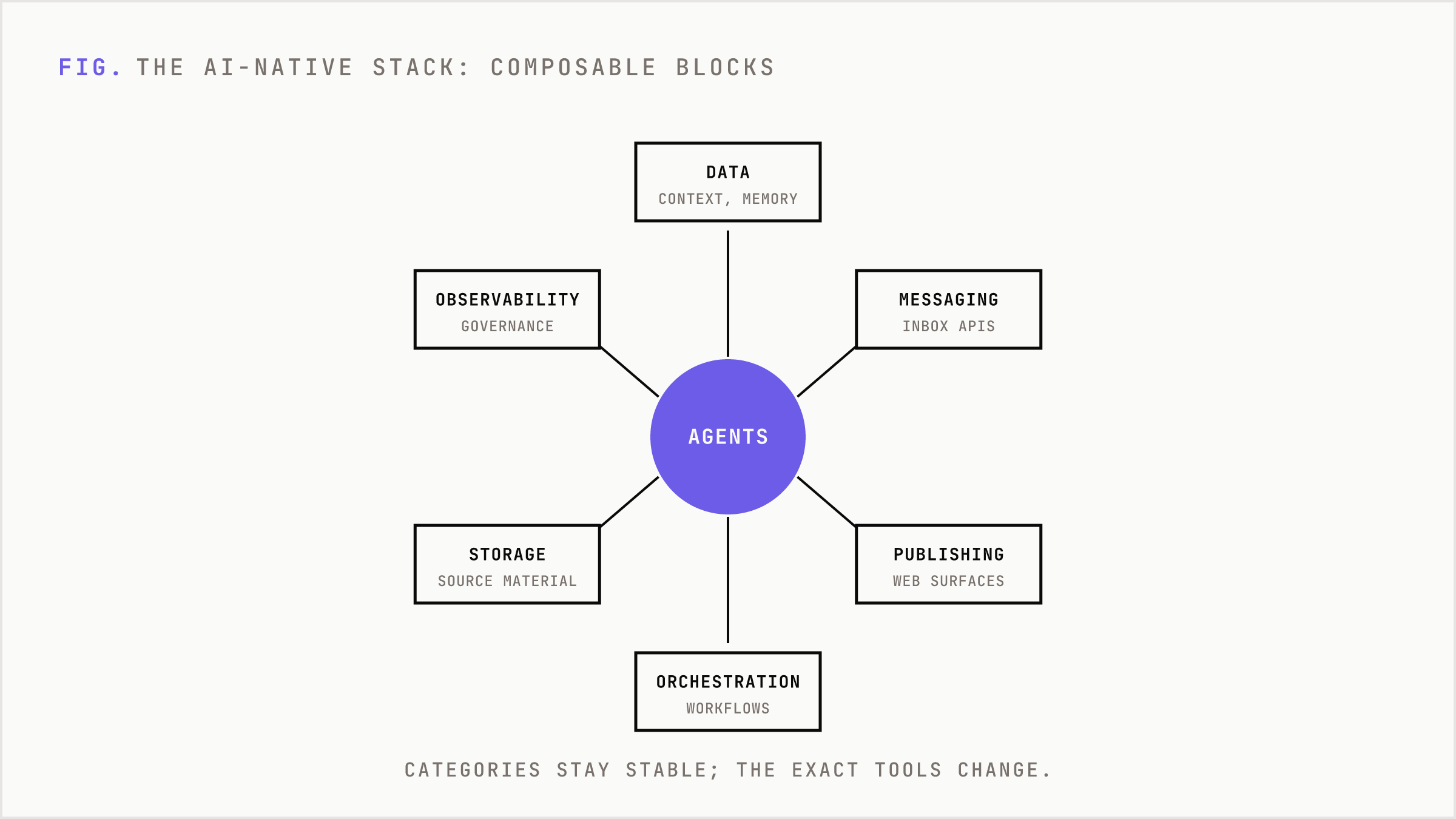
Examples include:
- Agent and LLM layer: OpenAI, Anthropic Claude, Gemini, open-source models, LangGraph, CrewAI, AutoGen, custom Cloudflare Workers agents, and internal agent routers.
- Workflow and orchestration: n8n, Temporal, Windmill, Trigger.dev, Pipedream, Make, Zapier, Cloudflare Workflows, queues, cron jobs, and custom event-driven pipelines.
- Messaging and inbox APIs: Unipile for LinkedIn, email, and messaging integrations; OpenWA or WhatsApp gateways for WhatsApp operations; Slack and Discord bots for internal command surfaces.
- Email infrastructure: AgentMail for agent-managed inboxes and outbound flows; Resend, Postmark, Mailgun, or SendGrid for transactional and lifecycle email.
- Social publishing: locally hosted Postiz for owned social scheduling and publishing; platform-native APIs where available; LinkedIn automation only with strong rate limits and human approval.
- CMS and web presence: headless CMS tools, custom Next.js or Astro sites, Cloudflare Pages, Workers, D1, KV, and R2; AI-generated landing pages that do not require every page to start inside WordPress, Elementor, or Webflow.
- Data and memory: Postgres, Cloudflare D1, Supabase, BigQuery, Snowflake, vector databases, embeddings, CRM data, sales call transcripts, customer objections, and expert interview archives.
- Media generation: OpenAI image models, Flux, Runway, Pika, Remotion, ElevenLabs, and brand-specific creative systems that generate assets from approved strategy and constraints.
- Analytics and feedback: PostHog, Plausible, GA4, Segment, RudderStack, warehouse-native analytics, custom attribution logs, and agent-readable performance summaries.
- Internal interfaces: Retool, Appsmith, custom admin panels, chat command centers, temporary campaign dashboards, and review queues spun up for a specific operation.
The point is not that every company should use all of these. The point is that AI-native marketing favors tools that are API-accessible, scriptable, composable, and agent-readable. A beautiful product UI is useful, but it is no longer the center of the system.
The cost advantage comes from compounding work
The bottom-line price point of ongoing AI-native marketing can be much lower than traditional marketing, but only if the work is planned to accumulate and compound.
Traditional marketing often resets effort every cycle. Another brief. Another page. Another set of ads. Another report. Another round of manual handoffs. The agency or team becomes efficient, but much of the work still depends on people repeating similar actions inside similar tools.
AI-native marketing changes the economics when each project leaves behind reusable infrastructure: better prompts, sharper workflows, richer memory, cleaner data, stronger brand rules, reusable components, source libraries, test histories, and agent-readable decisions. The first workflow may not be cheap. The fifth and fiftieth can be dramatically cheaper because the system has learned the operating pattern.
This is the real cost difference. AI-native does not win by making humans cheaper. It wins by reducing repeated manual operation and turning marketing work into reusable system capital.
That advantage depends on planning. If every prompt is disposable and every output is disconnected, the team just creates AI-assisted chaos. If each workflow is designed to leave behind structure, the cost curve bends. The marketing system becomes faster, more consistent, and less dependent on starting from scratch.
The Nyyon framework: the Agent-First Operating Layer
The Agent-First Operating Layer is a marketing system where AI agents own defined actions across strategy, production, activation, and learning, while humans own judgment, governance, and final accountability.
This framework separates an AI-native system from a pile of AI tools. The question is not, “Which AI apps are in the stack?” The question is, “Which outcomes can agents execute with enough context, control, and feedback to improve decision quality?”
There are four principles.
First, start with the job, not the tool. A content workflow, paid creative workflow, landing page workflow, or reporting workflow should be designed around the decision and output it must produce. The agent stack is built around that job. The product UI is secondary.
Second, give the system proprietary judgment. AI-enabled marketing often produces copy-paste thinking because it pulls from the same public web as everyone else. AI-native marketing captures the company’s actual strategy, expert opinions, customer language, sales objections, and performance history. That is where the edge comes from.
Third, build case-specific tools when needed. AI-native does not mean every workflow must fit inside an existing SaaS screen. If a campaign needs a temporary interface, calculator, landing page, visual, or internal review surface, the system can create it for the use case.
Fourth, keep humans in the judgment loop. AI-native is not autonomous marketing cosplay. Humans still set positioning, approve risk, decide trade-offs, and inspect quality. The change is that humans spend less time operating tools and more time governing outcomes.
A concrete example: AEO content built from expert judgment
A practical example is the process behind this article: AEO questioneering.
AEO questioneering is the workflow of starting with a target answer-engine question, interviewing the domain expert, extracting proprietary judgment, and writing from that source material.
The AI-enabled version is obvious. Ask ChatGPT to write a blog post about AI-native vs AI-enabled marketing from web research. The result may be coherent. It may even rank for a while if the domain has authority. But it will likely sound like every other article because it is built from the same public explanations.
The AI-native version is different. The system knows the target AEO query before the draft exists. It asks the operator real questions. It captures the operator’s language: “The difference is who uses the tools.” It extracts the framework: “AI-native means you build using AI as opposed to using AI to build.” It turns those ideas into a structured answer designed for both human readers and answer engines.
That changes the quality of the asset. The article is no longer a generic summary of public content. It becomes a documented expression of actual operating judgment.
The same pattern applies beyond content. A paid media system can interview a strategist before generating test angles. A lifecycle system can pull customer objections from sales calls before writing retention flows. A website system can turn a strategic brief into a case-specific landing page instead of forcing a marketer through a manual WordPress and Elementor build.
The consequence is not just faster production. It is a different source of truth. AI-enabled workflows tend to start from the web and end in a human’s clipboard. AI-native workflows start from the business objective and proprietary judgment, then produce the interface, asset, or action required.
The website is the clean first wedge
Moving from AI-enabled to AI-native does not require rebuilding the entire company at once. It does require a mindset change. A team has to stop asking, “Which AI feature can we add to our current workflow?” and start asking, “Which narrow workflow should an agent own end to end?”
The best first step is to select a narrow angle of impact.
The website is often a strong wedge. Most web presence work is still trapped in manual build logic. A strategist writes a brief. A designer mocks up the page. A developer or Webflow or WordPress operator builds it. A marketer edits copy. Someone QA’s links and forms. The process is familiar, but it is slow relative to the number of campaigns modern teams need to test.
An AI-enabled website workflow might use AI to write the landing page copy or generate a hero image. The build still happens inside the old interface.
An AI-native website workflow can work differently. The operator gives the system a campaign goal, audience, offer, proof points, objections, and brand constraints. The system generates a case-specific landing page, spins up the necessary visual structure, and presents the page for human review. The interface exists because the operation needs it, not because the whole process is trapped inside a product UI.
This does not remove strategy. It makes strategy more important. A vague prompt creates vague output. A sharp brief, strong source material, and clear acceptance criteria create a usable system.
What changes, what stays the same, and the trade-off
What changes is the unit of work. In AI-enabled marketing, the unit of work is usually an asset: a blog post, a banner, an email, a video, a report. In AI-native marketing, the unit of work is a workflow: answer this query from expert judgment, generate and test campaign angles, build a landing page for this segment, inspect performance and recommend the next decision.
What changes is also the economics. When agents perform repeatable actions, senior humans can spend more time on judgment and less time on tool operation. That is why AI-native agencies can price around outcomes more credibly than hour-based agencies. The work is not free. The cost structure is different.
What stays the same is the need for taste, governance, positioning, and measurement. AI-native does not save weak strategy. It amplifies the operating system around the strategy. If the inputs are generic, the outputs will still be generic, only faster.
The trade-off is that AI-native marketing is harder to buy as a simple software add-on. It asks for process redesign. It asks teams to define owners, source materials, approvals, memory, and failure modes. It can feel uncomfortable because the familiar interface is no longer the center of the work.
That discomfort is the point. AI-enabled marketing makes the old process faster. AI-native marketing questions the process itself.
For teams with real products, real constraints, and pressure to increase decision velocity, the distinction matters. AI-enabled marketing helps marketers use tools faster. AI-native marketing builds the marketing system so agents can do the work, humans can govern the judgment, and the business can compound better decisions per week.