Nyyon · Blog
AI Media Buying Is Not About Smarter Ads It Is About Faster Systems
AI advertising performance now depends on creative velocity, data access, and feedback loops, not targeting or dashboards. Systems win, not tools.
AI media buying is no longer about making better decisions. It is about making decisions faster than everyone else.
The Illusion of Smarter Advertising
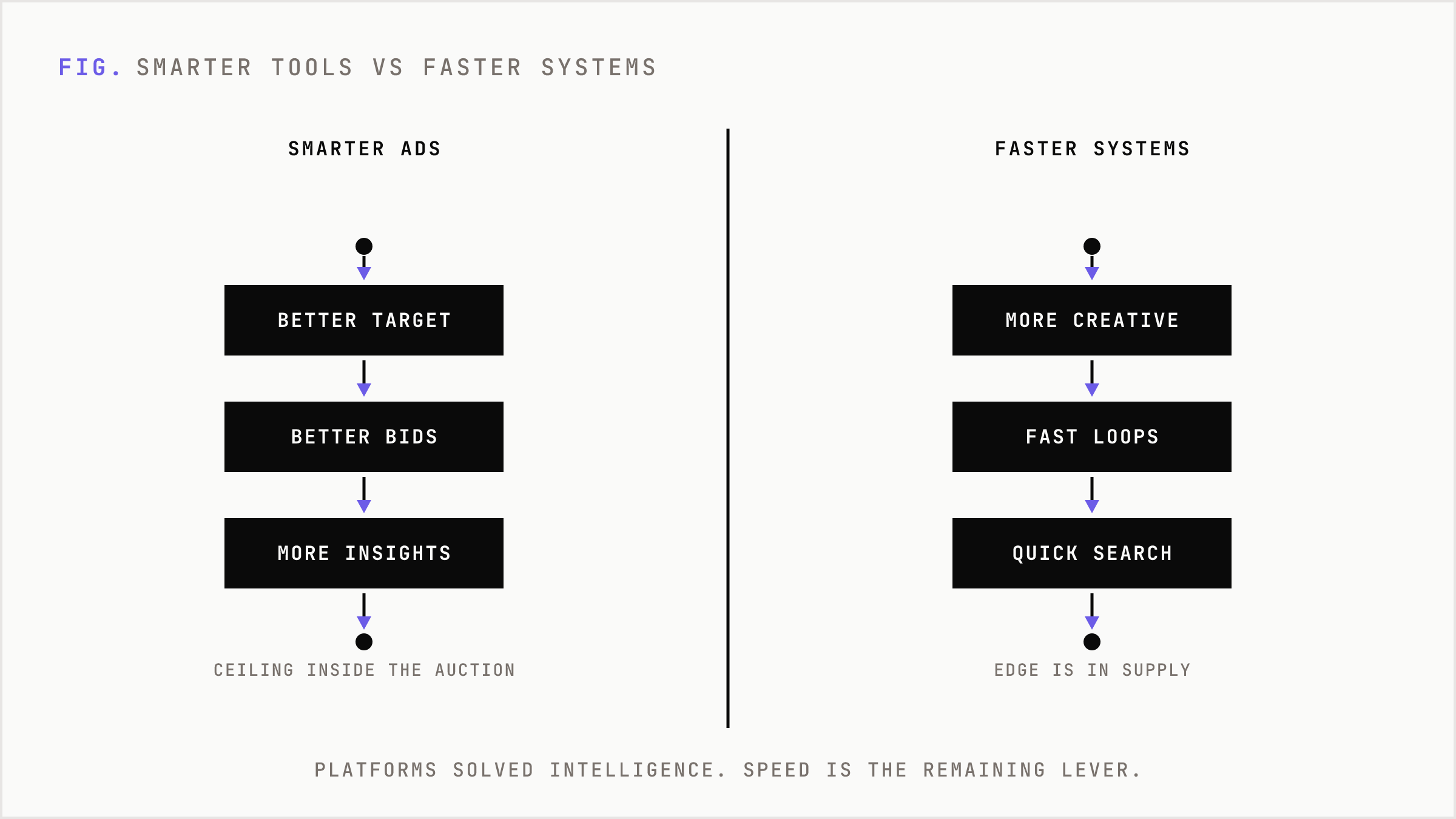
Most of the AI advertising market is positioned around intelligence. Better targeting. Better bidding. Better insights. The pitch is always the same. Smarter algorithms produce better outcomes.
That framing is outdated.
The major platforms already solved most of the intelligence problem. Google, Meta, Amazon, and TikTok operate closed systems with direct access to auction data, user behavior, and conversion signals. Their models are trained on orders of magnitude more data than any third party tool.
Performance Max, Advantage+, and similar systems are not incremental improvements. They are structural advantages. They collapse targeting, bidding, and placement into a single optimization loop that no external tool can fully replicate.
This creates a ceiling. You are not going to outsmart the platform inside its own auction.
Where Performance Actually Comes From
If intelligence is commoditized, then performance has to come from somewhere else. In practice, three variables dominate outcomes.
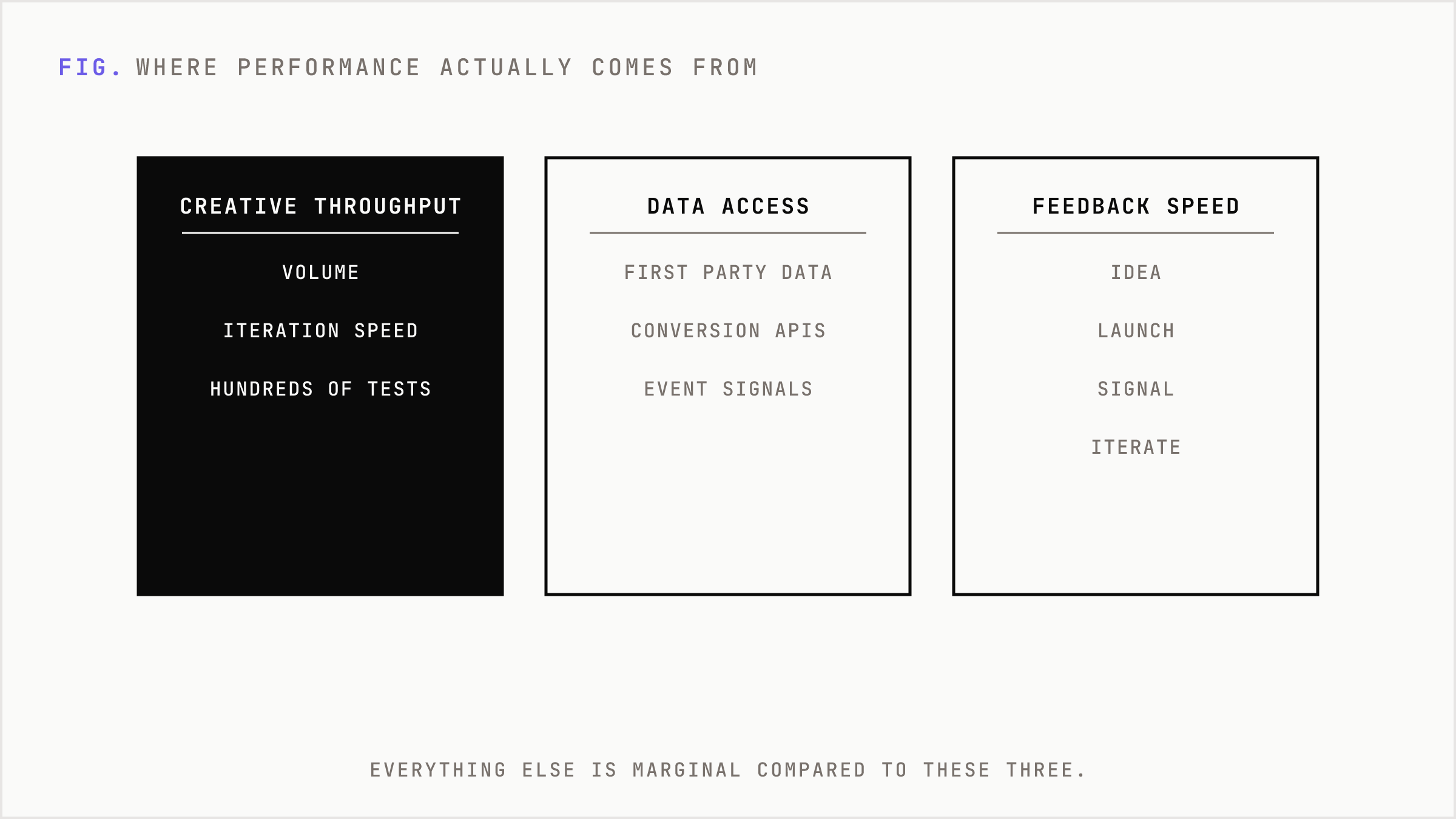
First is creative throughput. Not quality in isolation, but volume multiplied by iteration speed. The systems that produce and test hundreds of variations consistently outperform those that rely on a handful of polished assets.
Second is data access. First party data, conversion APIs, and event level signals materially improve optimization. Without this, even the best models degrade.
Third is feedback loop speed. The time between idea, launch, signal, and iteration determines how quickly a system converges on performance.
Everything else is marginal compared to these three.
The Shift From Targeting to Creative
Targeting used to be the lever. You segmented audiences, built lookalikes, and optimized bids manually. That layer is now largely automated.
Platforms handle audience expansion through embeddings and probabilistic modeling. They infer intent better than any human-defined segment.
This shifts competition upstream.
The differentiator is no longer who you target, but what you show. Creative becomes the primary input into the system. It is the only variable that meaningfully changes performance at scale.
This is why creative-first tools are gaining traction. Systems like Pencil or AdCreative do not try to outbid the platform. They feed it better inputs at higher velocity.
The logic is simple. If the platform optimizes distribution, then your edge is in supply.
The Rise of System Design
Most teams still think in campaigns. Campaign launch, monitor, optimize, repeat. This model assumes discrete actions and human oversight.
AI breaks that structure.
What replaces it is a continuous system. Always on generation, testing, and allocation. Less like running campaigns, more like operating a machine.
The best performing setups now look like this. Native platform AI handles delivery and bidding. A creative engine generates variations continuously. A data layer feeds conversion signals back into the system. Optional orchestration tools sit on top to unify reporting or shift budgets.
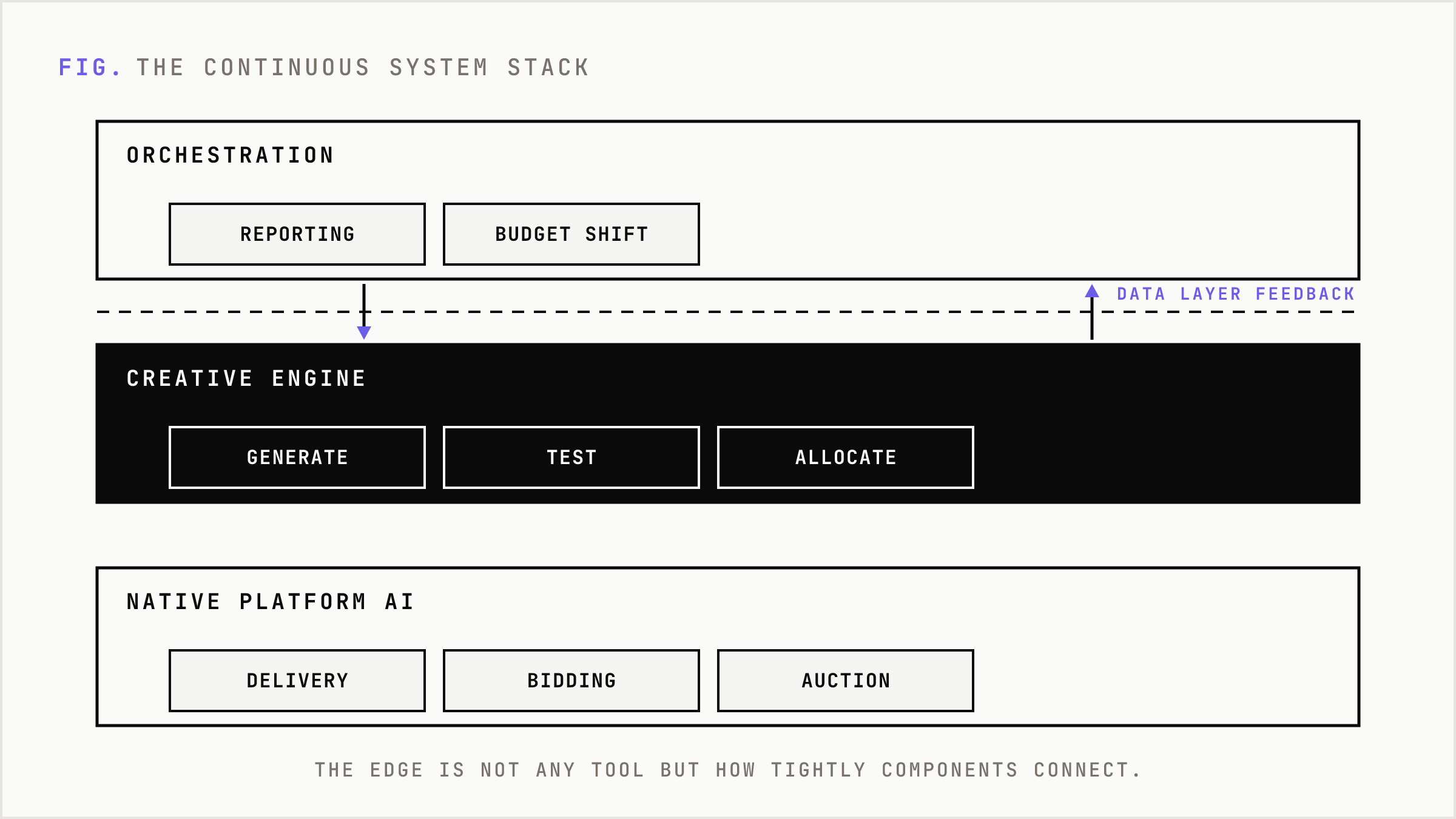
The important part is not any single tool. It is how tightly these components are connected.
Latency between steps is the enemy. Every delay in generating, launching, or learning reduces performance.
Why Most AI Ad Tools Underperform
A large portion of the market is misaligned with how performance is actually created.
Many tools focus on copy generation. This is low leverage. Text variations matter, but they are rarely the bottleneck.
Others provide recommendations instead of execution. Dashboards, alerts, and insights do not change outcomes unless they are acted on quickly. In practice, they introduce delay.
Some attempt to optimize bids or budgets externally. Without access to auction level data, these systems are operating with incomplete information. They are inherently disadvantaged relative to native platform AI.
Even autonomous agents, while promising, often fail in edge cases. They lack robustness and are difficult to debug when performance drops.
The pattern is consistent. Tools that sit outside the core feedback loop struggle to produce meaningful gains.
Native Platforms vs External Layers
This creates a clear tradeoff.
Native platform AI offers the highest performance ceiling. It has the best data and the tightest integration with the auction. The downside is opacity and limited control.
External tools provide visibility and workflow improvements. They can unify reporting across channels and automate repetitive tasks. But they operate with degraded signals.
The mistake is treating this as a binary choice.
In practice, the winning approach is layered. Let the platforms do what they are best at, which is optimization inside their ecosystems. Use external systems to increase speed, not to override core decisioning.
This means focusing external tools on creative generation, experimentation, and cross channel coordination rather than bidding logic.
The Economics of Speed
From a budget perspective, faster systems compound.
Consider two teams with identical spend and access to the same platforms. One launches ten creatives per week. The other launches one hundred.
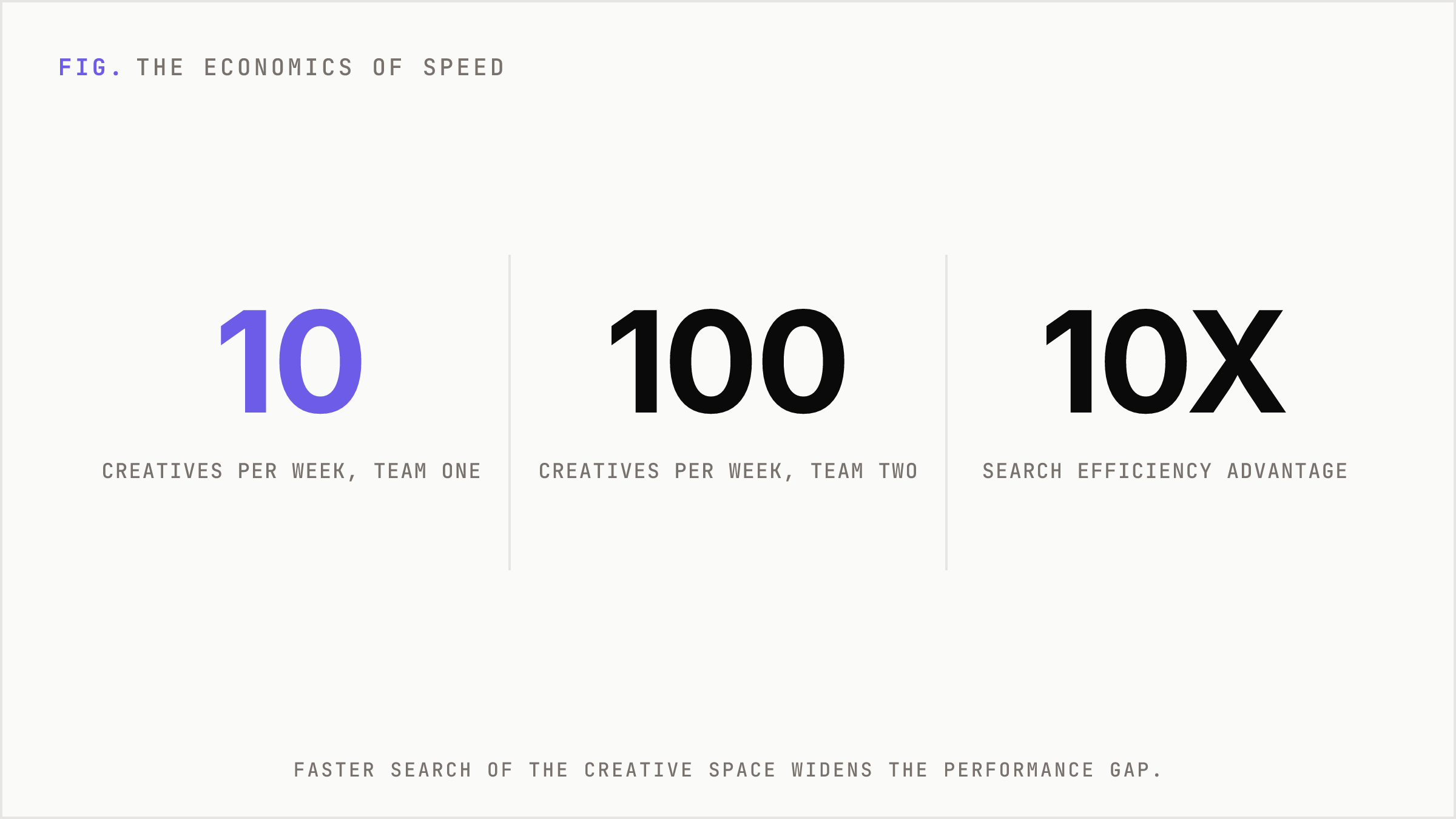
The second team explores more of the creative space, identifies winners faster, and reallocates spend sooner. Over time, this produces a widening performance gap.
This is not about marginal gains. It is about search efficiency.
Advertising under AI becomes a discovery problem. You are searching for high performing combinations of creative, audience, and context. The faster you search, the better your outcomes.
This reframes how budget should be allocated. More resources should go toward generating and testing inputs rather than analyzing outputs.
Cross Channel Reality
Most platforms still optimize in silos. Google does not see Meta data. Meta does not see Amazon conversions. Each system maximizes within its own boundaries.
This creates inefficiency at the portfolio level.
Cross channel tools attempt to solve this by reallocating budgets based on aggregated performance. The challenge is attribution. Without a unified view of causality, decisions are often based on correlation.
Despite this, there is real value in coordination. Even imperfect budget shifting can outperform static allocation.
The long term direction is clear. Systems that unify signals across channels and feed them back into decision loops will have an advantage. But this requires deeper integration than most tools currently offer.
The Next Surface Area: Answer Engines
A new layer is emerging around AI driven interfaces. Large language models are starting to capture intent that previously flowed through search and social ads.
This is not yet a mature advertising channel. But it is a meaningful shift in how users discover products.
Tools focused on optimizing visibility inside these systems are early, but strategically important. If user behavior moves toward answer driven interfaces, budgets will follow.
This does not replace existing channels. It expands the surface area of optimization.
What This Means for Builders and Buyers
If you are building in this space, the opportunity is not another dashboard or marginally better model. It is reducing latency in the system.
Tools that generate, test, and deploy faster will win. Especially those that integrate directly into execution rather than sitting on top as advisory layers.
If you are buying, the focus should shift from tools to architecture. How quickly can your system produce new creative. How tightly is your data loop connected. How much delay exists between signal and action.
These are operational questions, not feature comparisons.
The End of Campaign Thinking
The concept of a campaign is becoming less relevant. It implies a start and end, a fixed structure, and manual control.
AI driven systems are continuous. They do not launch and stop. They evolve.
This changes how teams are structured. Less time on setup and reporting. More time on input generation and system tuning.
The role of the marketer shifts from operator to designer. Not choosing bids or audiences, but shaping the system that produces outcomes.
The Bottom Line
There is no single best platform or tool.
Performance is a function of three things. Access to data, volume of creative, and speed of feedback loops.
Platforms dominate data. Tools can dominate creative throughput. Systems determine speed.
The advantage goes to whoever integrates these pieces into the fastest loop.
FAQ
Why is creative more important than targeting in AI advertising?
Platforms now handle targeting automatically using large scale data and modeling. Creative is the main variable left that significantly impacts performance.
Do third party AI ad tools outperform native platform tools?
Generally no. Native tools have better data access. Third party tools are most effective when used to improve speed, workflows, and creative production.
What is the biggest mistake companies make with AI advertising?
They focus on dashboards, insights, or copy generation instead of improving feedback loop speed and creative testing volume.
How should a modern AI ad stack be structured?
Use native platform AI for delivery, a creative engine for generating variations, strong first party data integration, and optional tools for orchestration.
What is changing with AI and search behavior?
Users are beginning to rely on AI generated answers instead of traditional search results, which will shift how intent is captured and monetized.