Nyyon · Blog
The Real ROI Engine in AI Marketing: Speed, Systems, and Strategic Control
AI marketing ROI comes from integrated systems, not tools. Learn how data, feedback loops, and strategy drive compounding performance gains.
AI does not improve marketing ROI by being smarter. It improves ROI by increasing decision speed and tightening feedback loops.
Tools Don’t Compound. Systems Do.
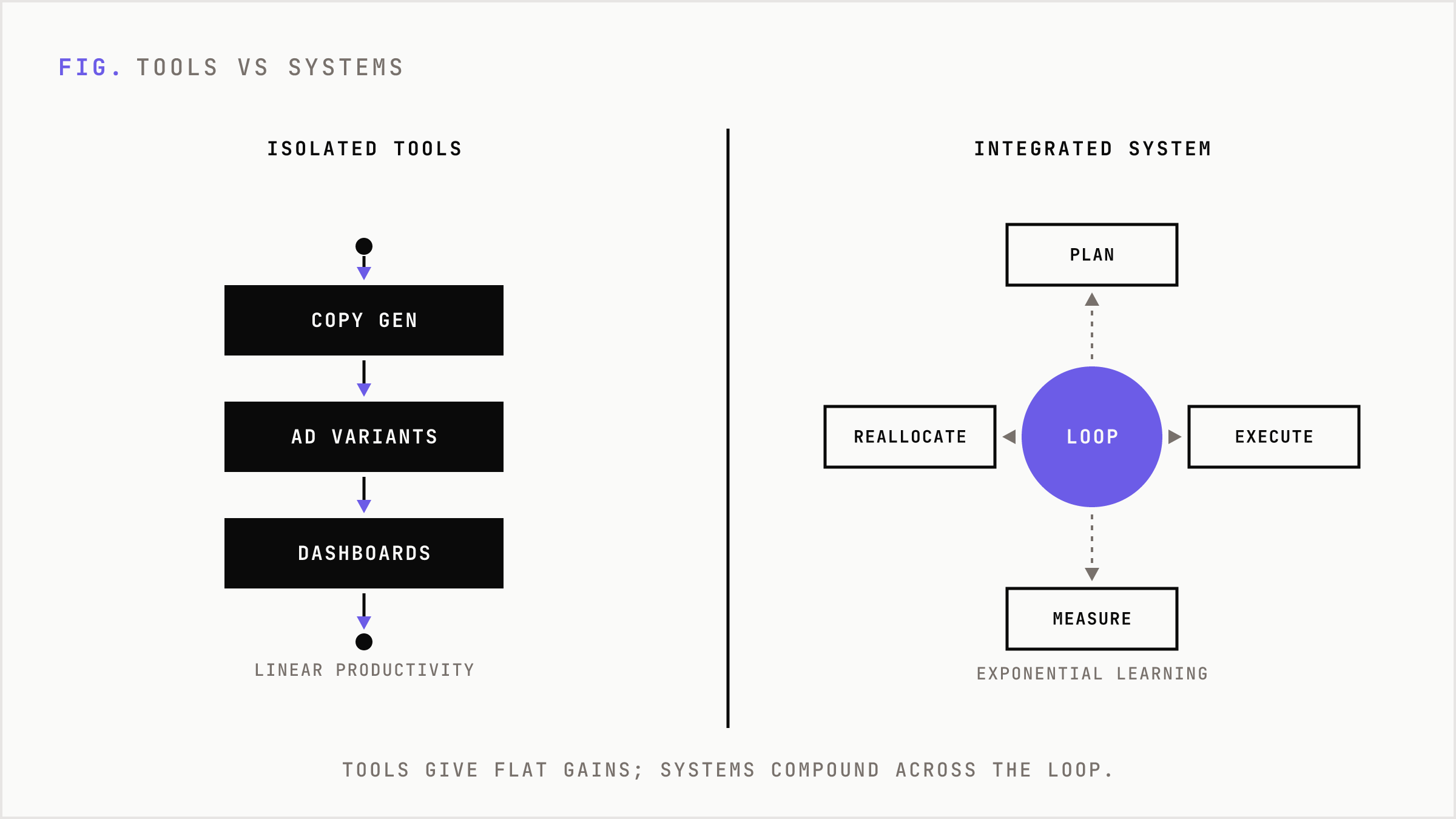
Most companies adopt AI the same way they adopted SaaS. They plug it into isolated tasks. Copy generation. Ad variations. Basic analytics. Each tool produces a small efficiency gain. None change the economics of growth.
This is why many teams report flat or marginal ROI from AI. The ceiling is built into the structure. A faster copywriter does not change how budgets are allocated. A better dashboard does not change what gets tested.
Compounding only starts when AI is embedded across the full loop. Planning, execution, measurement, and reallocation operate as a continuous system. Data flows in, decisions update, campaigns shift, and results feed back into the model.
The difference is not incremental. It is structural. One is linear productivity. The other is exponential learning.
The Feedback Loop Is the Product
The highest performing teams do not think in campaigns. They think in loops.
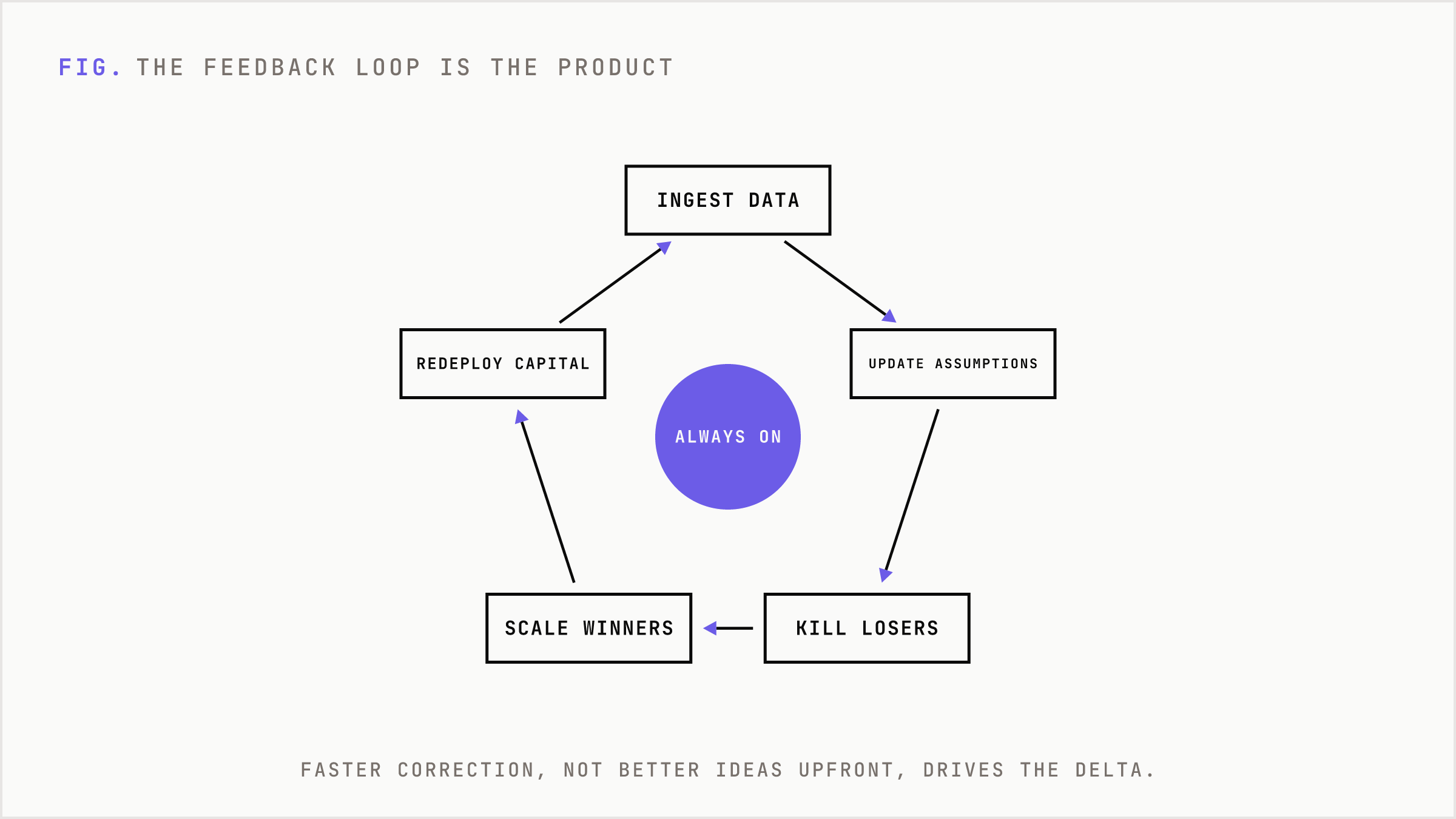
A campaign has a start and end. A loop is always on. It ingests performance data, updates assumptions, and redeploys capital continuously.
For example, a consumer subscription brand running paid social typically tests fewer than ten creative variants per cycle. The cycle might take two weeks. Results are reviewed. Budgets are adjusted manually.
Now compare that to an AI integrated system. Hundreds of creative variants are generated, deployed, and tested in parallel. Performance signals are captured daily. Underperforming assets are killed automatically. Budget shifts toward emerging winners within hours.
The gain is not better ideas upfront. It is faster correction. Losses are cut earlier. Winners are scaled sooner. The delta accumulates.
Where the Real ROI Shows Up
Across teams that have operationalized AI, a pattern emerges. ROI concentrates in a few high frequency domains.
Creative testing is the most obvious. Moving from ten variants to hundreds changes the probability distribution of outcomes. You do not need better instincts if you can search a larger space faster.
Predictive segmentation is next. Instead of broad audience buckets, models score users based on conversion likelihood, lifetime value, or churn risk. Spend is no longer evenly distributed. It is targeted toward expected return.
Budget allocation becomes dynamic rather than planned. Instead of fixed channel budgets, systems shift spend across channels based on real time performance signals and constraints like CAC or payback period.
Personalization closes the loop. Messaging, offers, and landing pages adapt to behavior rather than assumptions. This increases conversion rates without increasing spend.
None of these are new ideas. The difference is execution speed and integration. AI makes them continuous rather than episodic.
Architecture Beats Model Choice
There is an obsession with model quality. Which model generates better copy. Which model predicts better outcomes. This matters less than most teams think.
If your data is fragmented, your attribution is flawed, and your execution layer is manual, the best model in the world becomes advisory. It produces insights that sit in a dashboard.
High ROI systems share a simple architecture.
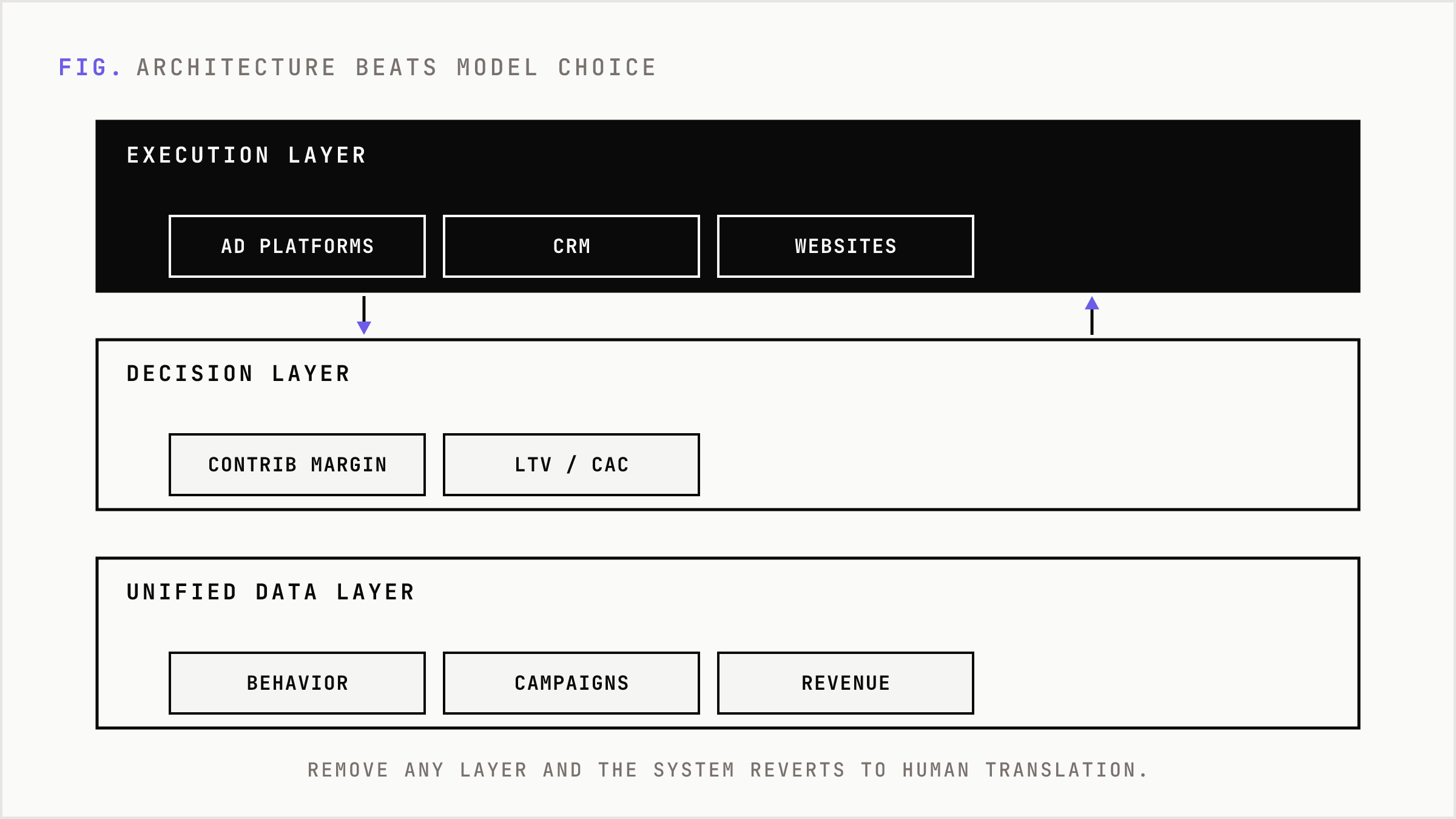
A unified data layer that connects customer behavior, campaign performance, and revenue outcomes. Usually a warehouse or CDP.
A decision layer where models are tied to actual business metrics like contribution margin or LTV to CAC ratio.
An execution layer with direct connections into ad platforms, CRM systems, and websites so decisions can be deployed automatically.
Remove any layer and the system breaks. You revert to human translation between steps. Latency increases. Learning slows.
Bad Objectives Kill Good Models
AI systems optimize whatever you tell them to optimize. This sounds obvious. It is the most common failure point.
Many teams still optimize for CTR or CPA because those metrics are easy to measure. The result is predictable. The system drives cheap clicks or low cost conversions that do not translate into profit.
A model trained on last click attribution will over invest in bottom funnel channels. Retargeting expands. Prospecting shrinks. Growth stalls while efficiency metrics look good.
The fix is not technical. It is strategic. Define the objective function in economic terms. Target CAC relative to LTV. Enforce margin floors. Set payback constraints.
Once the objective is correct, even average models produce better outcomes. When the objective is wrong, even sophisticated models create negative ROI.
Attribution Shapes Behavior More Than Algorithms
Attribution is not reporting. It is training data.
If your system believes conversions come from the last touch, it will optimize toward the last touch. If your system understands incrementality, it will allocate spend toward what actually drives lift.
This is why teams investing in geo experiments or lift studies often outperform those chasing incremental improvements in model architecture. The quality of the signal determines the direction of optimization.
Bad attribution does not just mismeasure performance. It actively trains the system to make worse decisions over time.
Human Judgment Is Still the Constraint
There is a persistent idea that AI replaces marketing strategy. In practice, the opposite is happening.
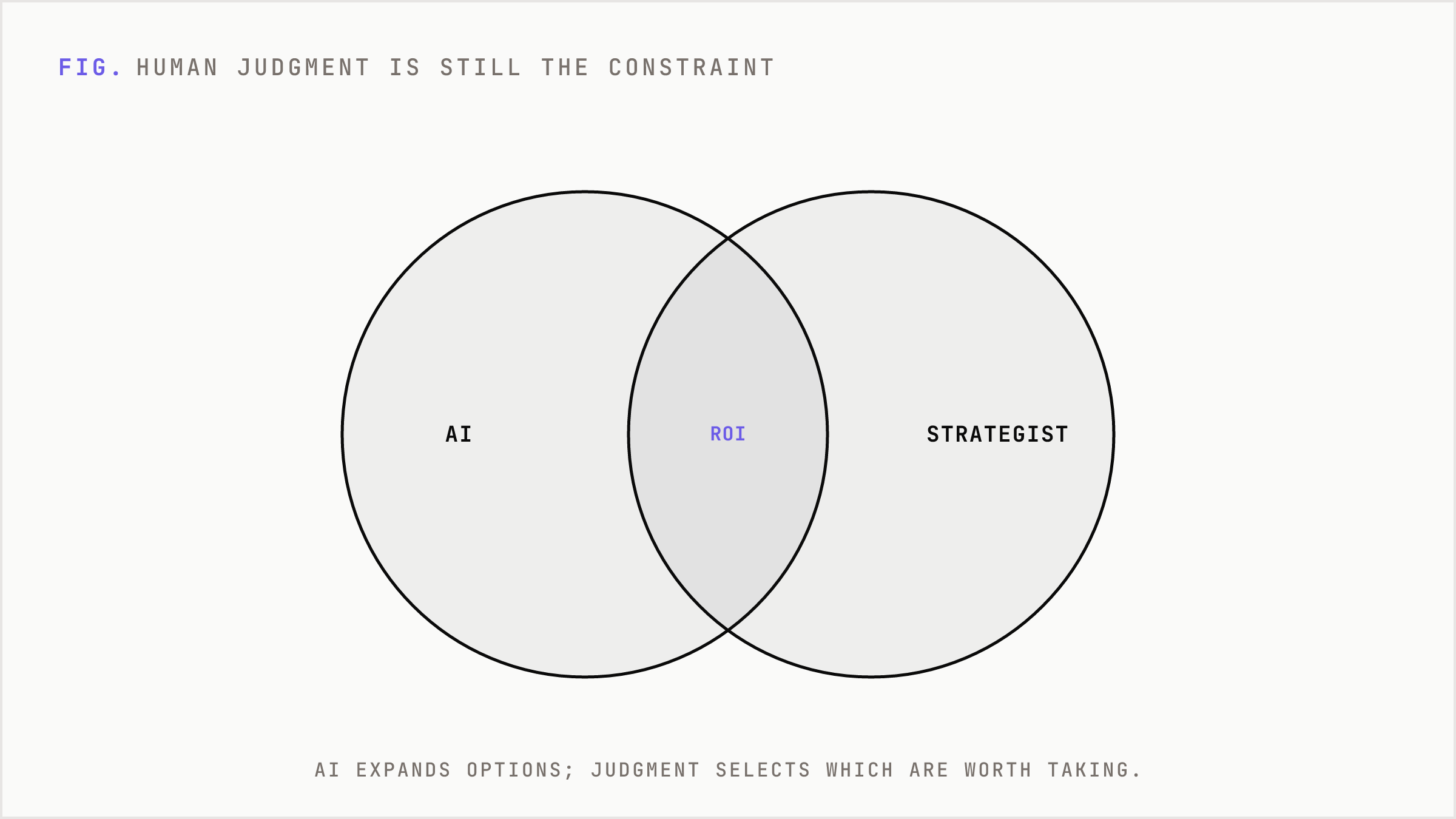
AI expands the number of possible actions. Someone still has to decide which actions are worth taking.
Positioning, narrative coherence, and risk management do not emerge from pattern recognition alone. They require judgment. Tradeoffs. Context.
The highest performing teams use AI to generate options. Variants of messaging. Audience splits. budget scenarios. A strategist selects and constrains those options based on business goals.
Remove the human layer and systems drift. They overfit to short term signals. Promotions increase. Brand erodes. CAC looks good until it doesn’t.
From Campaigns to Continuous Optimization
Traditional marketing runs on cycles. Plan. Launch. Analyze. Repeat.
This structure introduces delay. By the time results are analyzed, the market has shifted. Budgets remain fixed longer than they should. Losing strategies persist.
AI compresses the cycle into a continuous process. Experiments run constantly. Budgets adjust dynamically. Creative evolves in near real time.
The gain is not better planning. It is reduced latency. Decisions are made closer to the moment where data is generated.
In markets where customer behavior changes quickly, this speed becomes a competitive advantage.
Data Quality Sets the Ceiling
There is no workaround for bad data.
If conversion tracking is incomplete, models learn from noise. If revenue data is delayed, optimization lags. If customer profiles are fragmented, personalization breaks.
First party data becomes the most valuable asset. Transaction history. Product usage. CRM records. These inputs are stable and proprietary.
Teams relying heavily on third party signals face degradation over time. Signal quality drops. Models become less reliable. Performance becomes harder to sustain.
Organization Design Is the Hidden Bottleneck
Many companies have the right tools and still fail to capture value. The issue is structural.
Creative, media, and data teams operate in silos. Each has its own metrics. Feedback loops are slow or nonexistent.
AI systems require tight integration across these functions. The fastest teams organize around growth pods. Small groups with shared metrics and end to end ownership.
This reduces handoffs. Data flows faster. Decisions are made closer to execution.
It also changes skill requirements. Strategists need to understand data. Data teams need to understand business context. The boundary between roles becomes thinner.
The New KPI Stack
Channel metrics are losing relevance.
CTR and CPC describe activity, not outcomes. They are easy to optimize and easy to mislead.
High performing teams anchor on economic metrics. Contribution margin. LTV to CAC ratio. Payback period.
They also track system level performance. How many experiments run per week. How quickly iterations happen. What percentage of spend is controlled by algorithmic systems.
These metrics reflect learning velocity, not just output.
Cost Structure Shifts Over Time
AI driven systems require upfront investment. Data infrastructure. Integrations. Model deployment.
This often makes early ROI look worse than expected.
But marginal costs drop quickly. Generating additional creative becomes cheap. Running more experiments has near zero incremental cost. Decision making scales without linear headcount growth.
Returns become non linear. The system improves as it learns. Performance compounds.
Where the Advantage Actually Lives
Access to AI is not a moat. Models are widely available.
The advantage shifts to what is hard to replicate. Proprietary data. Tight integration. Fast feedback loops.
Two companies can use the same model and produce different outcomes. The one with better data and faster iteration will win.
This reframes competition. It is less about creative brilliance and more about operational speed.
The Implementation Reality
There is a clear sequence that shows up across successful teams.
First, unify data. Without this, nothing else works.
Second, define the objective function in economic terms.
Third, deploy AI in high frequency areas like creative testing and bidding where feedback is fast.
Fourth, close the loop with automated measurement and retraining.
Finally, expand into higher level decisions like budget allocation and strategic insights.
Skipping steps usually leads to stalled adoption. Systems remain partially manual. Gains plateau.
What This Means for Founders and Investors
AI marketing is not a tooling decision. It is an operating model decision.
If you treat it as a layer on top of existing workflows, expect marginal gains.
If you redesign around speed, data, and continuous optimization, the economics change.
Customer acquisition becomes more efficient over time. Not just cheaper, but more predictable.
That predictability compounds into valuation. Growth is no longer driven by isolated wins, but by a system that improves itself.
The takeaway is simple. AI does not create leverage on its own. Systems do. Strategy decides whether that leverage points in the right direction.
FAQ
Why do most companies see limited ROI from AI marketing tools?
Because they use AI in isolated tasks instead of integrating it across workflows. Without feedback loops and system-level optimization, gains remain incremental.
What is the most important factor for AI marketing success?
Unified data and a clear economic objective function. These determine how AI systems make decisions and whether those decisions drive real business outcomes.
Does model choice matter in AI marketing?
Less than expected. Architecture, data quality, and integration have a bigger impact on ROI than choosing between similar models.
How does attribution affect AI performance?
Attribution defines the training signal. Poor attribution leads AI to optimize the wrong behaviors, reducing long-term growth.
Can AI fully replace marketing strategists?
No. AI handles scale and pattern detection, but humans are needed for positioning, prioritization, and defining objectives.