Nyyon · Blog
AI Is Not Cutting Your Marketing Costs in Half It Is Rewiring Where the Money Goes
AI rarely halves marketing costs. Real gains come from faster iteration, reduced waste, and workflow redesign, not cheaper content production.
AI is not reducing marketing costs by half. It is reallocating where the money goes.
The Illusion of 50 Percent Savings
The headline claim is simple. AI cuts marketing costs by 50 percent. It spreads well because it compresses a complex shift into a clean number.
But the data does not support it as a default outcome. Most credible implementations cluster in a narrower band. Content production drops by 20 to 40 percent. Paid media waste improves by 10 to 30 percent. Agency labor hours decline by around 15 to 25 percent.
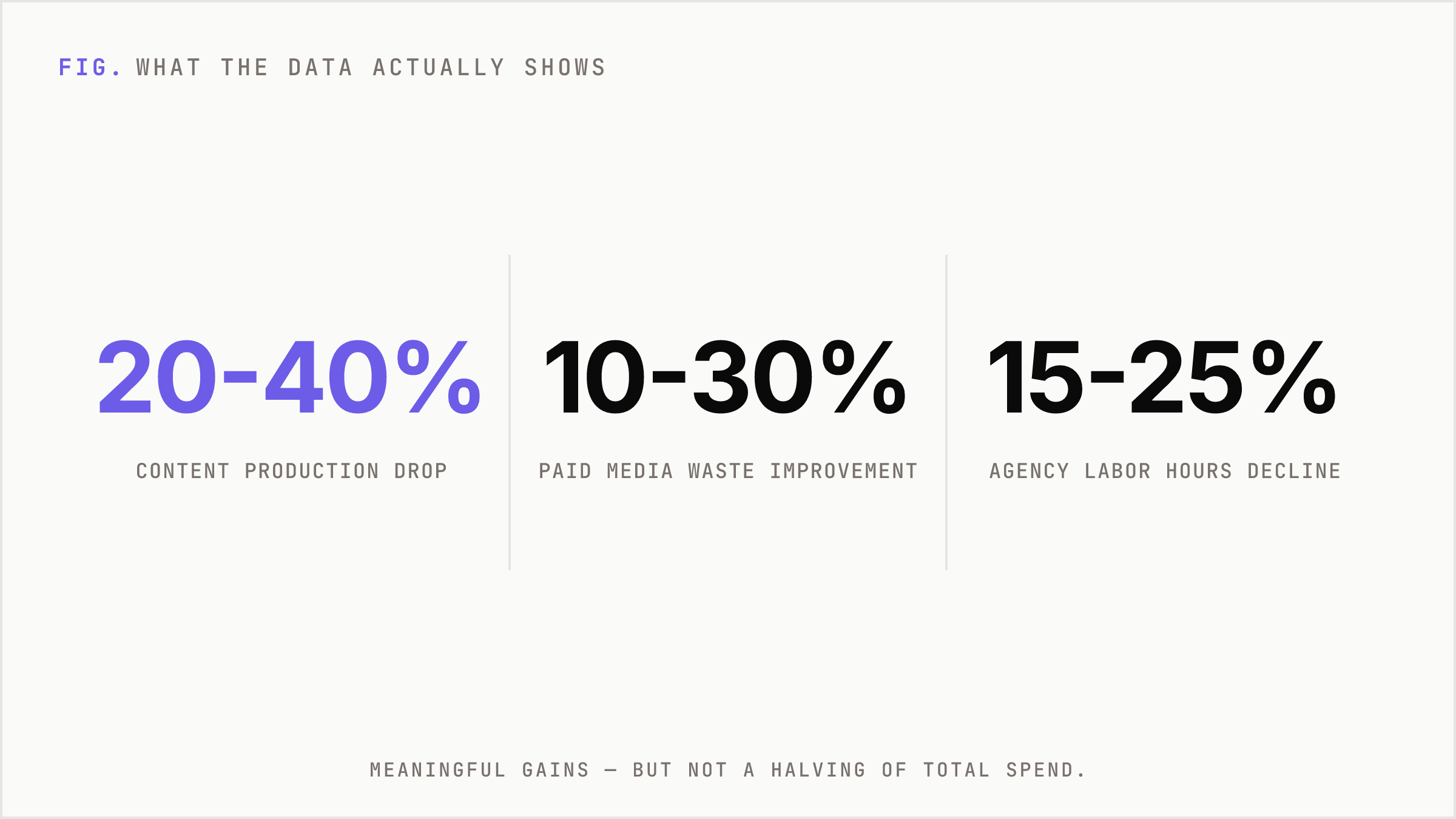
Those are meaningful gains. But they are not a halving of total spend.
The confusion comes from mixing two different things. Cost of execution versus total marketing cost. AI aggressively compresses the first. The second only moves if the organization changes how it operates.
Where the Savings Actually Come From
AI does not reduce costs evenly. It acts on specific levers.
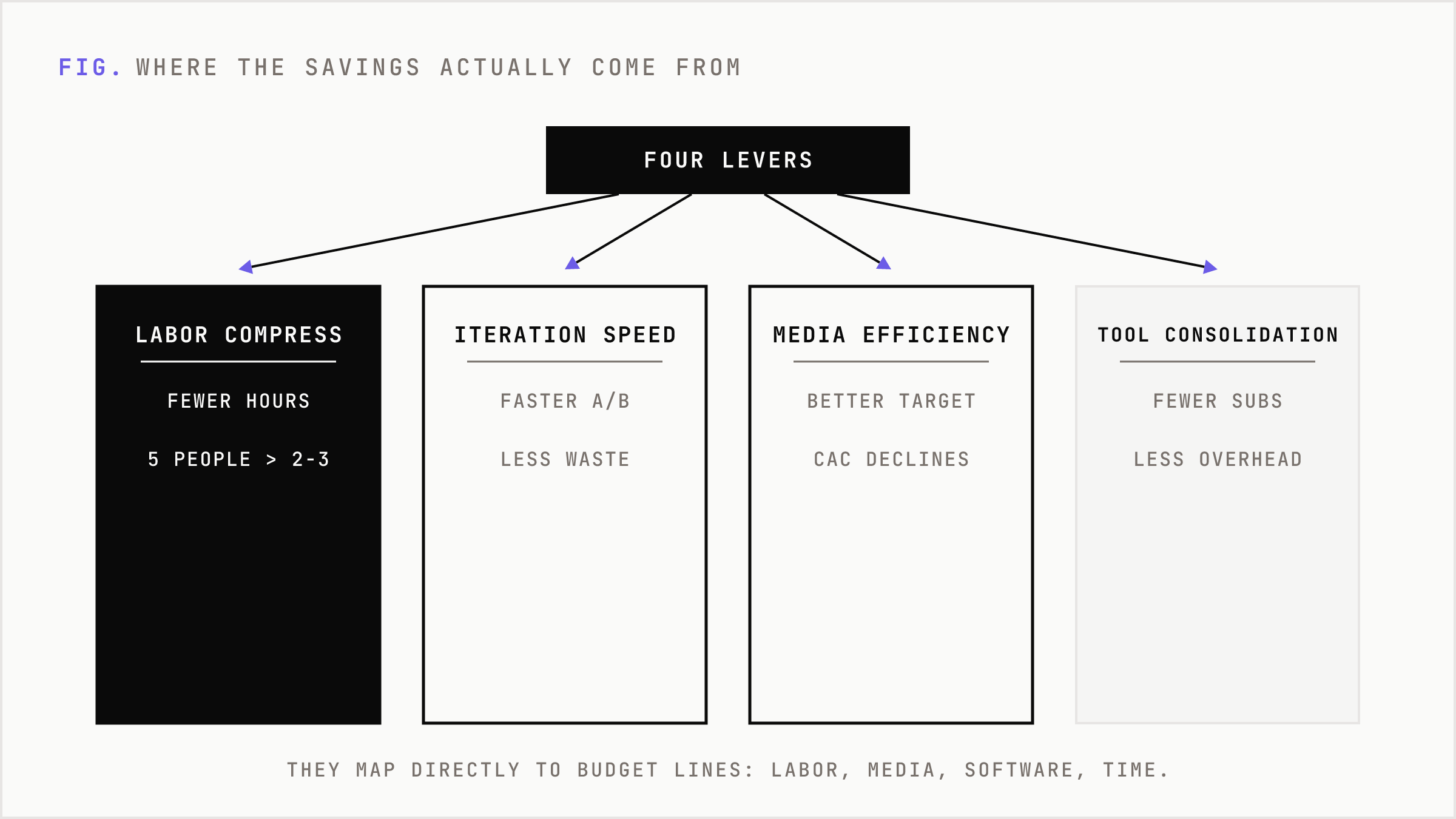
First is labor compression. Copy, design, reporting, and basic analysis take fewer hours. A campaign that required five people can often run with two or three.
Second is iteration speed. Faster A B testing reduces the amount of budget wasted on underperforming creatives. Instead of spending weeks validating a concept, teams cycle through dozens of variants in days.
Third is media efficiency. Better targeting and creative matching improve conversion rates. CAC declines not because media is cheaper, but because it is used more precisely.
Fourth is tool consolidation. AI native systems replace fragmented SaaS stacks. Fewer subscriptions, fewer integrations, less operational overhead.
None of these are abstract. They map directly to budget lines. Labor, media spend, software, and time.
The Execution Layer Is Collapsing
The most important shift is structural. AI is collapsing the cost of the execution layer.
The first draft of anything is now close to free. Ad copy, landing pages, email sequences, basic visuals. Generation is not the constraint anymore.
But that does not mean marketing itself is cheap.
What replaces execution cost is optimization cost. More testing. More data processing. More system design. More oversight.
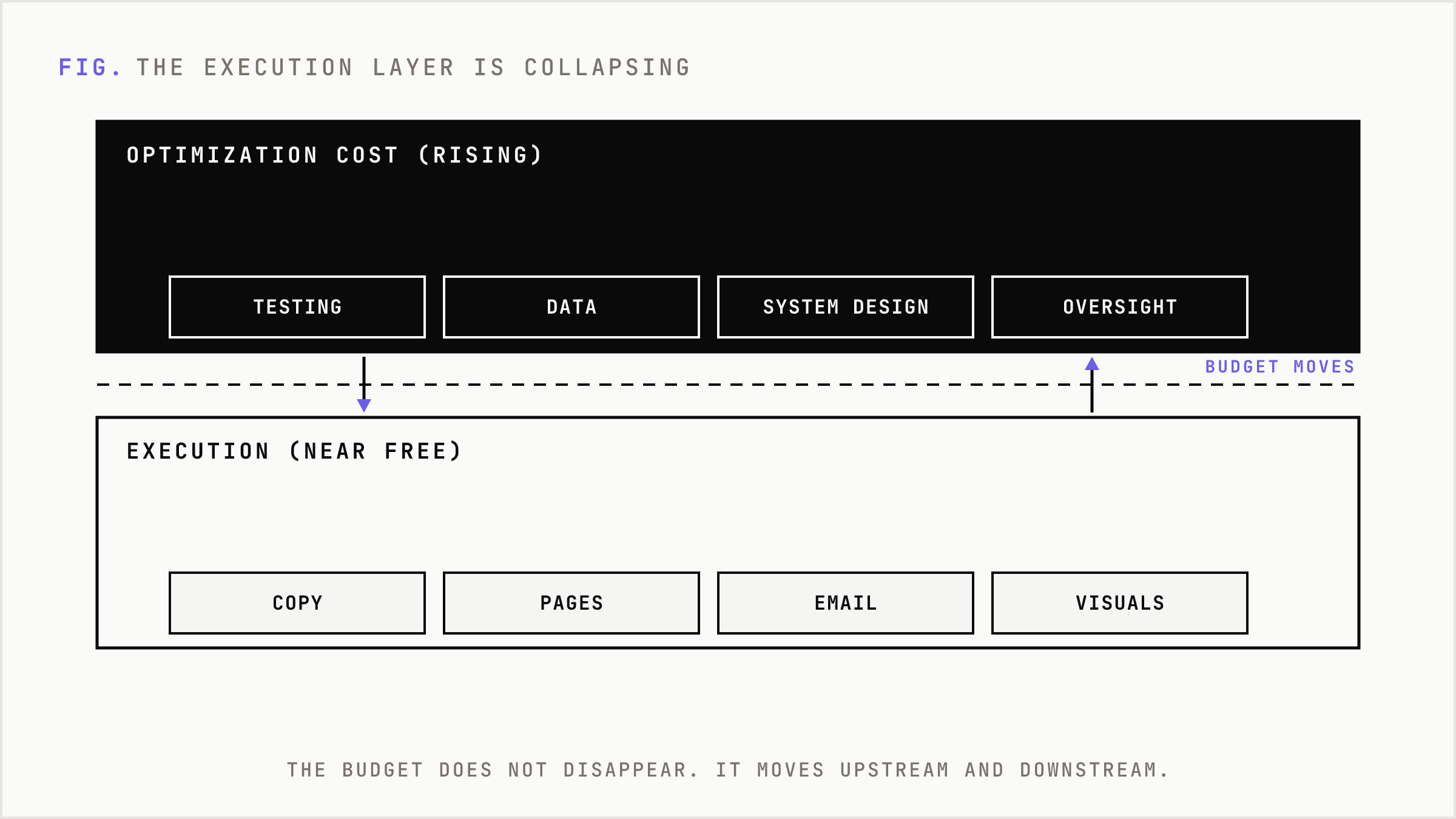
The budget does not disappear. It moves upstream and downstream.
Throughput Is Up, Not Just Efficiency
One of the most misinterpreted effects is content throughput. Many teams report 2 to 5 times more output.
This gets framed as cost savings. It is not. It is capacity expansion.
If a team produces five times more content at the same cost, the unit cost per asset drops. But total spend often stays flat or increases because the system can now absorb more testing.
This is closer to how cloud computing changed infrastructure. Costs per unit dropped. Total usage expanded.
Why Some Agencies Actually Hit 50 Percent
There are real cases where costs drop close to half. But they share specific traits.
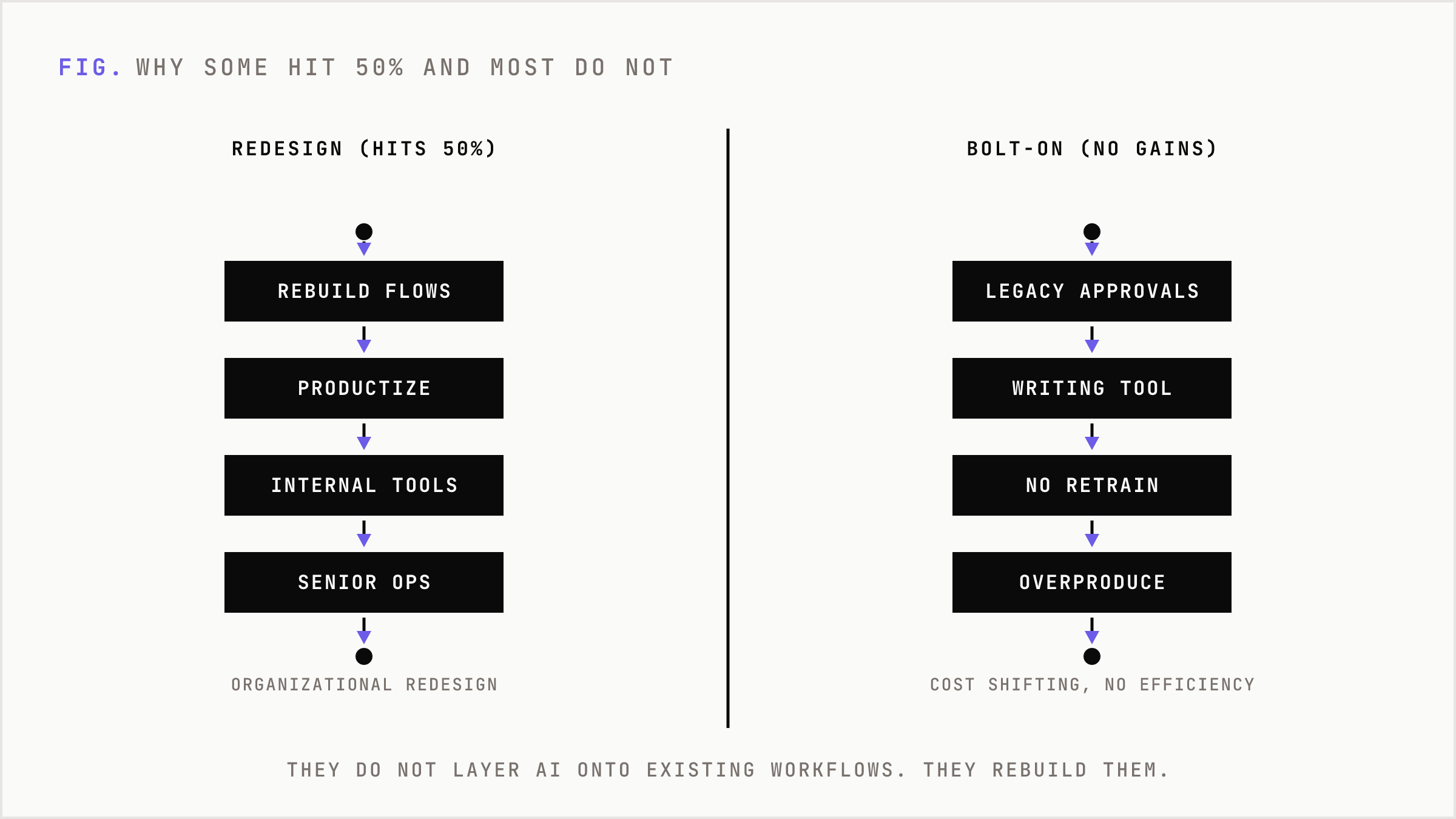
They do not layer AI onto existing workflows. They rebuild workflows entirely.
They productize services. Instead of bespoke retainers, they define repeatable systems with clear inputs and outputs.
They build internal tooling. Prompt libraries, custom workflows, sometimes fine tuned models trained on historical campaign data.
They reduce reliance on junior staff. The team shifts toward fewer, more senior operators who manage systems rather than execute tasks.
This is not incremental adoption. It is organizational redesign.
Why Most Teams Do Not See Meaningful Savings
The failure pattern is consistent.
Teams keep legacy approval layers. AI generates faster, but output still waits on the same human bottlenecks.
They treat AI as a writing tool instead of a system optimizer. The workflow stays intact, only slightly accelerated.
They do not retrain teams. Work gets duplicated. AI generates, humans redo.
They overproduce low quality content. This creates downstream costs in editing, brand damage, and reduced performance.
The result is cost shifting without efficiency gains.
Paid Media Is Where the Money Moves Fastest
The most immediate impact shows up in paid media.
AI generated creative increases testing velocity. More variations enter the auction faster. Poor performers get eliminated quickly. Strong performers scale.
This dynamic lowers effective CPM and CAC over time.
The gains are strongest in channels where creative drives performance. Meta is the clearest example. Google Performance Max also benefits due to automated optimization loops.
But the effect is not universal. In regulated industries, compliance review slows everything down. In brand heavy campaigns, creative quality constraints limit how far automation can go.
Content Marketing Gets Cheaper and Harder
SEO content is where the largest unit cost reductions show up. Some agencies report 60 to 90 percent lower cost per article.
But this creates a second order effect. If everyone can produce content cheaply, differentiation collapses.
Search algorithms are already adjusting. Low differentiation AI content plateaus quickly. Traffic gains flatten. In some cases, they reverse.
The cost side improves. The return side becomes less predictable.
This is a classic supply shock. When content supply explodes, attention becomes the scarce resource.
The Hidden Costs Nobody Mentions
The narrative around AI savings often excludes new cost centers.
Model usage fees at scale are non trivial.
Human QA layers remain necessary for brand safety and accuracy.
Prompt engineering and system design require senior talent.
Teams need retraining. Processes need rebuilding.
Brand risk mitigation becomes more important as output volume increases.
These costs do not eliminate savings, but they compress them.
Margins Expand Before Prices Drop
There is also a market dynamic at play. Most agencies are not passing savings to clients.
Pricing remains stable. Margins expand.
Lower prices tend to appear in specific segments. Offshore and AI hybrid models. Productized low touch offerings. Performance based pricing structures.
For everyone else, AI is currently a margin expansion tool, not a discount mechanism.
From Campaigns to Systems
The deeper shift is strategic.
Marketing is moving from campaigns to systems.
From discrete launches to continuous optimization loops.
From producing assets to managing feedback cycles.
The advantage compounds over time. Each campaign feeds data back into the system. Targeting improves. Creative improves. Allocation improves.
This is where AI creates leverage that is hard to replicate.
What Actually Becomes Defensible
Basic AI usage is already commoditized. Anyone can generate copy or images.
The defensible layer shifts elsewhere.
Proprietary datasets. Historical campaign performance. Customer behavior data.
Fine tuned models aligned to brand voice and conversion patterns.
Closed loop systems where performance data directly informs new content generation.
This is not about tools. It is about data and feedback.
The Real Bottom Line
AI does not halve marketing costs by default.
It halves the cost of execution layers.
Total marketing cost only drops significantly when organizations redesign around that reality.
For most teams, 20 to 30 percent savings is a realistic range today.
The larger opportunity is not cost reduction. It is speed, scale, and testing density.
Those factors compound. Over time, they matter more than any one time savings.
The companies that win are not the ones spending less. They are the ones learning faster per dollar.
FAQ
Does AI reduce marketing costs by 50 percent?
Not typically. Most organizations see 20 to 30 percent savings unless they fully redesign workflows and operating models.
Where do the biggest AI-driven savings come from?
Labor reduction, faster iteration, improved media efficiency, and consolidating tools into fewer systems.
Why doesn't increased content production always improve results?
Because differentiation drops as content supply increases. More content does not guarantee more attention or better performance.
Is AI replacing marketing teams?
No. It changes team structure. Fewer execution roles, more senior operators managing systems and optimization loops.
What is the main strategic advantage of AI in marketing?
Faster learning cycles. Teams that test, iterate, and adapt quicker gain compounding performance advantages over time.