Nyyon · Blog
AI From Day One: The New Marketing Agency Model Leaders Should Watch
AI-native agencies are not firms with ChatGPT. They are service systems built around agents, feedback loops, governance, and outcomes.
The agency model is not being automated at the edges. It is being rebuilt around AI as the operating layer.
That sounds like a slogan until you look at the workflow.
A traditional agency sells coordinated labor. Strategy writes the brief. Creative develops concepts. Media translates the campaign into channels. Analytics reports after the fact. Account management absorbs the friction. The client pays for people, meetings, revision cycles, and the hope that enough experienced judgment survives the handoffs.
An AI-native agency starts from a different premise. The unit of production is not a department. It is a system. Research, strategy, copy, creative variation, media testing, reporting, and learning loops are designed around AI from the start. Humans still matter. They matter more, but in different places. They decide, edit, govern, and interpret. They do not manually carry every object across the factory floor.
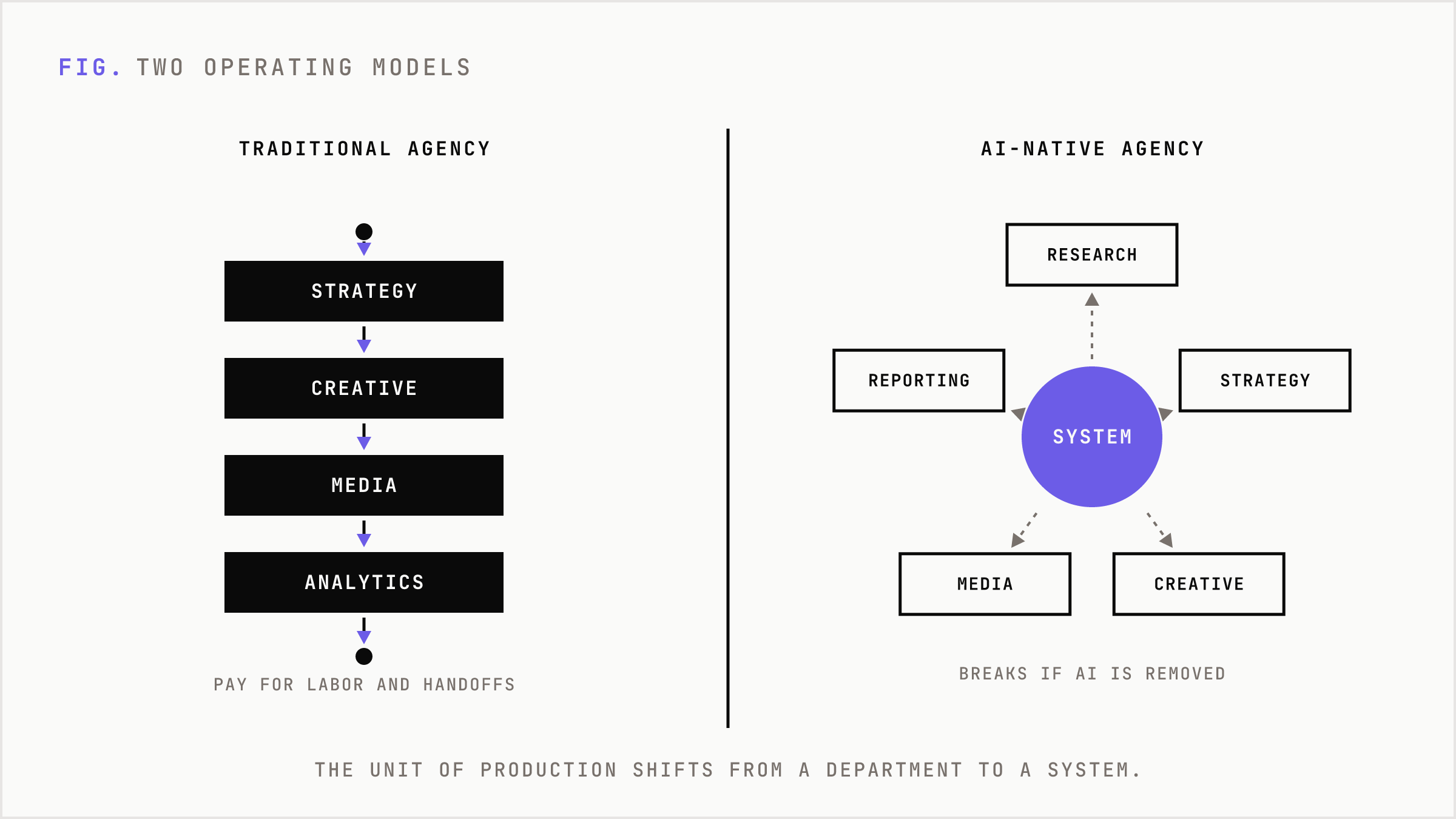
This is the distinction buyers need to understand. AI-native does not mean an agency uses ChatGPT. It means the agency would break if AI were removed from its core operating model.
The useful definition is structural
IBM has drawn a clean line between AI-native and AI-augmented. AI-native systems are designed with AI as a core layer, not as an add-on. The warning is equally useful: the phrase is already becoming a buzzword.
For agencies, the practical test is simple.
- An old agency using AI tools has faster labor.
- An AI-native agency has a repeatable production system, human judgment, feedback loops, and outcome packaging.
- An AI-native marketing agency turns marketing operations into agentic workflows instead of departments.
The first version saves time. The second version changes the cost structure, speed of learning, and shape of the service.
This matters because marketing budgets do not move because a vendor has a new tool stack. They move when a buyer can replace an existing line item with something faster, clearer, or more accountable. The agency budget is a service budget. The software budget is a tool budget. AI-native service companies attack the service budget by doing the work, not by asking the client to operate another platform.
That is why Y Combinator has been pushing the idea of AI-native service companies. The next wave is not only software that improves outsourced work. It is companies that sell the completed service and use AI internally to change the economics of delivery.
The market is ready, but not mature
The demand signal is already visible. McKinsey reported in 2025 that 88 percent of organizations use AI regularly in at least one business function, up from 78 percent a year earlier. Marketing and sales remain among the most active functions. Reported revenue gains from AI are especially common in marketing, sales, strategy, corporate finance, and product development.
But usage is not transformation. Only about one-third of organizations say they have begun scaling AI programs. That gap is the opening.
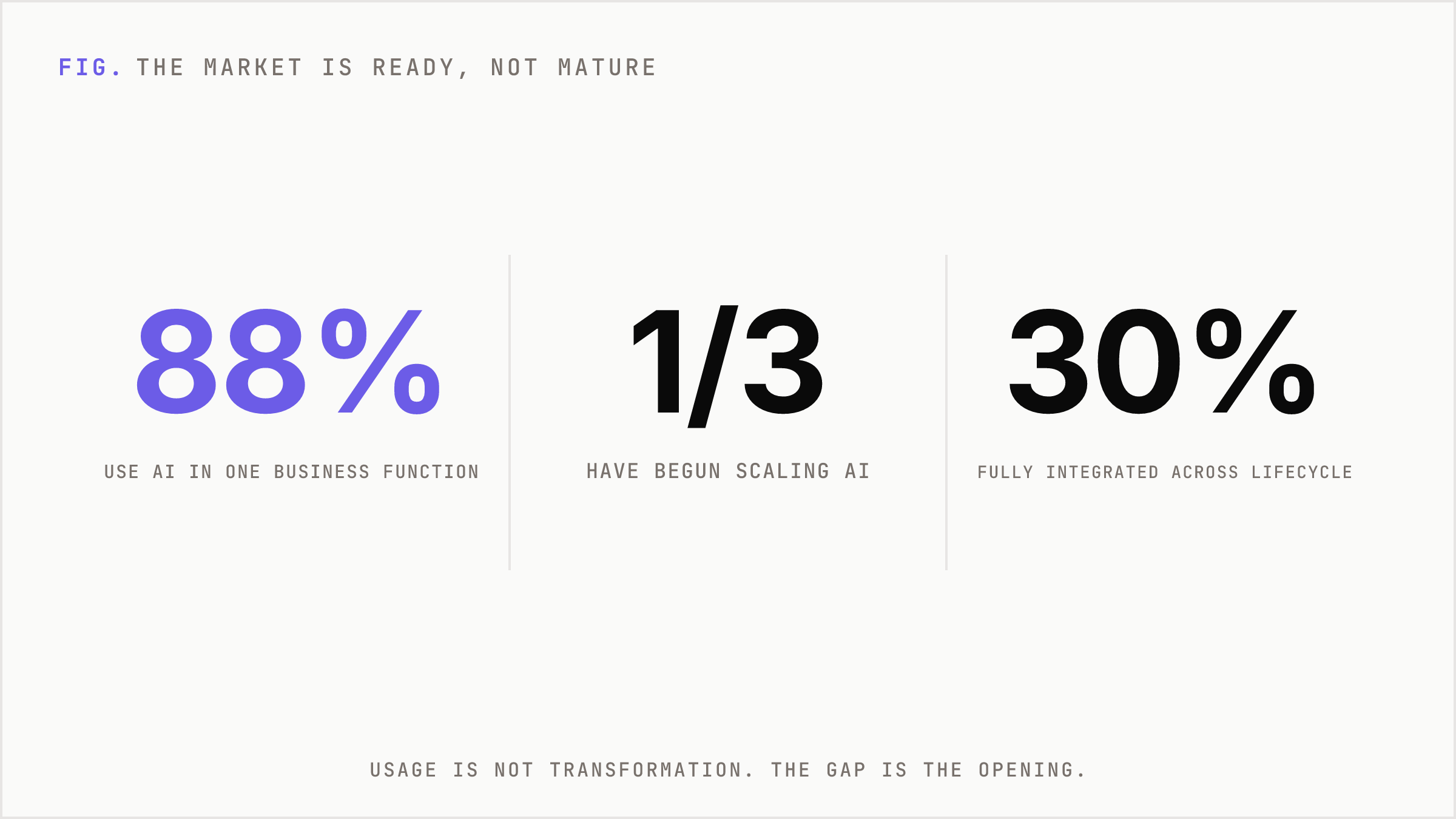
IAB found in 2025 that only 30 percent of agencies, brands, and publishers had fully integrated AI across the media campaign lifecycle. Half of the companies not yet fully integrated expected to get there by 2026. Half the industry lacked an AI roadmap.
The blockers are not mysterious. Data quality. Data protection. Tool fragmentation. Transparency. Half of brands worry they do not have enough visibility into how agencies and publishers use AI on their behalf.
Gartner found a similar tension. Many marketers are exploring generative AI, but fewer report significant benefits. The hard part is not making content. The hard part is making on-brand, commercially usable, publishable content at scale.
That is the buyer problem. Not access to models. Not lack of demos. The problem is operational trust.
The task-level mechanics are where the model changes
Start with a basic campaign.
In a conventional agency, the team gathers inputs, researches the market, writes a brief, presents a direction, builds assets, pushes media live, then reports on performance. Each step has a person, a queue, a meeting, and a version history. The model is flexible, but slow. The client experiences expertise as latency.
In an AI-native agency, the same campaign is decomposed into repeatable workflows.
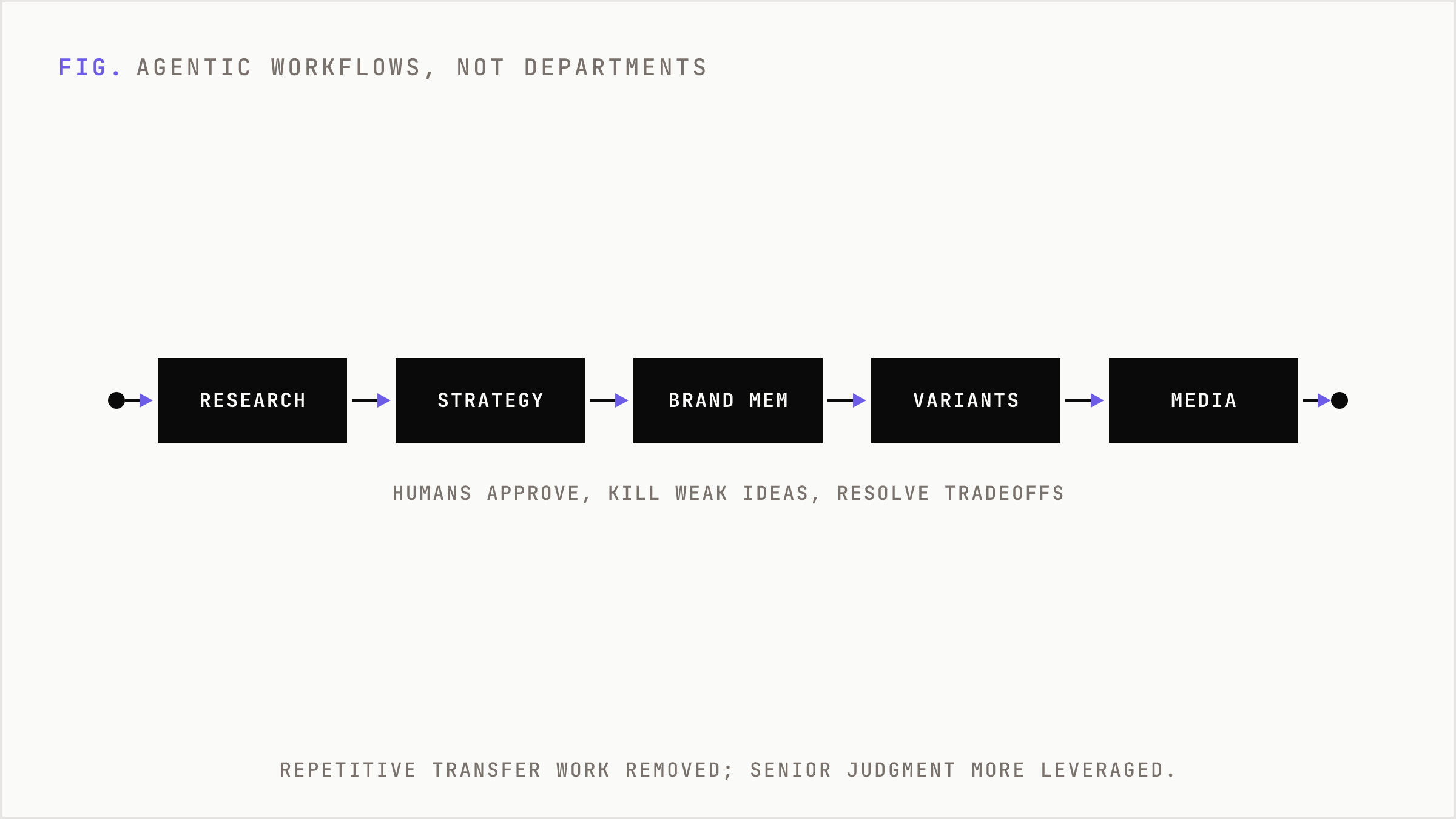
- Research agents collect competitor, audience, search, social, and category signals.
- A strategy workflow turns those signals into positioning options and campaign hypotheses.
- A brand memory system checks voice, claims, exclusions, tone, and approved language.
- A creative variant engine generates ad, email, landing page, and social variations against the same strategic spine.
- Human strategists and creative directors approve the direction, kill weak ideas, and resolve tradeoffs.
- Media workflows map variants to audiences and channels.
- Reporting agents turn performance data into learnings and next actions.
The difference is not that AI writes more copy. The difference is that the campaign becomes a learning loop. The output of one sprint becomes structured input for the next sprint. Brand context compounds. Performance data feeds new hypotheses. The system remembers what worked, what failed, and what the client will never approve again.
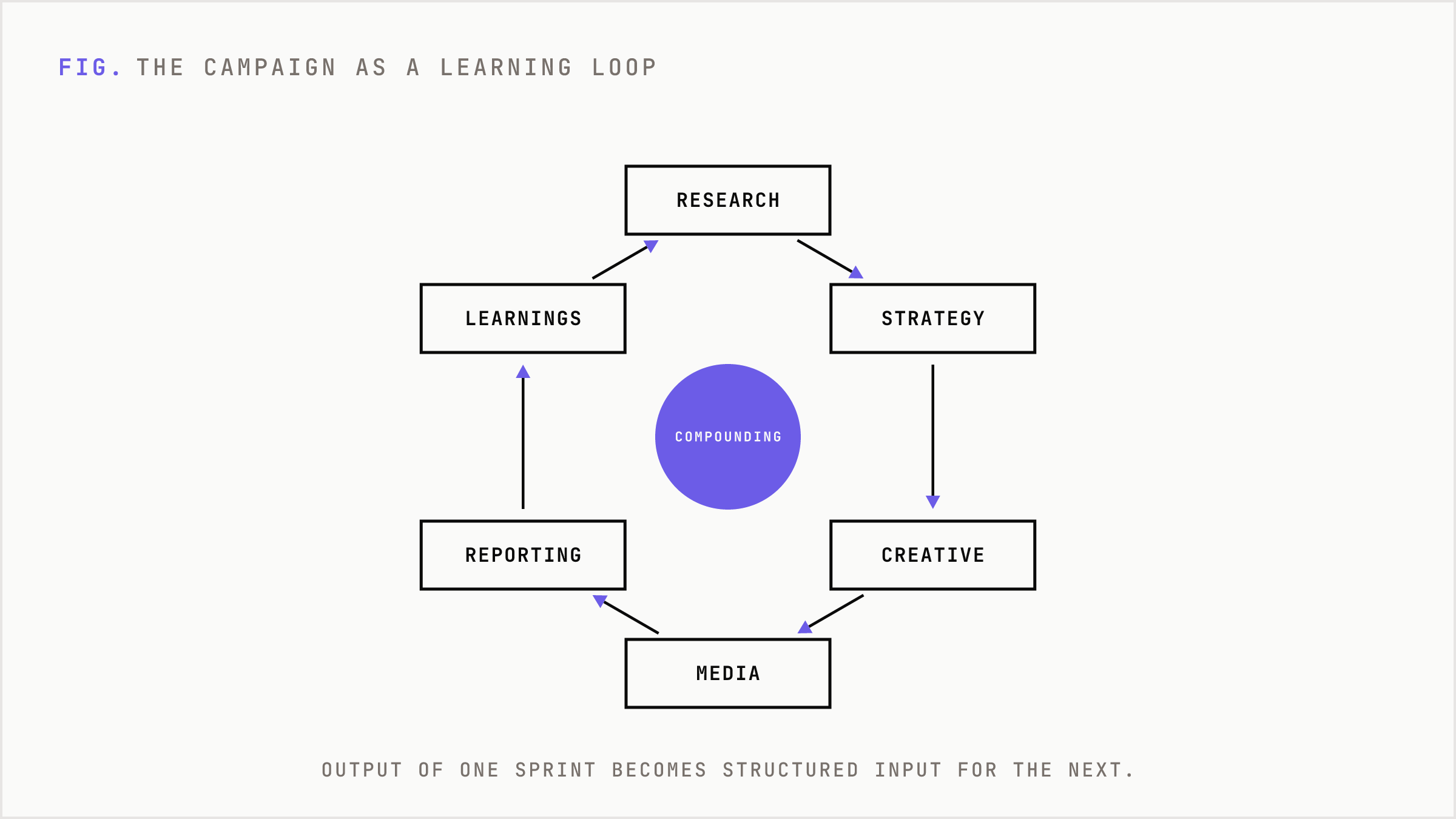
That is where the margin comes from. Not from replacing every human. From removing repetitive transfer work and making senior judgment more leveraged.
The real examples are still early, but the pattern is visible
Nyyon is a clean example of the AI from day one positioning. It presents itself as AI-native marketing with white-glove delivery. The offer spans strategy, content, creative, paid media, automation, brand, and web. The operating promise is speed: a 48-hour strategic brief, campaigns live in 2 to 3 weeks, outcomes over hours. The important point is not the phrase AI-native. It is the coupling of speed, human service, and structured delivery.
RZLT is another useful case. It positions as an AI-native growth agency and talks less like a tool user than a workflow builder. Its proof points include agentic workflows, custom models on live audience data, automated campaign pipelines, and performance tracking across CAC, LTV, payback, conversion, and pipeline. It claims launches in 3 weeks versus traditional 3-month strategy cycles. That is the right axis: cycle time and business metrics, not model names.
RevUp Studio shows the vertical specialist version. It focuses on InsurTech and B2B tech founders, builds client-owned AI content infrastructure, and uses concepts like Founder Context Protocol and AI Visibility Score. Its wedge is not generic AI content. It is domain context plus measurable visibility across AI answer engines like ChatGPT, Gemini, Claude, and Perplexity.
Commander applies the model to localization and international marketing. That is a strong use case because localization is expensive, repetitive, sensitive to cultural nuance, and easy to ruin with shallow automation. AI can compress the first draft and adaptation layer. Humans still need to protect meaning, tone, and local fit.
Cosmic Charlie represents the creative shop version: born in the era of AI, full-funnel, human-led, built by agency veterans. This is another likely pattern. Experienced creative leaders start smaller firms with AI-native production models and avoid the legacy cost base.
Then there are the validators from the incumbent side. Monks.Flow, WPP Open, Publicis CoreAI, and Brandtech with Pencil all show where the large agency market is moving. Monks has positioned AI agents across planning, creation, scaling, and delivery. WPP has invested heavily in WPP Open and reported tens of thousands of monthly active users. Publicis is integrating Adobe Firefly into CoreAI for personalized content at scale. Brandtech and Pencil demonstrate the compounding advantage of generative creative tied to performance data across large media spend.
These are not all AI from day one. Many are legacy groups rebuilding the operating system mid-flight. That is harder. They validate the direction, but they also carry old incentives: utilization, departments, account layers, and complicated rosters.
The buyer is not buying AI
The buyer is buying fewer problems.
Most marketing leaders do not want prompts, hallucination checks, fine-tuning debates, AI policy drafts, tool subscriptions, and ten dashboards that disagree with one another. They want a campaign shipped. They want the brand protected. They want to know what changed in the market. They want an answer when the CFO asks what the spend produced.
This is why white-glove AI matters. Self-serve AI moves work to the client. AI-native services remove work from the client.
That is the substitution dynamic. The agency is not competing only with other agencies. It is competing with internal hires, freelancers, SaaS tools, offshore production, and the option of doing nothing. To win, the new model must compress more than cost. It must compress decision time.
If an agency can turn a messy input into a strategic brief in 48 hours, launch a campaign in weeks, produce enough variants to test real differences, and report results in business language, it becomes a different budget conversation. The buyer is no longer asking how many hours were used. The buyer is asking which outcome was unlocked faster.
The moat moves from headcount to workflow IP
Traditional agencies built moats through talent, reputation, relationships, process, and client history. Those still matter. But they are no longer enough.
The AI-native moat is workflow IP.
- Reusable research and strategy workflows.
- Client context memory.
- Prompt and evaluation libraries.
- Brand voice systems.
- Human approval gates.
- Data boundaries and audit trails.
- Performance feedback loops.
- Vertical benchmarks.
- Dashboards that connect activity to outcomes.
This is defensible because it compounds inside delivery. Every campaign can improve the system if the agency captures learning correctly. Every client interaction can sharpen context. Every performance result can update the next set of hypotheses.
The weak version is a list of tools on a capabilities page. That is not a moat. Tool access equalizes quickly. Workflow quality does not.
The bullshit filter is simple
Most AI agency claims fail under basic diligence. Ask five questions.
- Where does AI act in the workflow, and where do humans decide?
- What client data goes into the system, and what does not?
- How is brand consistency evaluated before anything ships?
- What metrics improved beyond content volume?
- What part of the process gets better after each campaign?
Good answers sound operational. Bad answers sound like tool demos.
Real signals include human approval gates, model and data governance, internal benchmarks, client-facing dashboards, repeatable service products, and agentic workflows tied to KPIs. The best examples can show before and after numbers: cycle time, cost per asset, test volume, CAC, conversion rate, pipeline contribution, content velocity, or AI search visibility.
Bullshit signals are just as clear. The agency lists tools. It says 10x with no metric. It uses AI only for copywriting. It has no data policy, no QA system, no proof of brand consistency, and no commercial outcome beyond faster content.
The first wedges will not be everything marketing
AI-native agencies that try to be universal from day one will run into the same problem as every generalist agency: unclear substitution. The buyer needs a reason to switch now.
The strongest wedges are narrow and measurable.
- Performance creative.
- Paid media iteration.
- Founder-led thought leadership.
- Lifecycle email.
- Landing page testing.
- Localization.
- Answer engine optimization and AI search visibility.
These categories have high production load, tight feedback loops, and visible business metrics. They also benefit from context memory. The system gets smarter because the work repeats.
The weakest wedge is generic content. Commodity blogs, generic social posts, and AI-written brand books without distribution do not create durable value. They create volume. The market already has volume.
AI-native does not mean humanless
The strongest version of this model is not a robot agency. It is a smaller, sharper, more instrumented agency.
Humans move from drafting to directing. From production to judgment. From reporting to interpretation. From coordination to decisioning. AI does the heavy lift. Humans protect taste, truth, strategy, and risk.
This is why the category will not simply collapse into software. Marketing is full of ambiguous judgment. What should the brand say? Which claim is credible? Which audience matters first? Which creative is merely clever and which one might sell? Which result is noise and which one changes the plan?
Software can assist. A service system can own the outcome.
The strategic implication
The term AI-native marketing agency will get abused. That does not make the category fake.
The category is better understood as an AI-native marketing operating system delivered as a service. The agency wrapper survives because clients still want accountability, taste, strategy, governance, and speed without hiring a new internal team.
For founders, the opportunity is to build service companies with software economics hiding inside. For investors, the question is whether workflow IP, data loops, and vertical focus can create durable gross margin expansion. For marketing leaders, the question is whether a vendor can replace a slower service line with a faster operating model without increasing brand risk.
The winners will not be the loudest AI agencies. They will be the ones that can explain their workflow, expose their governance, show their metrics, and keep shipping.
AI from day one is not a positioning trick if it changes how the work is made, priced, measured, and improved. Everything else is just a faster version of the old agency.
FAQ
What is an AI-native marketing agency?
An AI-native marketing agency is built with AI as a core operating layer from the start. AI is embedded into research, strategy, production, testing, reporting, and feedback loops. It is not just a traditional agency using AI tools to speed up manual work.
How is AI-native different from AI-enabled?
AI-enabled means people use AI tools inside an existing workflow. AI-native means the workflow itself was designed around AI. The structure, staffing, delivery model, data loops, and pricing logic change.
Are there real examples of AI-native marketing agencies?
Yes. Examples include Nyyon, RZLT, RevUp Studio, Commander, and Cosmic Charlie. Larger market validators include Monks.Flow, Brandtech with Pencil, WPP Open, and Publicis CoreAI, though many incumbents are adapting legacy structures rather than starting from zero.
What should buyers ask before hiring an AI-native agency?
Ask where AI acts in the workflow, where humans approve, how client data is protected, how brand consistency is evaluated, and which business metrics have improved. Strong agencies answer with systems and evidence, not tool lists.
Does AI-native mean humanless?
No. The best model uses AI for heavy production, research, variation, and analysis while humans handle strategy, taste, governance, risk, and interpretation. The human role becomes more leveraged, not irrelevant.