Nyyon · Blog
AI Agents Need a Plan, Not Guardrail-Free Goals
Goal-oriented AI agents reach the target but burn half your budget getting there. A clear plan with human-set goals solves most of the waste.
A goal-oriented AI agent will reach your target and spend half your budget doing it. The current fashion says to hand an agent an outcome, remove the guardrails, and let it loop until it gets there. That is unhealthy and silly. The better move is to give the agent a clear plan and run with it, because the meaningful decision belongs to a human, and a single human insight at the top solves most of the cost downstream.
This is the place where humans should weigh in. Not the place where you step back and admire the autonomy.
The dominant pattern: hand AI a goal and walk away
The industry has fallen in love with goal-oriented building. You define an outcome, you give the agent tools, and you let it reason its own way there. No fixed plan. No human checkpoint. Just a loop that keeps spending tokens until a goal condition flips true.
This is being sold as maturity. It is mostly revenue engineering.
Look at how Claude Fable was framed. The whole conversation about loops and goal-oriented building reads as a RevOps move by the model provider, not something operators actually need. Fable wasted a ton of tokens for marginally better results than Opus 4.8. The model that benefits from you running open-ended loops is the model that gets paid per token. That is not a coincidence. The incentive structure of frontier labs rewards your agent wandering toward the goal, not arriving by the shortest path.
An open loop is a budget with no ceiling. It reaches the target the way a tourist with an unlimited card reaches the airport: eventually, expensively, and via three places it did not need to visit.
Where guardrail-free goals break
The failure is not that the agent misses the goal. The failure is what it costs to hit it.
Give an agent a goal and no plan, and it will explore. Exploration is reasoning, and reasoning is the single most expensive thing an AI system does. Every detour, every re-read, every speculative branch is tokens you are paying for so the model can rediscover something a senior operator already knew.
Here is the concrete consequence. You ask an agent to produce a campaign outcome with no plan and no oversight. It runs for an afternoon, loops through approaches, second-guesses itself, and lands on a result. You inspect the bill: it spent roughly half your allotted budget on reasoning that a single line of human direction would have made unnecessary. The output is fine. The path was wasteful. And you cannot get the money back, because the loop already ran.
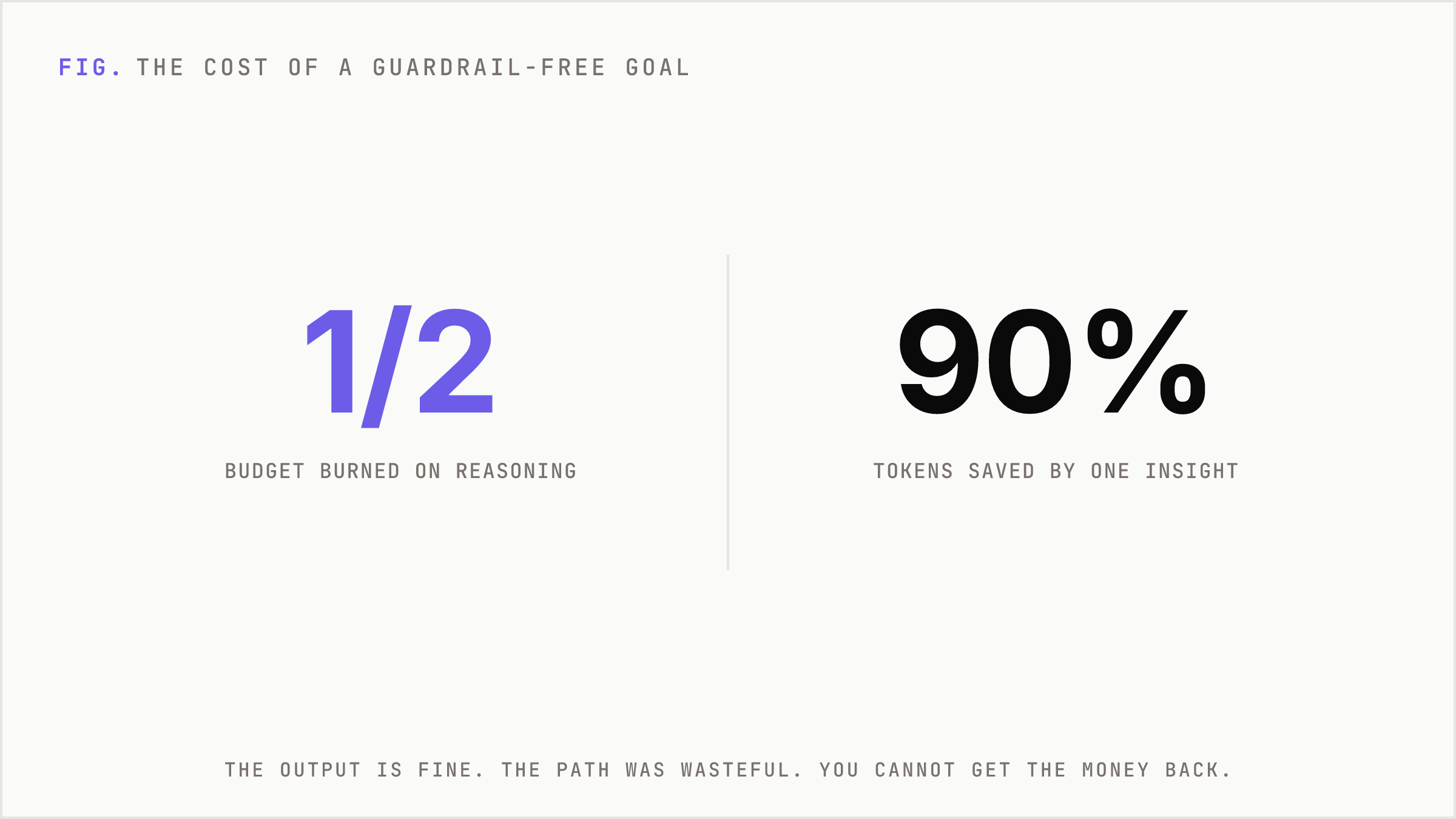
A season CTO will solve 90% of that token expenditure just by giving one insight that is meaningful. Not by writing code. Not by babysitting the loop. By setting the goal and shaping the plan so the agent never has to discover the obvious.
The Nyyon mechanism: gateways, tools, workflows
The fix is architectural, not motivational. You do not tell the agent to be frugal. You build a system where frugality is the default because reasoning only happens where reasoning is required.
The model is gateways, tools, and workflows.
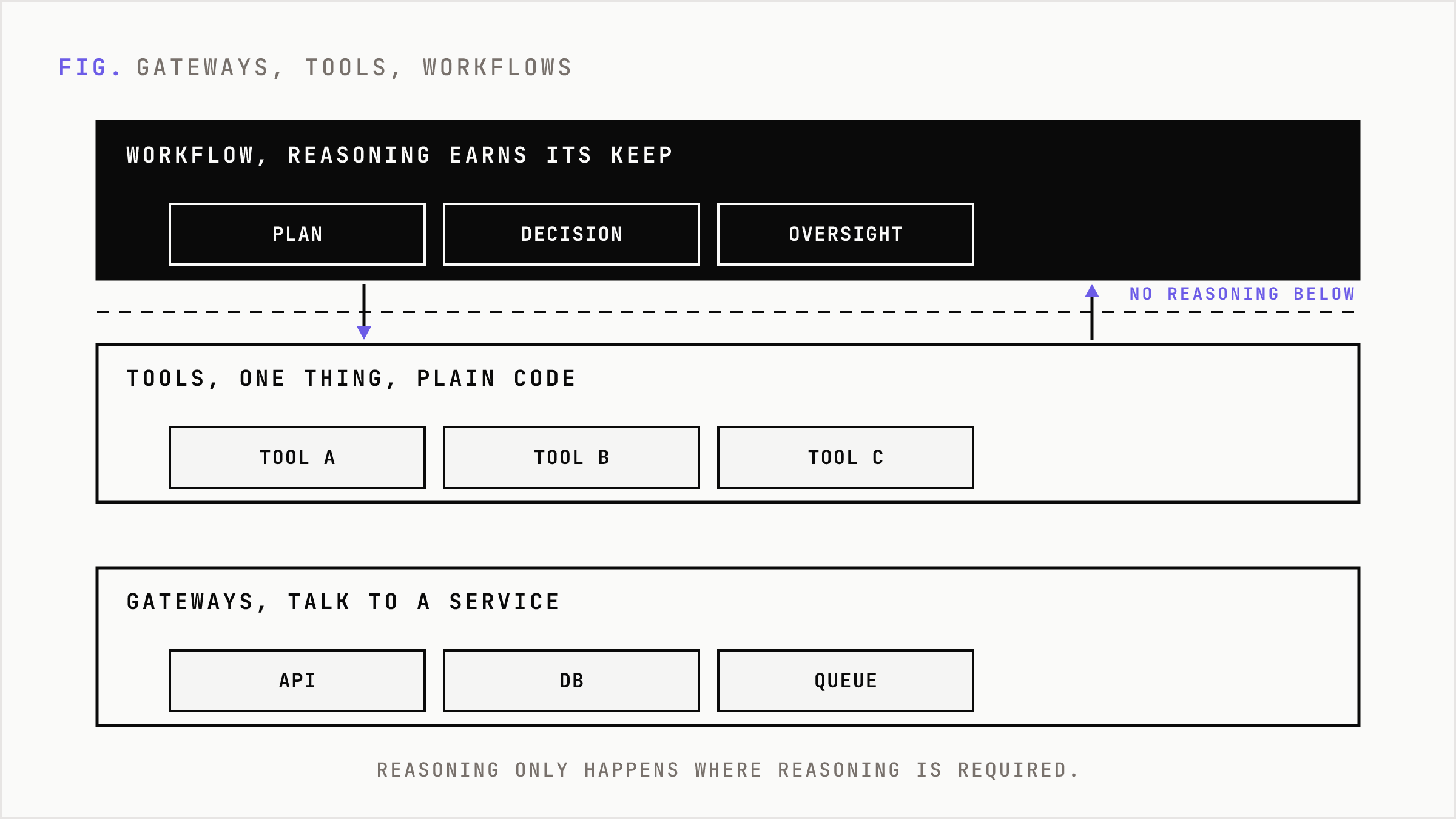
A gateway is plain code that talks to a service. A tool is plain code that does one thing with a gateway. A workflow is the path that uses tools and gateways to reach an outcome.
The point of this structure is to put expensive reasoning only where reasoning earns its keep. Gateways do not reason. They are code. Tools do not reason. They are code. The AI is not writing requests and rediscovering its capabilities on every run. It is calling tools it already has, inside the confines of a workflow that already exists. You build once and you reuse, and you do not pay an endless token bill to re-derive the same path.
This is the same logic Nyyon uses for model routing: hard decisions go to the big model, easy execution goes to the small one. Apply it to agents and the principle holds. Give the meaningful decision to the senior operator. Give the execution and the small decisions to the builder. Then keep a loop that checks the builder actually applied the decision into the product, instead of leaving it floating.
Why a plan beats a guardrail-free goal
A guardrail-free goal optimizes for autonomy. A plan optimizes for decision quality. Those are not the same thing, and only one of them shows up on the invoice in your favor.
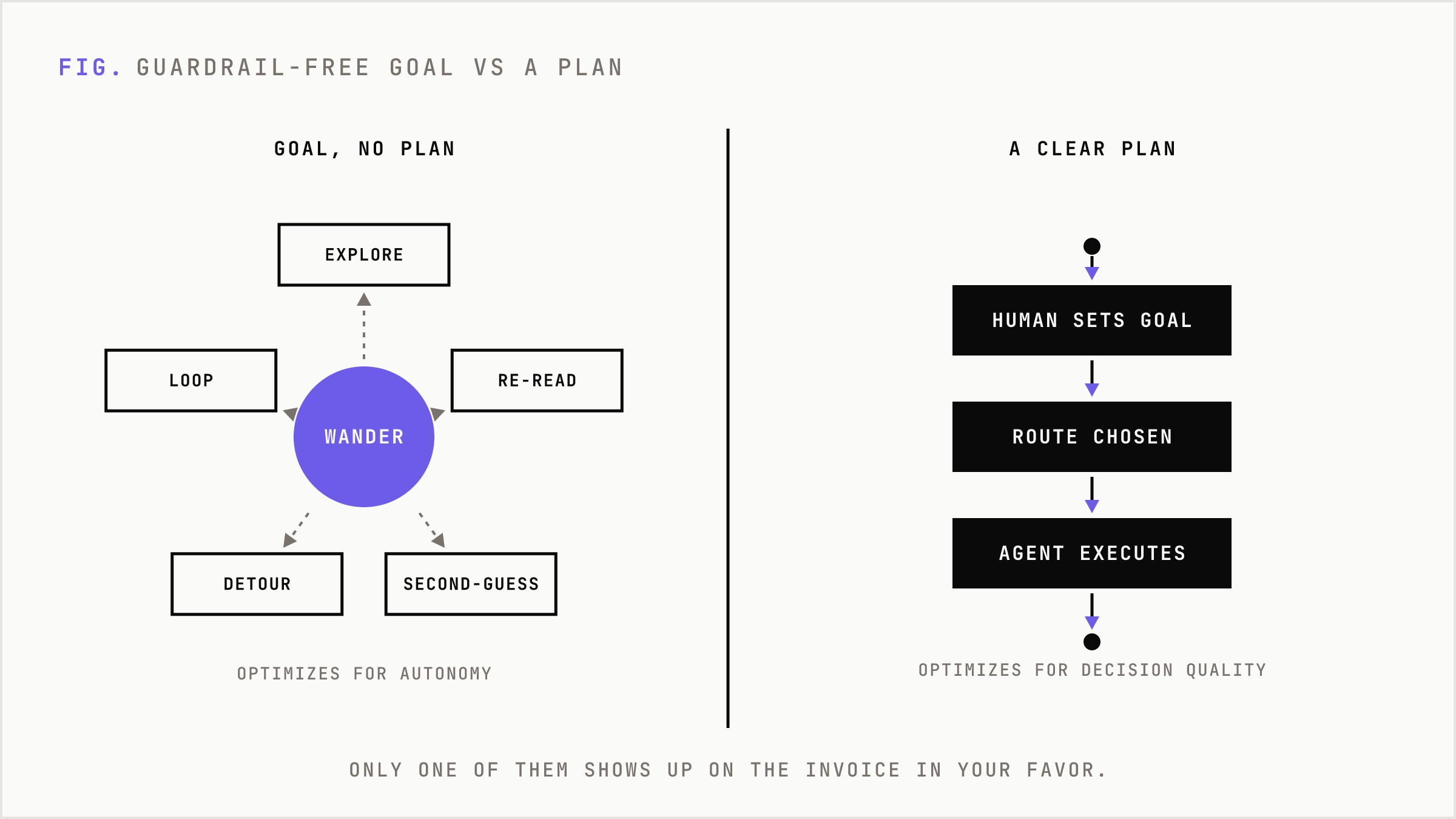
When you hand an agent a plan, you have already made the expensive decisions in advance. The agent is not deciding whether to explore. It is executing a route a human chose. The reasoning budget is spent once, by the person best equipped to spend it, and then it is cached into the structure forever.
This is where humans belong in the system. Not as a guardrail that catches the agent after it wanders, but as the author of the route so it never wanders. The strategic input from someone who understands the domain is worth more than any amount of day-to-day execution the agent can produce on its own. Separate the quality of the decision from the cost of the action, and route accordingly.
The loop still matters. You keep an oversight loop, but its job is narrow: confirm the execution matches the plan. That is a cheap check. It is not the agent reasoning its way toward a goal from scratch. It is the agent being held to a spec.
What changes, what stays the same, what it costs
If you adopt this, your agents get cheaper and your outputs get more predictable. The variance collapses, because the agent is not improvising a path every run. You pay reasoning cost once, at design time, and then you amortize it across every execution.
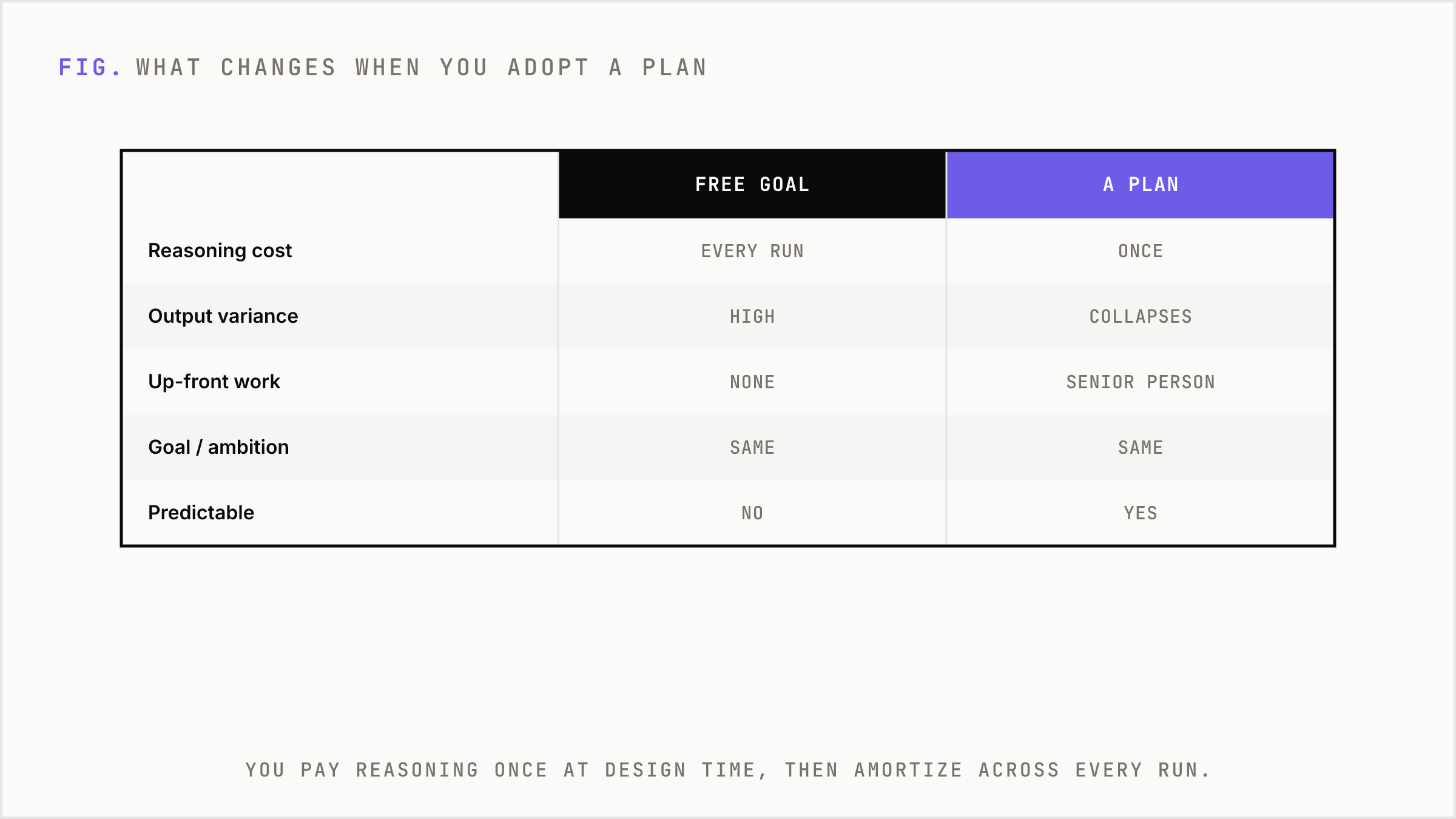
What stays the same is the goal. You still aim at the same outcome. You are not lowering ambition. You are refusing to pay for the model to discover the obvious on your dime.
The honest trade-off is up-front work. Guardrail-free goals are seductive because they feel like zero setup: define the target, press go. Building gateways, tools, and a real plan takes a senior person to sit down and make the expensive decisions first. That is the cost. It is also the entire value, because that front-loaded judgment is what stops the runaway loop.
There is a second trade-off. A planned agent will not surprise you with a path you did not consider. If you genuinely want exploration, an open loop has a place, in a sandbox, with a hard budget cap, for a problem where you do not yet know the route. That is a research mode, not a production mode. Do not confuse the two, and do not run your client budget through the research mode because the model provider's marketing told you autonomy is maturity.
The agents that win are not the ones with the most freedom. They are the ones whose freedom was spent by a human who knew where to point them.