Nyyon · Blog
Affordable AI Marketing Agencies: What Startups Should Really Pay For
A clear guide to AI marketing agency pricing for startups, with stage based budgets, red flags, and how to buy faster learning instead of fluff.
The cheapest AI marketing agency is usually not the affordable one.
For startups, affordability is not a sticker price. It is a runway calculation. It is the cost of learning what sells before the company runs out of time. A $750 monthly package can be expensive if it produces generic posts, bad leads, and no signal. A $6,000 retainer can be cheap if it compresses six months of market learning into six weeks.
That is the practical problem behind the search for affordable AI marketing agencies. Founders are not really asking for AI. They are asking for more output per dollar, less headcount risk, faster iteration, and fewer expensive mistakes.
AI changes the agency market because it compresses the cost of production. Drafts, variants, reports, briefs, email sequences, and simple creative can now be produced faster. But the hard work has moved upstream and downstream. Upstream is positioning, ICP clarity, offer design, and channel selection. Downstream is testing, attribution, conversion, QA, and interpretation.
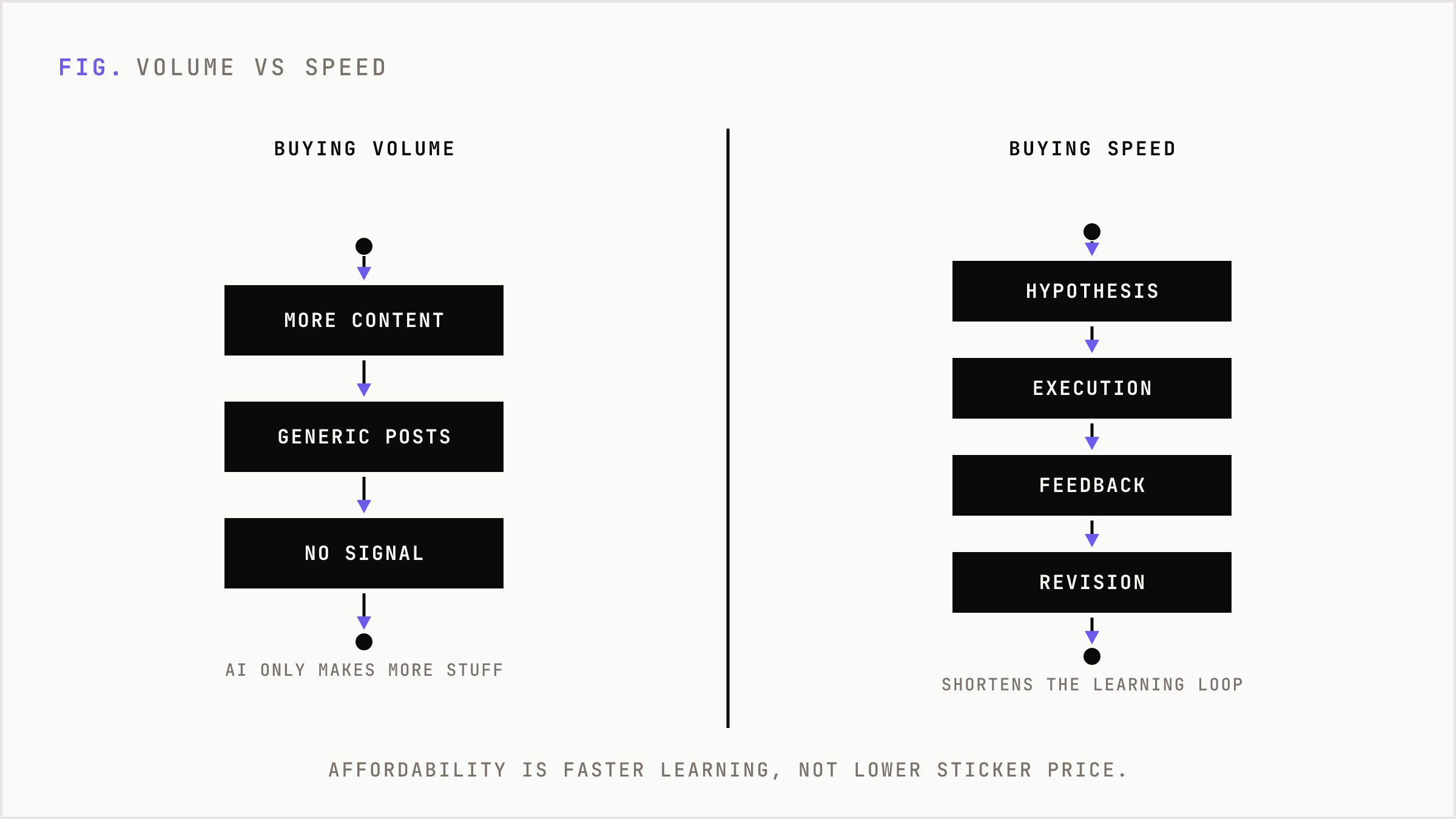
If an agency uses AI only to make more content, you are buying volume. If it uses AI to shorten the loop between hypothesis, execution, feedback, and revision, you are buying speed. Startups should pay for speed.
The Real Price Bands
The market has split into four practical tiers.
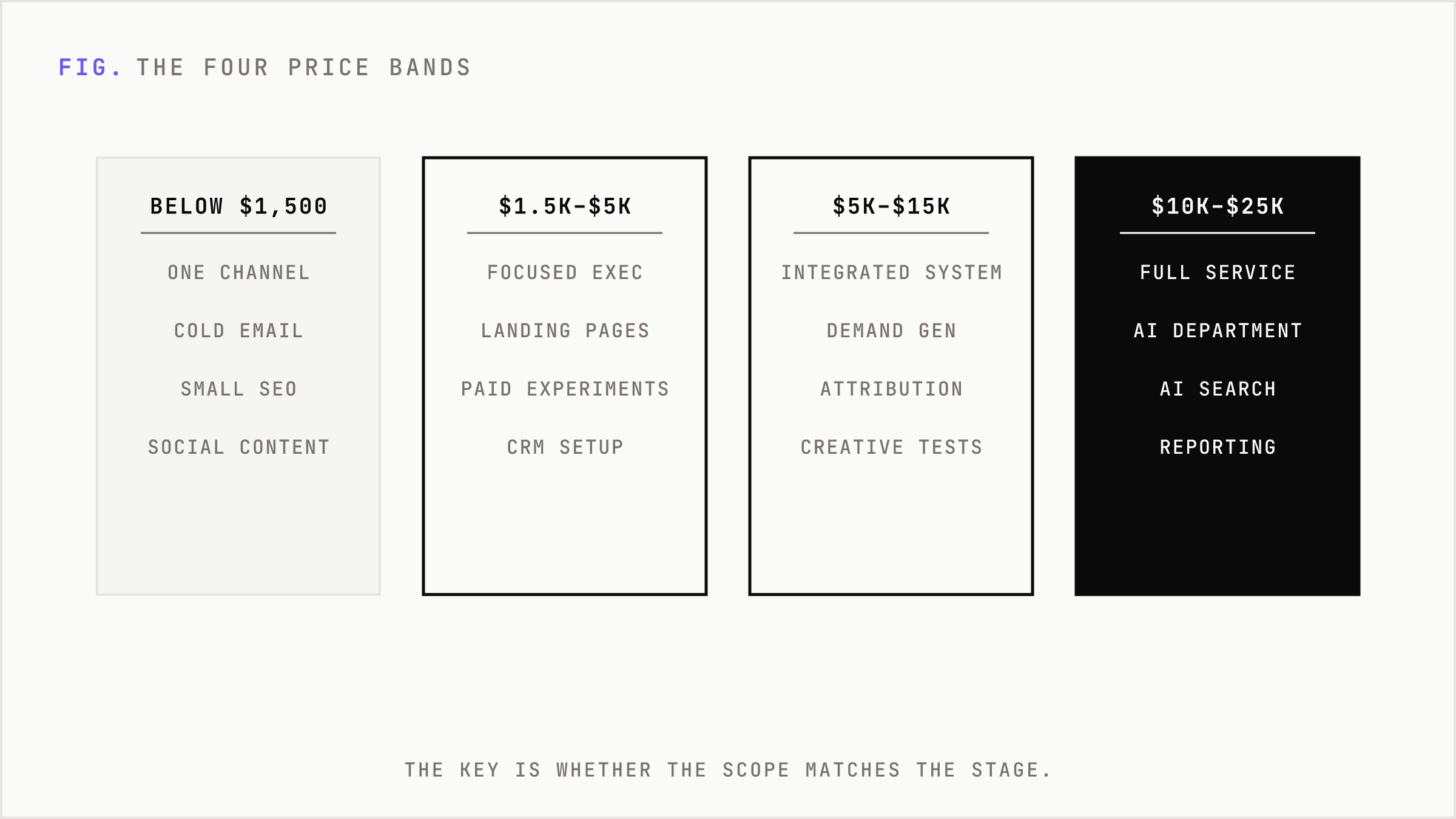
Below $1,500 per month, you are usually buying a narrow service. That might be one paid media platform, a cold email system, a small SEO package, social content, or a productized content workflow. AI Advantage Agency, for example, has advertised paid media starting at $750 per month for one platform. Nexa has shown cold outreach around $1,499 per month. Seovative lists entry level AI powered SEO packages in South African rand that are far below typical US retainers.
These offers can be useful. They are not full growth systems. They work when the founder already knows the ICP, the offer, the message, and the basic funnel. They fail when the agency is expected to discover the market while producing low cost deliverables.
From $1,500 to $5,000 per month, the buyer can expect focused execution. This is the realistic seed stage range for content, landing pages, outbound, paid experiments, SEO basics, CRM setup, or marketing automation. AIVA publishes transparent plans around $1,421, $2,061, and $4,480 per month. BS Agency lists paid media packages at $1,500, $3,000, and $5,000 per month, with setup fees. This is the zone where a startup can buy a serious channel motion, not an entire department.
From $5,000 to $15,000 per month, the offer should become integrated. Strategy, creative, paid media, SEO, lifecycle, analytics, and reporting start to connect. The agency should own a system, not a task list. At Series A and beyond, this is where demand generation, pipeline attribution, creative testing, sales enablement, and AI search visibility become part of the same operating model.
Above $10,000 to $25,000 per month, the market moves toward full service AI enabled marketing departments. Pricing guides from AI marketing providers place serious full service programs in this range, while AI SEO starter packages often begin around $3,000 to $5,000 per month and AI content programs often sit around $2,000 to $8,000 per month.
The key is not whether these numbers are high or low. The key is whether the scope matches the stage.
Stage Determines What Affordable Means
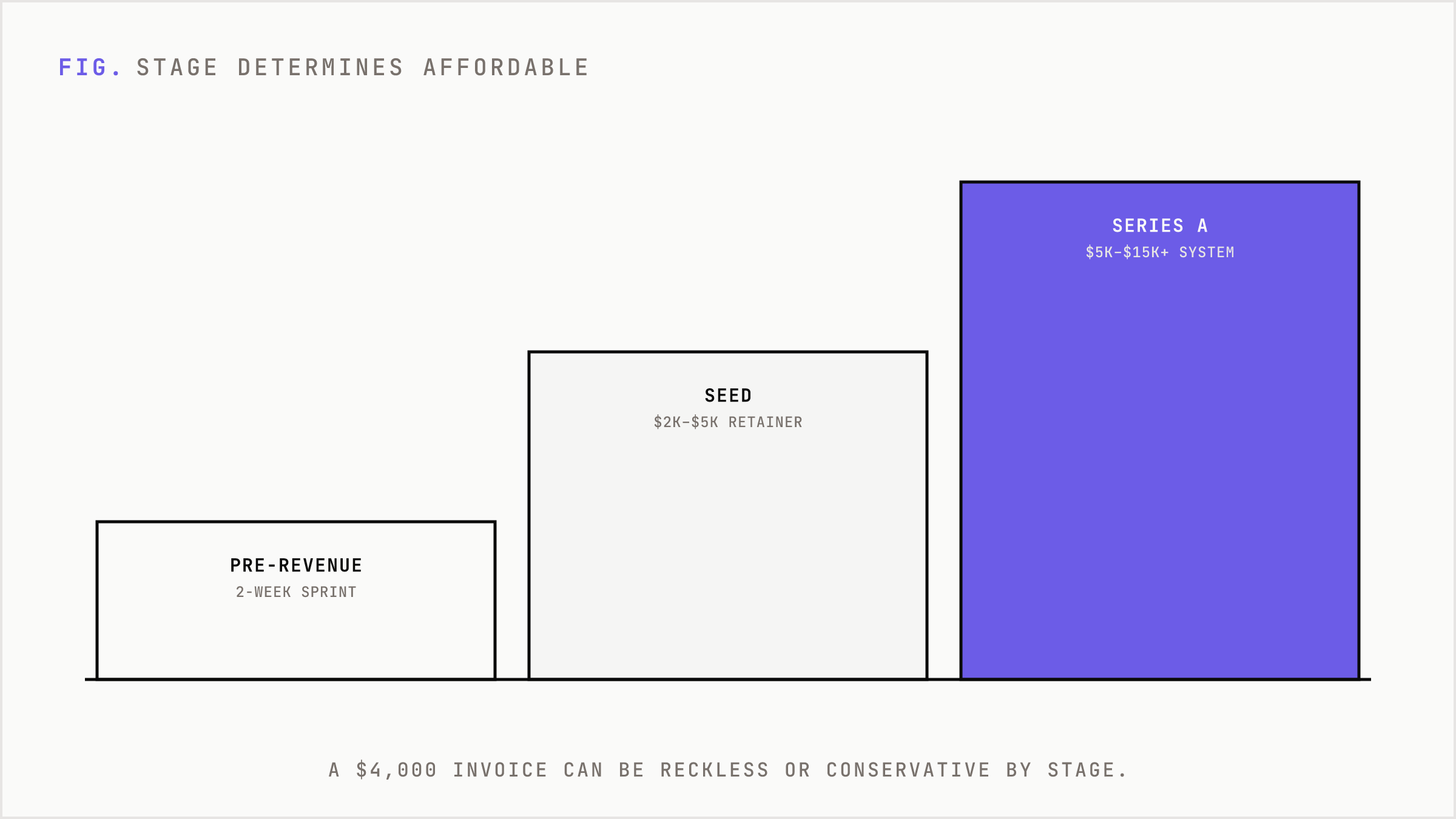
A pre revenue startup should not buy a full service retainer. It usually does not have enough signal to feed one. The immediate need is positioning, a clear landing page, founder led content, basic outbound, and analytics. One or two channels are enough. More channels create noise.
The best model at this stage is a sprint. Two weeks. A positioning audit. ICP research. Messaging framework. Landing page rewrite. Ten to twenty content or ad variants. Tracking setup. A channel recommendation. The output is not just assets. It is a sharper view of what to test next.
A seed stage startup has a different problem. It has early traction, but not a repeatable acquisition system. It needs offer testing, a content engine, outbound infrastructure, landing page iteration, paid experiments, and CRM automation. A $2,000 to $5,000 monthly retainer can make sense if the agency is narrow, measurable, and fast.
Series A companies need scale discipline. They usually have a product, a market, and revenue pressure. The question becomes which channels can generate qualified pipeline at a cost the company can defend. That requires demand generation, paid media, SEO and AEO, lifecycle email, creative testing, and revenue reporting. A $5,000 to $15,000 plus monthly agency can be rational if it replaces several hires, accelerates testing, and improves CAC payback.
The same invoice means different things at different stages. A $4,000 agency can be reckless for a pre seed company with six months of runway. It can be conservative for a seed company wasting $15,000 per month on scattered tools, contractors, and untracked paid ads.
AI Has Changed the Substitution Math
Traditional agencies were built around labor. More deliverables meant more people, more hours, more account management, more margin pressure. AI breaks part of that model. It lets smaller teams produce more variants, research faster, summarize data, draft briefs, repurpose content, and build lightweight automations.
That does not automatically make agencies better. It makes bad agencies louder.
The commodity layer is collapsing. Blog drafts, ad variants, social captions, first pass email sequences, and basic reports are no longer scarce. A founder with a good prompt library and discipline can produce a lot of this internally.
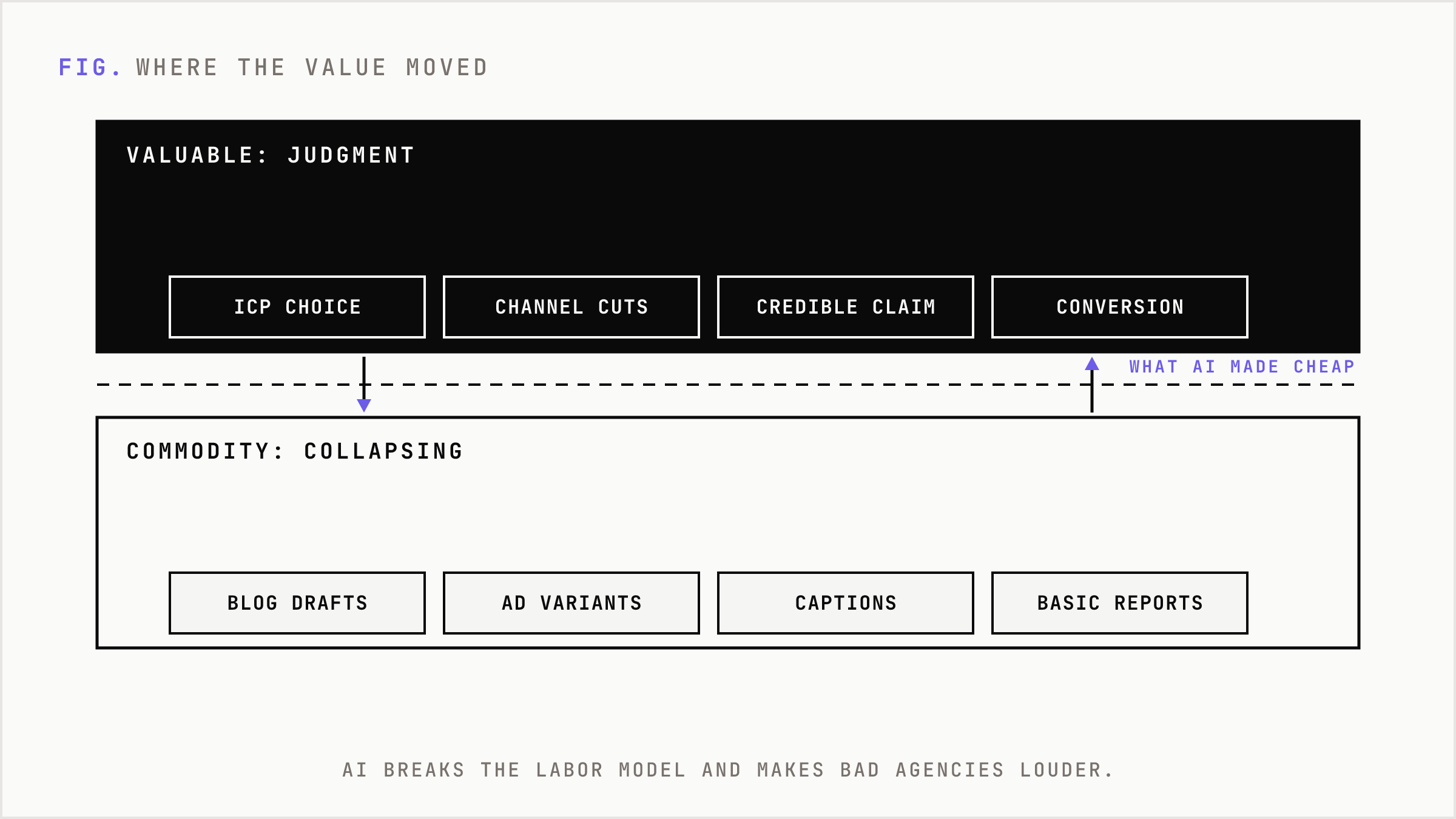
The valuable layer is judgment. Which ICP is worth pursuing. Which channel should be ignored. Which claim is credible. Which landing page section is blocking conversion. Which lead source is producing meetings but not revenue. Which content asset can become citation worthy. Which automation will save time without corrupting data.
This is why the phrase AI marketing agency is too broad. Many firms are AI assisted content shops. They use ChatGPT inside the old agency workflow. That can reduce costs, but it rarely changes the growth loop.
An AI native agency redesigns the workflow itself. Research feeds briefs. Briefs generate controlled variants. Variants map to tests. Tests feed reports. Reports change messaging, targeting, creative, and landing pages. Human strategists set the logic, check the work, and decide what matters. AI expands throughput. It does not replace responsibility.
What Cheap Gets Wrong
Cheap agencies often create hidden costs that do not appear in the proposal.
Bad positioning makes every channel underperform. Generic content trains the market to ignore you. Poor outbound can damage sending domains. Paid ads without landing page testing burn budget while producing false negatives. SEO without intent mapping creates pages nobody useful reads. Reporting without pipeline connection produces comforting dashboards and no decisions.
The most common failure is scope vagueness. The proposal says content, paid media, SEO, automation, and strategy. The invoice says $1,200 per month. The reality is a junior operator, AI generated drafts, recycled templates, and a monthly report full of impressions.
A serious affordable agency is specific. It tells you what is included. It tells you what is not included. It separates agency fees from ad spend. It names tools, setup fees, contract length, deliverables, review cycles, and ownership. It defines the primary KPI for the first 30, 60, and 90 days.
It also tells you what not to do. That is a high signal behavior. If an agency recommends paid ads before the landing page can convert, it is selling media spend. If it recommends five channels before one channel has signal, it is selling activity. If it cannot explain how it prevents AI hallucinations, it is selling risk as efficiency.
AI Search Raises the Bar
Search is changing, but not in the cartoon version where SEO dies overnight. Google AI summaries, zero click behavior, and answer engines are changing how content earns attention. Pew reported that around one in five Google searches in March 2025 produced an AI summary. SparkToro and Datos found that only a minority of Google searches send clicks to the open web. BrightEdge data has also shown that many tracked queries still do not produce AI Overviews, which means classic SEO still matters.
The right conclusion is simple. Startups should not replace SEO with AEO or GEO. They should expand the job.
SEO gets you found by search engines. AEO and GEO help you get cited by answer engines. Content operations create authoritative assets consistently. PR, founder POV, customer proof, and third party mentions feed trust signals that machines and humans both use.
A weak agency sells AI content. A stronger one builds citation worthy pages, comparison pages, structured product pages, schema, expert backed content, founder points of view, internal linking, and visibility tracking. This matters because content is no longer only competing for rankings. It is competing to become source material.
The Buying Checklist
Founders should evaluate an AI marketing agency like they would evaluate a system vendor, not a creative vendor.
- Scope: What exactly ships each month?
- Strategy: Who makes channel, ICP, and positioning decisions?
- Workflow: Where is AI used, and where are humans required?
- QA: How are claims checked before publication?
- Data: How is customer or proprietary data protected?
- Ownership: Who owns ad accounts, analytics, landing pages, CRM workflows, domains, creative files, prompts, dashboards, and content assets?
- Measurement: What are the 30, 60, and 90 day KPIs?
- Failure mode: What would make the engagement fail?
The ownership question is not administrative. It is strategic. If the agency controls your ad account, dashboards, automations, or email domains, switching costs rise. If you do not own the learning history, you are renting your own marketing memory.
The AI workflow question is equally important. A credible agency can explain how it trains on brand voice, validates claims, prevents hallucinations, protects customer data, and applies human review. If the answer is vague, the process is vague.
Buy Learning Velocity First
Startups should sequence marketing spend in three phases.
First, buy learning velocity. This means positioning, ICP clarity, message testing, landing page quality, tracking, and a small number of channel experiments. The goal is not scale. The goal is signal.
Second, buy repeatability. Once a message and channel show traction, the agency should turn it into a system. Content calendar, outbound process, paid creative pipeline, lifecycle flows, CRM hygiene, reporting cadence, and weekly optimization.
Third, buy scale. Only after CAC, conversion, lead quality, and payback begin to stabilize should the startup fund a broader full stack motion.
This sequencing matters because AI makes it easier to do the wrong thing faster. A company can now generate 100 mediocre assets in the time it once took to produce ten. That is not leverage if the message is wrong. It is waste with better tooling.
The best affordable AI marketing agencies do not promise unlimited output. They promise faster movement from uncertainty to evidence. They reduce wasted spend. They preserve senior judgment. They give the startup more experiments per dollar without turning the brand into generic machine text.
The Nyyon View
Affordable should not mean cheap. It should mean efficient against the real constraint: runway.
A startup does not need a bloated agency. It does not need a prompt jockey. It needs senior marketing judgment, AI accelerated execution, channel focus, clear measurement, fast learning loops, and ownership of assets.
The useful question is not, how low is the retainer? The useful question is, what expensive uncertainty will this agency remove?
If the answer is unclear, do not buy the retainer. Buy a sprint. Force the work into a short window. Test the agency on diagnosis, speed, clarity, and commercial judgment. Then decide whether it deserves a larger role.
The most affordable AI marketing agency is the one that helps a startup reach validated positioning, repeatable acquisition, and lower CAC before runway runs out. AI should reduce waste, not just increase output. Buy learning first. Buy volume second. Buy scale only when the system can absorb it.
FAQ
How much should a startup pay for an AI marketing agency?
Most seed stage startups should expect $1,500 to $5,000 per month for focused execution. Pre seed companies are usually better served by a sprint. Series A companies often need $5,000 to $15,000 plus per month for integrated growth work.
Are cheap AI marketing agencies worth it?
They can be worth it for narrow tasks if your positioning, funnel, and channel strategy are already clear. They are risky when you need strategic judgment, conversion work, analytics, or market discovery.
What should an AI marketing agency actually do?
A strong agency should combine strategy, execution, testing, reporting, and workflow design. AI should accelerate research, briefs, variants, reporting, and automation, while humans handle judgment, QA, positioning, and prioritization.
Should startups hire an agency or build in house?
Pre seed startups should usually stay lean and use sprints or fractional support. Seed companies can use a focused agency to build repeatable acquisition. Series A companies often use agencies to supplement internal teams and accelerate channel testing.
What is the biggest red flag in an AI marketing agency proposal?
Vague scope. If the agency cannot define deliverables, ownership, workflow, QA, KPIs, and what happens in the first 30, 60, and 90 days, the low price may hide high execution risk.