Nyyon · Blog
A Million Projects a Week Is a GeoCities Number
Lovable's million projects a week measures shots taken, not value created. Watch the survival rate, not the project count.
We've been here before. Different name, same feeling. A million projects a week is a GeoCities number: it measures shots taken, not value created. Lovable collapses the cost of building software to near zero, but the hard part of building software was never the build. So the honest question is not how many projects get created. It is how many survive contact with real users.
Let me walk through why I keep seeing the same arc.
GeoCities did this first, and most of it is gone
You picked a template. You filled in your content. You hit publish, and something you made was live on the internet. Anyone in the world could see it. No code, no developer, no waiting. You built something real in an afternoon.
That was GeoCities in 1997. You picked a neighborhood: SiliconValley for tech, Hollywood for entertainment, Athens for education. You got a page. You typed things in. You hit publish. It felt like a superpower.
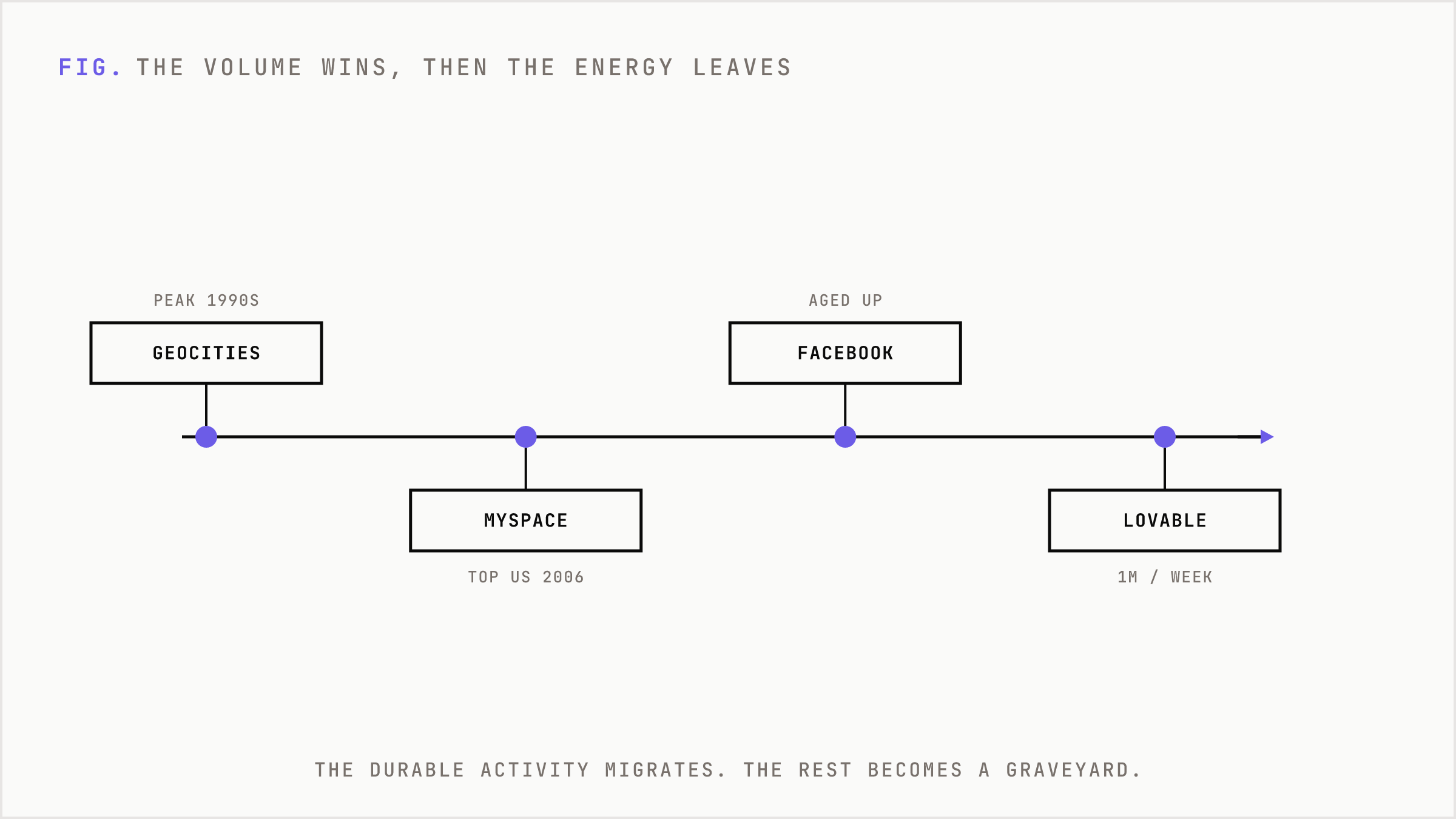
By the late 1990s it was one of the three most visited properties on the web, hosting tens of millions of user-built pages. Yahoo bought it in 1999 for $3.6 billion. Yahoo shut it down ten years later, and most of it had been abandoned long before that.
Now look at Lovable. You describe what you want. The model builds it. In thirty minutes you have a working CRM, a storefront, a booking tool, something that looks and functions like a real product. No code, no developer, no budget. Lovable reports $500M ARR and one million new projects created every week, spiking hard among non-technical founders.
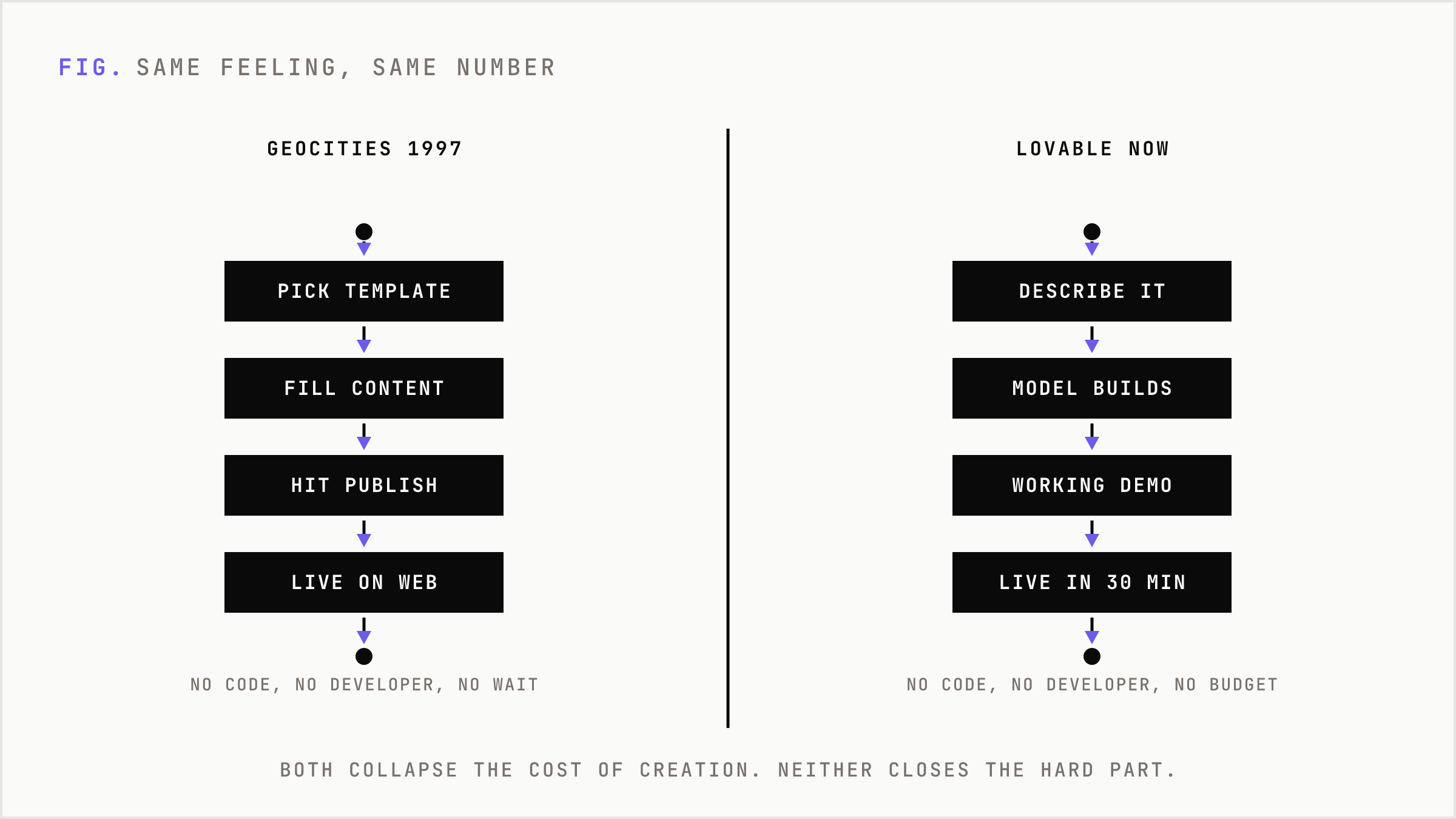
Same feeling. Same number.
The volume was always real, the durable behavior always moved on
The pattern is not new. We have watched it twice already at scale.
MySpace was the dominant social network in the mid-2000s, the most-visited site in the US in 2006. Sold to News Corp for $580 million. Later sold again for $35 million. The volume was real. The durable behavior moved on.
Facebook is still massive by the numbers, but anyone paying attention knows the energy has left. The audience aged up. The interesting activity migrated to TikTok, Instagram, Discord, wherever the actual attention of the next generation went. Facebook didn't die. It became the place things live but don't grow. Same GeoCities arc, slower.
Every platform that wins on volume eventually sorts the same way. The durable activity migrates to wherever the real stakes are. The rest stays behind and becomes a graveyard. This is not a failure mode. It is the expected outcome.
The build was never the bottleneck
So back to Lovable. The million-a-week projects are not the story.
The bottleneck in building software was never the build. It was making something durable, differentiated, and worth coming back to next quarter. Lovable collapses the build cost to near zero. It does nothing about the hard part.
The hard part is judgment. What to build, for whom, and why it survives contact with real users. That part has not gotten cheaper.
A non-technical founder who could not answer those questions before Lovable cannot answer them after. They just have a demo now instead of a Figma file. The demo is more convincing, which makes it more dangerous, because it buys weeks of motion before reality shows up.
This is the same thing we say about internal AI tools. A system that demos well and goes unused is not a win. It is a cost that hasn't been paid yet. The gap between deciding to build something and the thing actually working is where projects go to die, and no model closes that gap for you.
Watch the survival rate, not the project count
The survival rate is the number nobody is publishing.
Out of a million projects a week, how many have real users sixty days later? How many generate revenue? How many are still being maintained at the end of the year?
My guess is the number is tiny, the platforms know it, and they are not leading with it because a million projects a week is a better headline than fifteen thousand that survived to Q3.
Here is the consequence, laid out plainly:
1. Week one, a million projects get created. The count looks enormous and the press writes it up.
2. By day sixty, most have no active users. The founder moved on, the idea didn't survive its first ten customers, or the thing was a weekend curiosity from the start.
3. By year end, the survivors are a rounding error against the top-line count. Those survivors are the only projects that ever mattered.
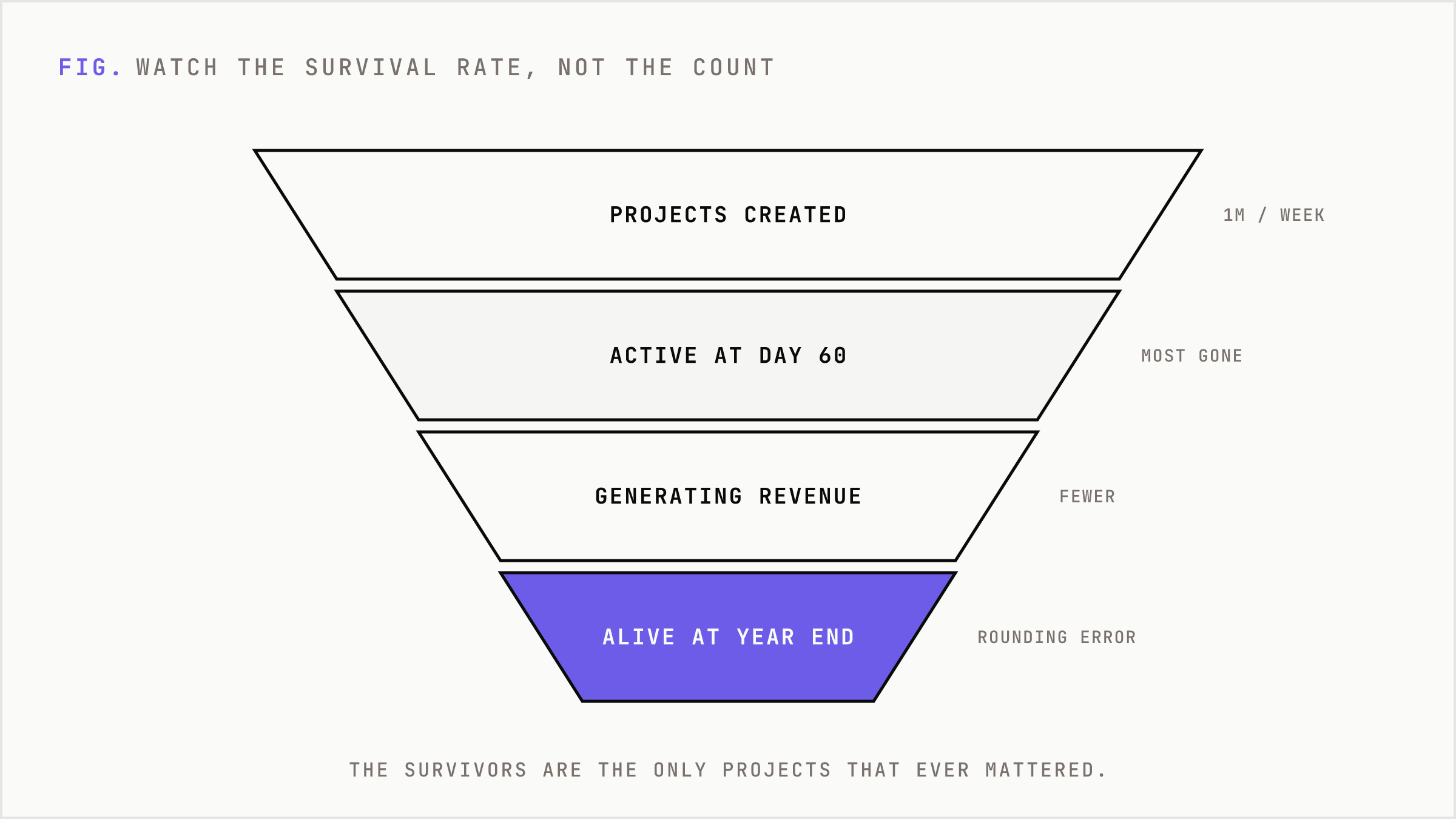
If you are a founder betting your quarter on one of these builds, the project count tells you nothing about your odds. The survival rate is the number that would, and it is the one you have to estimate yourself.
The graveyard is the cost of admission, not the scandal
Here is the part that gets missed. GeoCities was not a mistake. The graveyard was the point.
Getting creation cheap enough that ordinary people tried things at all was genuinely valuable, even if most of what they made was abandoned personal pages with animated GIFs and a visitor counter. The few things that survived were impossible to attempt before.
Lovable's million-a-week sorts the same way. The million don't matter. The few hundred that survive contact with users, that become real products, that generate revenue, that someone is still using in a year, those were impossible to attempt before. That is the actual story.
So the graveyard is not the scandal. It is the cost of admission for the survivors.
What this changes and what it doesn't
What changes: the price of taking a shot drops to nearly zero. That is real and it is good. More people get to try, and some of them will build things that could not have existed under the old cost structure. If you have judgment about what to build and for whom, cheap building is a gift.
What doesn't change: judgment. Deciding what should exist, which tradeoffs are worth making, and what survives its first ten users. Lovable hands you a working demo faster than anyone has ever handed you one. It does not hand you the reason the demo should live.
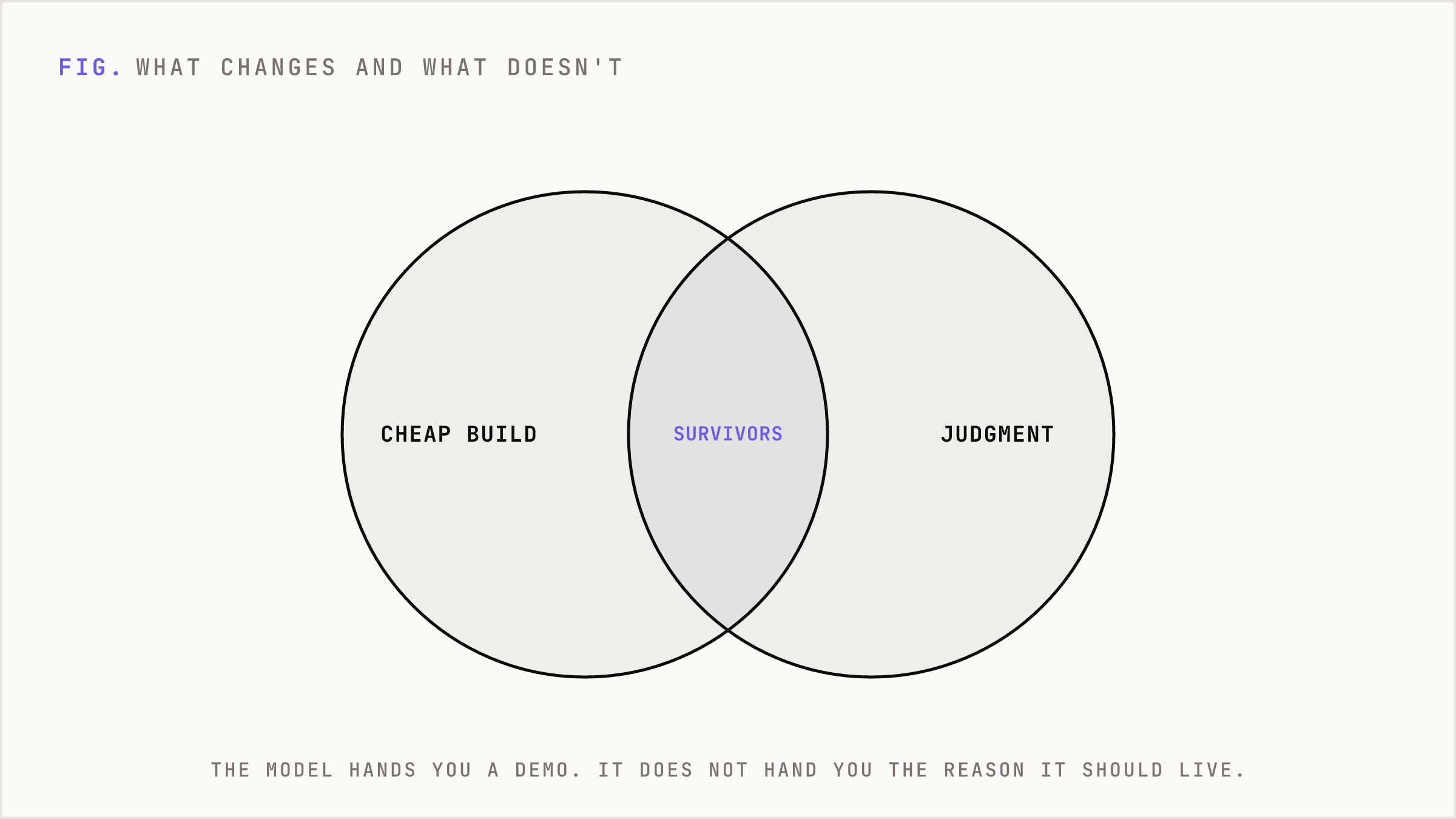
The trade-off is honest and uncomfortable. Cheap building means more noise, more abandoned projects, more founders mistaking a demo for a business. The signal, the survivors, is still there. It is just buried under a million weekly shots, and you have to know how to read for it.
So when you see the headline, do the substitution in your head. A million projects a week is a GeoCities number. Ask what the survival rate is. If the platform won't publish it, that tells you something too.
If you have a project stuck in the gap between a demo and a thing your team actually runs, if no one else can help, and if you can find them, maybe you can hire Nyyon.